
Every nonprofit periodically faces tough choices—what to grow, what to pause, what to stop, or whether to pursue a new opportunity. And because every strategic decision involves allocating limited resources, leaders need to balance trade-offs when making those decisions.
For each decision, the organization’s strategy is meant to be a guide–at least in theory. In practice, it can be challenging to build a bridge from a strategic plan filled with optimism and potential to a tough choice that may disappoint a staff member, a board member, or a funder.
What are decision criteria?
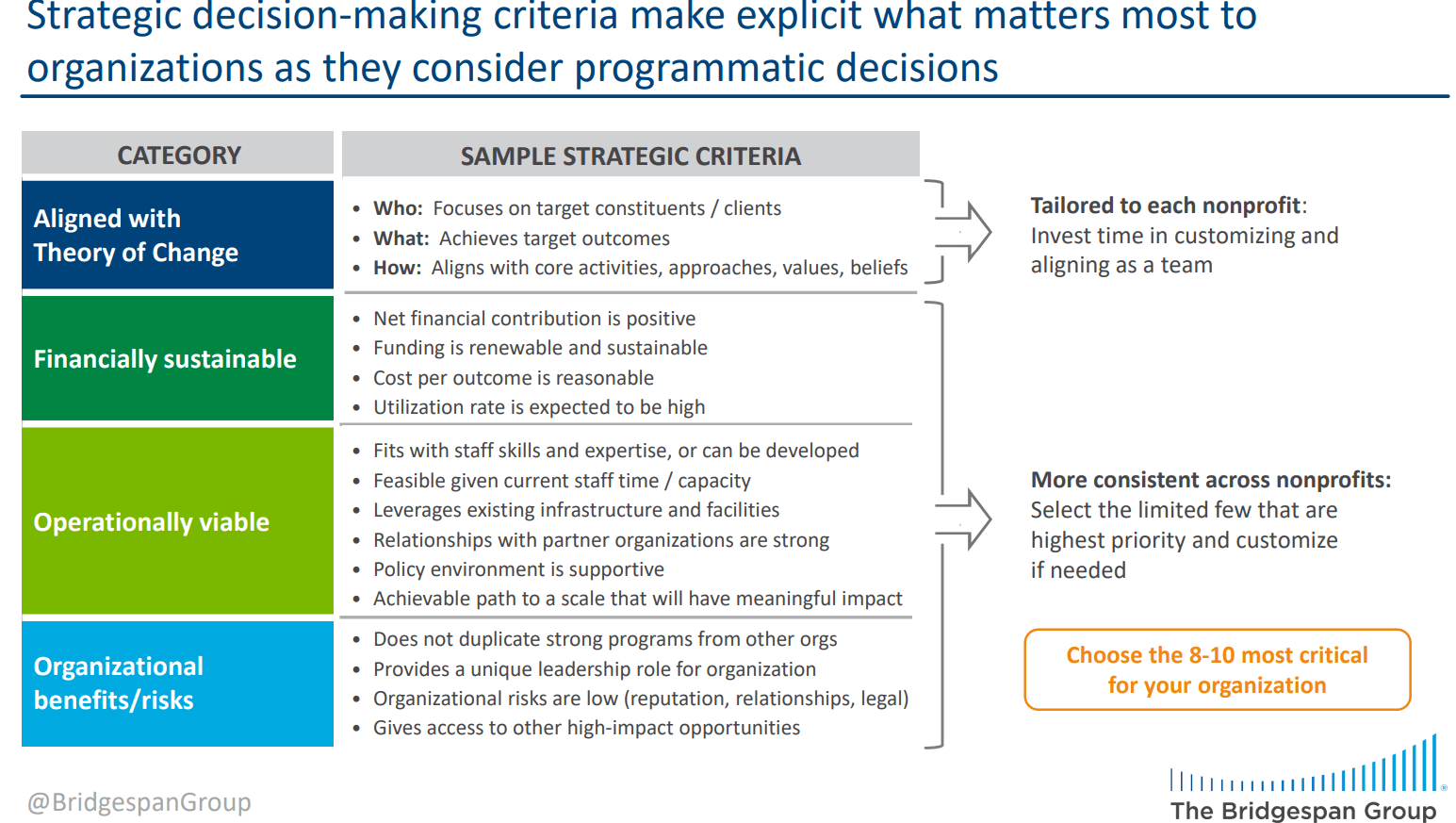
Strategic decision-making criteria are the explicit factors your team agrees to use when deciding whether to pursue (or stop) a program, initiative, or opportunity. They work best when anchored in strategy, including clarity on:- Who you aim to serve or influence
- What outcomes you seek
- How your approach creates those outcomes
The Bridgespan Group has previously written about how to develop decision-making criteria for making strategic decisions. In this article, we focus on the next steps: how to use those decision criteria as a practical tool, rather than a one-time exercise.
Here we share lessons from Kevin Huffman, CEO at Accelerate, an education nonprofit focused on putting proven learning approaches into practice in schools, and Mark Edwards, president and CEO at The Food Trust, which works across multiple stakeholders to make nutritious food available to all. Huffman and Edwards shared their experiences during a webinar Bridgespan hosted on developing strategic decision-making criteria.
The Problem Decision Criteria Helps Solve: The 10-Way Tie
Many nonprofits face the 10-way tie: multiple promising opportunities, competing stakeholder expectations, and limited resources. Rooted firmly in your organization’s strategy, decision criteria establish a structured, data-driven, shared approach for choosing among the many things you could be doing. They also make it easier to explain decisions afterward, because the logic is visible.
It seems straightforward but putting it into practice is trickier than it seems. Below are four ways Huffman and Edwards put decision criteria to work in their organizations.
Get everyone in the organization on board early
One of the most underestimated benefits of decision criteria happens when you develop them. The process presses teams to name trade-offs explicitly: what they are optimizing for, what they are willing to sacrifice, and what they are no longer willing to do. When decisions rest on implicit logic—unspoken priorities, individual instincts, and historical precedent—disagreement can feel personal. Criteria make decision logic discussable.
Edwards emphasized that developing decision-making criteria doesn’t have to be limited to an executive team; it can include leaders and staff deep within the organization to test decision criteria against real decisions and use cases. “We reached down fairly deep within our organization, … involving people in the process. ... Roughly 25 to 30 percent of our staff participated. We engaged all our staff at the executive leadership level, senior leadership level, and then just broader leadership level.”
This kind of engagement can improve decision criteria by revealing where definitions are fuzzy, and build buy-in because people understand the decision logic before it’s used to make difficult calls. “This saves you from yourself in many ways,” shared Huffman. “If you’re making decisions and then trying to align people and trying to explain why decisions are being made, … it’s going to be a lot harder and a lot worse, at least in my experience.”
Strategic Decision-Making Criteria Examples
Strategic Decision-Making Criteria Template (click to enlarge)
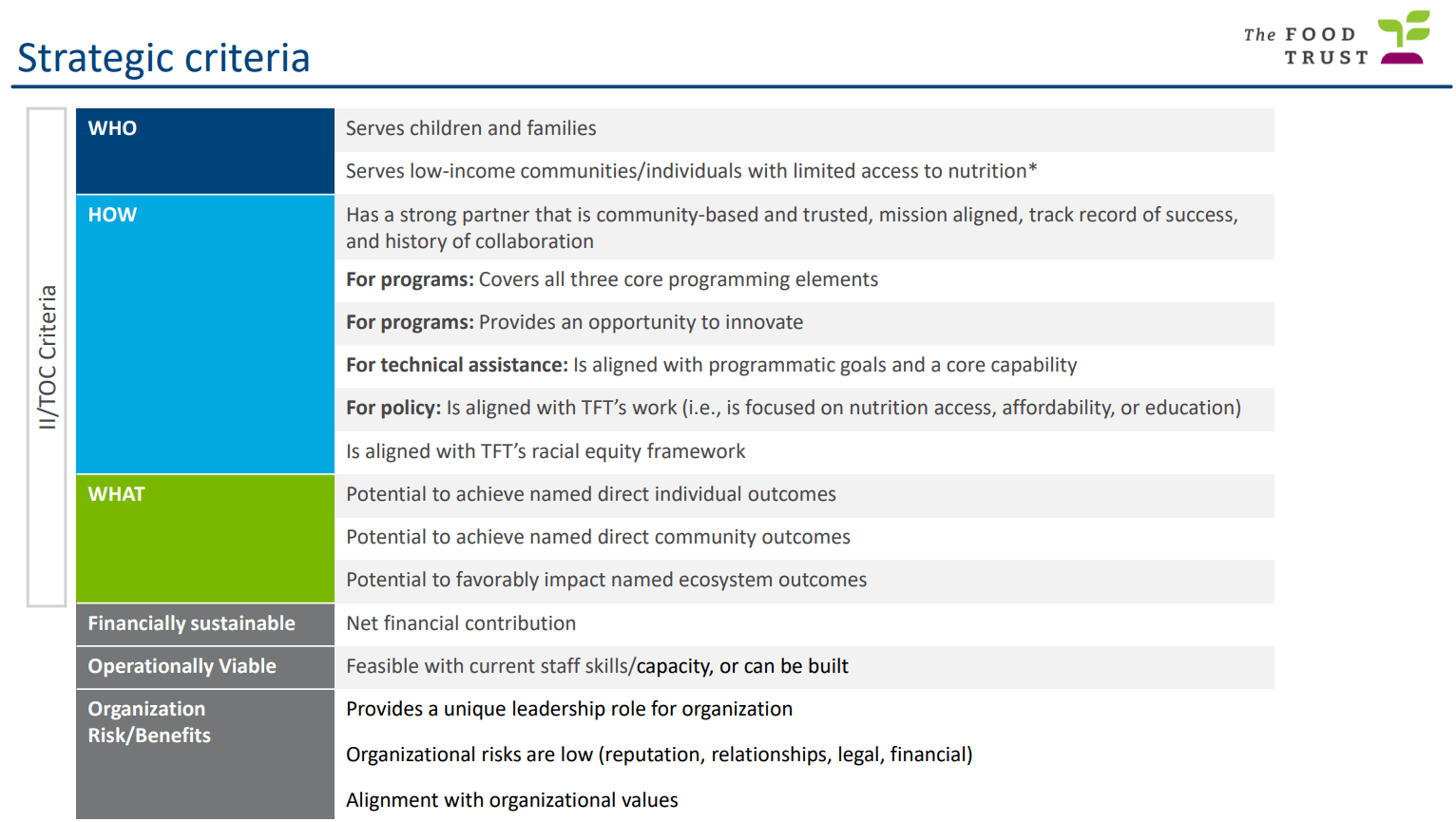
How the Food Trust Adapted the Template to Track Their Criteria (click to enlarge)
Regularly apply decision criteria
Many nonprofits develop strategic decision-making criteria during their strategic planning process, and then never look at them again. In the webinar, Edwards and Huffman emphasized the opposite: decision criteria can be a living part of the organization’s operating rhythm, pulled out as decisions occur, and refined as the organization learns.
“It’s really become ingrained in our organization’s process of assessing not just one and done, but also assessing as we go,” shared Edwards. One simple signal of whether decision criteria are “living” is when people in your organization can describe them—and use them—without hunting for last year’s strategic planning deck.
Deepen clarity with a rubric
Even when an organization has decision criteria laid out, there’s still a chance that teams may interpret them differently. Expanding on the rationale for each criterion using a rubric can help leaders build a shared language to answer questions like, “How well does this option fit our strategy and intended impact?” and “Can we realistically deliver this well with our current capacity, capabilities, and funding?” A rubric ties the decision criteria together in one simple assessment tool that provides a consistent approach, ensuring decisions don’t hinge on who happens to be in the room or who argues most persuasively.
Accelerate's Rubric
In this example from CEO Kevin Huffman of Accelerate, the rubric helps clarify whether an opportunity is weak, moderate, or excellent against his organization's decision criteria. (Click to enlarge) 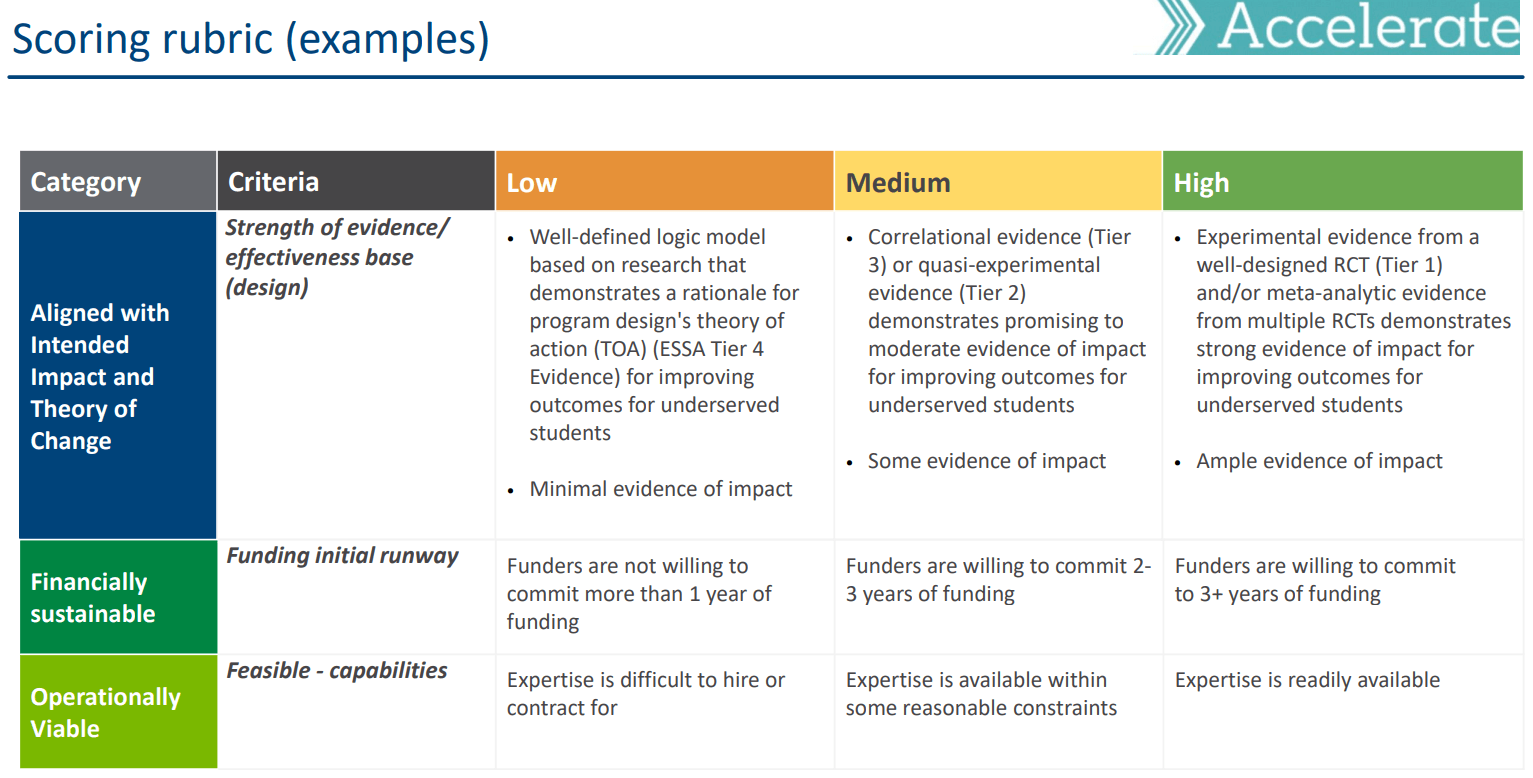
This clarity can help an organization be more objective about whether a given opportunity makes sense. And when a decision is unpopular (and some will be), leaders can point to the explicit set of considerations rather than leave the appearance of personal preference.
Use decision criteria to communicate priorities
Decision criteria aren’t just an internal tool. They can help nonprofits communicate a consistent story externally, especially when shifting organization priorities or declining opportunities. Huffman noted that sharing decision criteria can deepen strategic conversations with funders beyond a single “yes/no” decision, enabling them to show how their strategic thinking is evolving and what they plan to do: “It’s engaged funders in a richer conversation about our work and about what our theory of change is,” he shared.
Saying “no” is often one of the hardest things to do. Clear decision criteria are especially valuable here, helping leaders more easily explain why an opportunity isn’t a fit right now, which opportunities would be a fit, and which trade-offs the organization is prioritizing. This clarity is helpful for funders, boards, and staff, particularly during periods of disruption or change.
***
Even well-designed decision criteria won’t help if they are applied only during planning or used only by the executive team. Their value shows up when applied year-round to evaluate such things as a tempting opportunity, a budget squeeze, or a program that is drifting. Used consistently, decision criteria can give teams a shared decision logic to return to, so choices don’t get second-guessed every time conditions change.