
The artificial intelligence (AI) landscape in Africa is evolving rapidly. The next few years will be decisive in determining the direction it takes. For African nonprofits, this poses an incredible opportunity to shape the AI agenda on the continent. When used systematically, AI can help nonprofits innovate faster, reach more people, and strengthen their impact. In fact, some of this is already underway: AI is helping farmers with advice on weather and crop diseases, making diagnostics easier and more accurate for community health workers, and helping teachers create better learning aids for students.
Yet in our conversations with nonprofits across Africa, we found that while almost all believe in the potential of AI, few today are using it to advance their organisations’ missions. This aligns with global trends. Our recent survey of nonprofits around the world, conducted in partnership with Nonprofit Technology Enterprise Network (NTEN), found that 70 percent of nonprofit leaders and staff agree they are not taking advantage of meaningful opportunities to use AI in their organisations. What many are using AI tools for is day-to-day tasks that increase organisational efficiency. While that can be a strong starting point for organisations to become more comfortable with AI tools, if AI adoption stops at productivity, much of its potential to advance organisations’ missions – especially in resource-constrained settings like Africa – is left on the table.
Our research aims to bridge the gap between AI’s potential to advance a nonprofit’s mission and its ability to realise it in practice. It does so by helping nonprofits carefully consider the “why” and “how” of adopting AI, so that they can use it more responsibly and equitably to achieve their missions. It draws on interviews and a focus-group discussion with over 40 nonprofits and social enterprises, funders, experts, and intermediaries to understand how organisations have used AI to advance their missions – how they started, how their approaches evolved, and the strategic and organisational choices they faced along the way – and the wider ecosystem conditions that shaped these journeys.
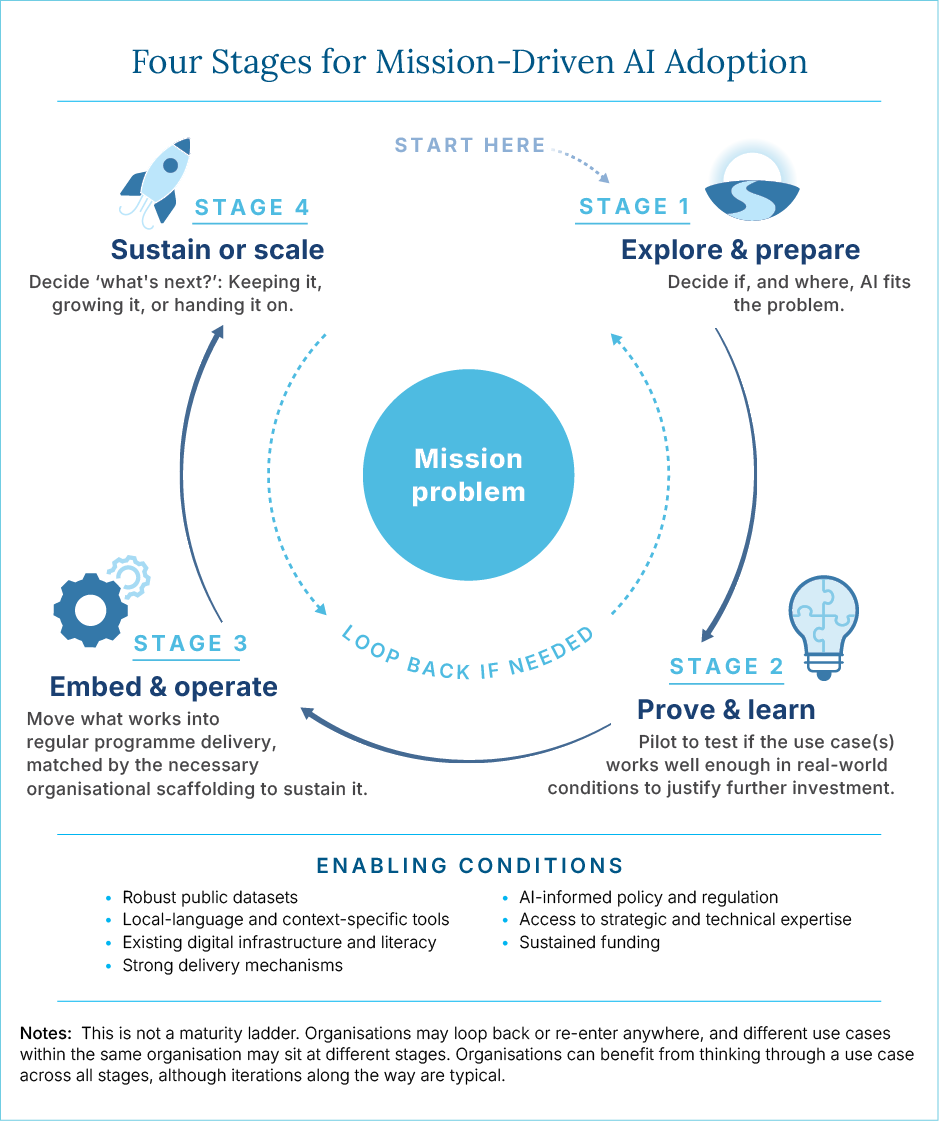
Four Stages for Mission-Driven AI Adoption
For each stage, organisations can consider the following questions:
Stage 1: Explore and prepare
- What’s the problem we’re trying to solve?
- Is AI the right tool to solve the problem?
- Do we have the right data, in the right language, for the AI problem we want to solve?
- Are our teams and leadership confident and comfortable with using AI?
Stage 2: Prove and learn
- Should we build, buy, adapt, or partner?
- Does our use case work in “real-world” conditions?
- How are we defining success, and is our pilot measuring up?
Stage 3: Embed and operate
- Can we integrate the use case with our existing programmes and delivery systems?
- Do we have a working AI governance policy?
- Do we have the talent and resources to sustain this long term?
Stage 4: Sustain or scale
- What does scale look like for this use case?
- Are we ready to scale through public systems?
Alongside these questions, organisations emphasised that mission-driven AI is shaped by its environment. Several external factors overlap with organisational ones to determine when and how AI can be effective. These can include existing digital infrastructure (access to the internet and smartphones, for example), policies and regulations around AI use, availability of local context-specific resources, and existing mechanisms for reaching communities (such as frontline workers, schools, government platforms, and community networks). The opportunities and constraints of the local context in which nonprofits work can significantly influence how AI is implemented, sustained, or scaled.
There are also “missing links” that nonprofits need to strengthen or build to fully realise the promise of AI. These include tailored funding support that matches nonprofit needs at every stage (for example, unrestricted, risk-tolerant capital for Stage 1 versus patient capital that explicitly covers operating costs for later stages); more open-source shared infrastructure, whether sector-specific data for AI to build on or open-source models adapted to African contexts; access to strategic and technical expertise that can help nonprofits grapple with the questions listed above; and collective capacity building across all ecosystem players so that everyone is on the same page about what AI can or cannot do.
Lastly, the aim of our research is not to advocate for mission-driven AI adoption as the “end goal” that all nonprofits must strive for. Instead, we hope this research can serve as a starting point for nonprofits beginning their AI journeys, helping them make informed decisions about whether and how to use AI to achieve their goals.