
The residents of Banda village in rural Rwanda describe a shift in how they make decisions together. Weekly community meetings – once attended by only a few – now draw broader participation, including women who previously felt unable to speak in public.
For Gaudence Uwamahoro, a 40-year-old widow raising five children, that shift has been both personal and practical. Before joining the village planning process, she struggled to provide for her family and rarely participated in community life. “I was lonely, without confidence, and unable to speak in public because I believed that no one would hear a poor woman like me,” she recalls.
Through collective discussions, Banda’s residents identified pig and goat rearing as a shared priority. Uwamahoro was among the 101 households that received direct community funding linked to the community’s plan, which helped her start raising pigs and join a village savings group. The income and productivity gains were tangible: she used manure to improve her harvest, sold surplus or piglets to bring in cash, and was able to send her eldest daughter back to school. As her household stability improved, so did her confidence and participation. “In those weekly meetings, I came out of my loneliness,” she says. “Today, I speak with confidence, share ideas, and get jobs more easily through the connections I’ve made.”
Why Direct Community Funding Can Feel Risky
Evidence from community-driven approaches, including cases like Banda, suggests that when communities hold meaningful decision-making authority, control funds, and receive financing, programmes can be more durable and responsive to local priorities. Yet many programmes continue to be designed and managed from a distance, with funders setting priorities, defining success, and making course corrections without the day-to-day knowledge and realities that communities face. Even when programmes do “consult” communities, funders can keep the real levers of power by controlling the budget, selecting vendors or implementers, and reserving final approval for key decisions.
Funders often justify their caution with familiar reasons: they worry about the misuse of funds, uneven local capacity, and what it will mean for their own accountability and visibility. As a result, they add layers of control – restricted grants, pre-approved line items, long approval chains, and reporting templates they use uniformly for all grantees. In practice, these structures can shift accountability upwards to satisfy distant requirements rather than outward to the people the work is meant to serve. They also slow responses when conditions change – for example, when communities need to reallocate spending midstream, switch an approach that isn’t working, or act quickly in a crisis – because each adjustment requires external permission.
Where funders have structured support to place communities at the centre of decisions, either by providing flexible resources directly or by partnering with facilitative, community-rooted organisations, the experience points to a different understanding of risk. Funding is paired with inclusive planning, visible financial routines, and shared accountability practices that make proximity workable in practice. In this way, risk is not eliminated but made more manageable by strengthening community power and assets and by making decision making and accountability more visible to the people closest to the work. The risks are actively managed through local systems, rather than being personified by them.
Spark Microgrants and the Trevor Noah Foundation (TNF) illustrate how these community-led models can be structured without displacing local leadership. Spark is a global nonprofit that facilitates community-driven development by pairing seed grants with facilitated planning processes. TNF is a South African nonprofit aiming to improve educational equity for children and youth aged 5 – 35 in underserved communities.
Rather than designing or implementing projects on behalf of communities, Spark and TNF help communities set priorities, manage resources, and act collectively over time. For instance, in Spark’s village planning processes, communities identify shared priorities and manage funds linked to those plans. In TNF’s Khulani Schools Programme, learner leaders – students in formal or informal leadership roles within the school community – and school stakeholders define priority challenges and shape responses, with partners providing facilitation rather than prescribing interventions.
Direct community funding reorients funder involvement. Instead of determining which projects are funded or tightly controlling how money flows, funders help create the conditions for strong community decision making through flexible resources, thought partnership, and technical assistance when requested. In many settings, this approach is associated with faster problem-solving and more durable outcomes because decisions are grounded in real-time information and communities have ownership. Over time, it can also reduce misalignment, delays, and costly course corrections that often happen when funders prescribe approaches from more distant offices.
Direct Community Funding Builds on What Communities Know and Do
Across our research, and through insights shared by Spark and TNF, we have found that direct funding works best when it starts with what communities already have: local knowledge, relationships, leadership, and informal ways of solving problems together. While Spark’s work in villages and TNF’s work in schools operate in different contexts, both illustrate how local groups can identify priorities, organise participation, and strengthen routines that make funding workable.
 Community meeting: Residents and local leaders in a Rwandan community convene to review plans and strengthen collective decision making, November 2025. (Photo: Elisabeth Makumbi/The Bridgespan Group)
In our community-driven change (CDC) research, we describe how the approach involves building a community’s power and assets, and strengthening them over time, to give communities increasing “ownership” of their own priorities. Intermediaries working in communities, such as Spark and TNF, can help a community’s power and assets take root in different settings by convening inclusive meetings, supporting basic financial routines, and creating simple ways to track progress. They don’t replace local ways of working; rather, they strengthen the decision making and accountability already present and make those assets clearer to communities.
What follows are several themes we’ve seen in communities where CDC is at work.
Communities hold decision-making power
In the strongest examples, communities define their priorities, select projects, and own implementation plans. Where decision authority is clear and local, interviewees describe fewer handoffs, less confusion about responsibilities, and stronger follow-through. In Banda, for example, villagers collectively identified pig and goat rearing as a shared priority. In TNF’s work with secondary schools, learner leaders at several schools independently identified psychosocial support and mental well-being as the most urgent challenges, based on their lived experience, and then helped shape the actions taken. Spark’s and TNF’s work demonstrates that intermediaries can support community decision making by helping communities translate their own priorities into practical decisions.
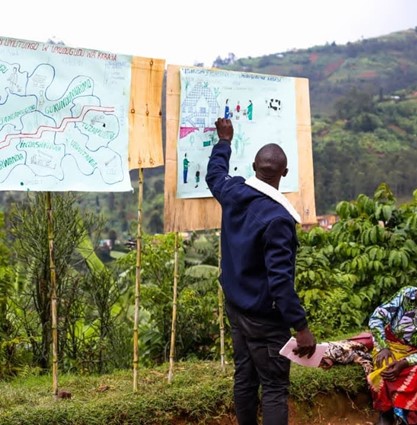 Community development agenda: In Rwanda, community members define local development priorities using participatory mapping tools, November 2025. (Photo: Elisabeth Makumbi/The Bridgespan Group.)
Facilitation enables participation and follow-through
Trained facilitators, often locals or from nearby communities, help groups move step by step from visioning to planning to implementation. Their role is less about project management and more about enabling deliberation: surfacing trade-offs, making processes understandable, and ensuring that people who are often excluded can participate meaningfully.
In Spark-supported villages, facilitation helps turn shared priorities into clear plans that are discussed and revisited during regular meetings. In TNF’s Khulani Schools Programme, partners like Columba Leadership support a values-based leadership process that helps school stakeholder groups – especially learner leaders – move from shared diagnoses to collective action without prescribing the intervention.
Equity and inclusion are designed into the process
Regular community forums, such as weekly meetings, structured discussions, or scheduled visioning sessions, create opportunities for broader participation, especially for women, youth, and others who may otherwise feel unable to speak. Oftentimes, inclusion isn’t a separate goal; it is part of how communities strengthen accountability and make decisions that reflect a wider set of needs.
In Banda, women’s participation in weekly meetings changed who spoke and who made decisions. In TNF’s work, educators, learners, parents, and alumni jointly shape how they move forward, shifting how community members describe their experiences from “it’s a programme” to “it’s our work,” with clearer shared responsibility.
 Community budgeting: Community representatives in Rwanda review and validate financial records to ensure accountability, November 2025.
(Photo: Elisabeth Makumbi/The Brigespan Group)
Financial routines make funds visible to the community
Communities commonly rely on straightforward financial practices to make community-managed project funds visible to their members. These may include bank accounts, treasurer records, community sign-off on withdrawals, and review by small oversight groups. In some settings, these systems are already in place; in others, intermediary support – such as training for treasurers, ledger templates, or community reporting practices – help formalise the practices, making finances easier to track.
In Spark-supported villages, regular meetings and simple recordkeeping help keep financial decisions transparent to the community. In one TNF-supported school, leadership teams mobilised resources to sustain their priorities, including self-funding a counsellor’s salary and forming partnerships with local organisations – signals of ownership that go beyond TNF’s support.
Conflict resolution pathways provide a backstop
Communities frequently rely on existing local administrative channels (e.g. in Rwanda, village to cell to sector to district) to resolve disputes or larger issues. Intermediaries sometimes play a brokering role, helping to clarify how and when to escalate issues, without shifting authority away from community decision making.
Measurement supports learning, not compliance
Communities and intermediaries often track a small number of indicators or record qualitative stories that are meaningful locally – enough to spot problems early and adjust course. For instance, TNF observed school leadership teams monitoring uptake of counselling services and adapted its activities based on feedback. This emphasis on learning aligns with CDC measurement guidance, which prioritises what communities and local organisations can use to make decisions, not what outsiders want to monitor.
Light-touch capacity strengthening avoids dependency
Additional support that strengthens and enhances capacity is most effective when it is light touch and targeted (e.g. bookkeeping, procurement routines, inclusive decision-making processes, or basic risk planning) and when it leaves communities more capable than when the partnership began. When intermediaries play this scaffolding role, they help communities formalise and extend practices already in use, increasing the likelihood that communities will continue to use them after the intermediaries step back.
Exits are part of the process
Durability often depends on whether processes are integrated into existing community structures and whether expectations about external support – and its exit – are clear from the start. In Spark-supported settings, routines such as regular meetings and locally owned plans help sustain momentum beyond direct engagement. TNF is also testing a school-based self-help group model to progressively shift coordination and accountability to school communities as TNF steps back, using clear milestones and shared responsibility rather than ongoing high-touch support.
Key Takeaways for Funders
Across the examples described above, effective direct funding generally relied on a small set of repeatable actions.
- Centre community decision-making power: Create conditions for communities to set priorities, make budget choices, and own implementation plans.
- Invest in facilitation and inclusion: Support the processes that make participation meaningful, especially for groups that have historically been left out
- Support financial visibility, not heavy control: Strengthen simple routines that make funds traceable and decisions visible locally (e.g. records, sign-offs, public review).
- Use measurement for learning: Promote simple tracking that helps communities and partners spot issues early and adapt.
- Budget for capacity strengthening through scaffolding, not dependency: Use light-touch diagnostics and targeted support when communities request them or when they identify gaps, so partners are stronger and more independent over time.
- Plan for persistence and exit: Set clear expectations and timelines early; design for transition so communities and community-rooted partners are not worse off when external support tapers.
- Reinforce good judgement rather than trying to control misuse: Treat local decision making as an asset to strengthen, not a risk to manage solely through restrictions.
A Practical Tool for Funders Assessing Community-Driven Organisations
The themes highlight practical differences between programmes that consult communities and those that position communities at the heart of decision making. For funders interested in exploring how these themes play out in practice, The Bridgespan Group has developed a checklist that can serve as a starting point for assessing the extent to which organisations bring a community-driven approach to their work. The checklist can also help funders understand how to support community-rooted organisations in advancing their efforts to centre community decision making.
Uwamahoro’s story reflects a broader pattern observed across community-driven efforts: when communities hold meaningful decision-making authority, and when the processes that support that authority are intentionally strengthened, resources can translate into tangible economic and social gains and stronger local leadership. In many settings, this has meant pairing funding with inclusive facilitation, visible financial routines, and clear pathways for learning and accountability. Direct community funding that builds on community power and assets gives communities room to choose what matters, respond to challenges as they emerge, and sustain progress over time.