
Sovereign wealth funds (SWFs) are among the largest and most influential pools of capital worldwide. As of 2026, at least 100 SWFs collectively managed more than US$15 trillion in assets – over twice the amount managed a decade earlier. Close to half of these SWFs are based in Asia, representing more than 75 percent of global SWF assets under management. Four of the 20 largest institutional funders in Asia are state-linked institutions, accounting for more than US$1.4 billion in giving in 2024, according to Bridgespan’s forthcoming high-impact philanthropy research. Six of the 20 largest corporate givers in Asia are also state-linked, accounting for a further US$1 billion.
Alongside their commercial investment activities, some SWFs and other state-linked institutions have established or supported philanthropic institutions, such as foundations or trusts. These state-linked philanthropies use grants, long-term capital investments, and cross-sector relationships to address social challenges.
Some state-linked philanthropies have operated for more than a decade, yet the field remains comparatively under-examined. There is limited shared language, evidence, and practical guidance on what makes these institutions distinctive, how they create value, and the conditions under which they may be most effective.
Our forthcoming report suggests that their defining feature is not state affiliation alone. Rather, it is their unique combination of proximity to government and public systems and autonomy to act flexibly and pursue public-purpose goals.
What do we mean by state-linked philanthropy?
In addition to philanthropic institutions directly linked to SWFs, we examined a broader group of organisations founded, seeded, or otherwise supported – financially or operationally – by the state, state-linked institutions, or royal families. This group includes SWFs, state-owned corporations, state development banks, and other public institutions. We reviewed existing research, organisational websites, annual reports, public filings, and other publications; conducted more than 20 interviews with leaders, practitioners, and experts; and held a virtual workshop with leaders of state-linked philanthropies.
The state-linked institutions we examined in our research varied considerably in their structure, governance, funding sources, mandates, and relationships with government. What they share is a public-purpose orientation and some degree of discretion in how they pursue social impact.
Our research also selectively draws on philanthropic institutions that are not classified as state-linked philanthropies but whose experiences offer relevant lessons on long-term capital, partnerships with government, cross-sector collaborations, and institutional design.
What makes state-linked philanthropy distinctive?
Proximity can take several forms: alignment with national priorities, access to policymakers and public systems, and – in some cases – access to government budgetary resources. Autonomy means retaining sufficient discretion over the institution’s mandate, governance, strategy, capital deployment, partnerships, and operations to exercise independent judgement and respond to emerging needs. We call the deliberate management of these two dimensions “calibrated proximity.”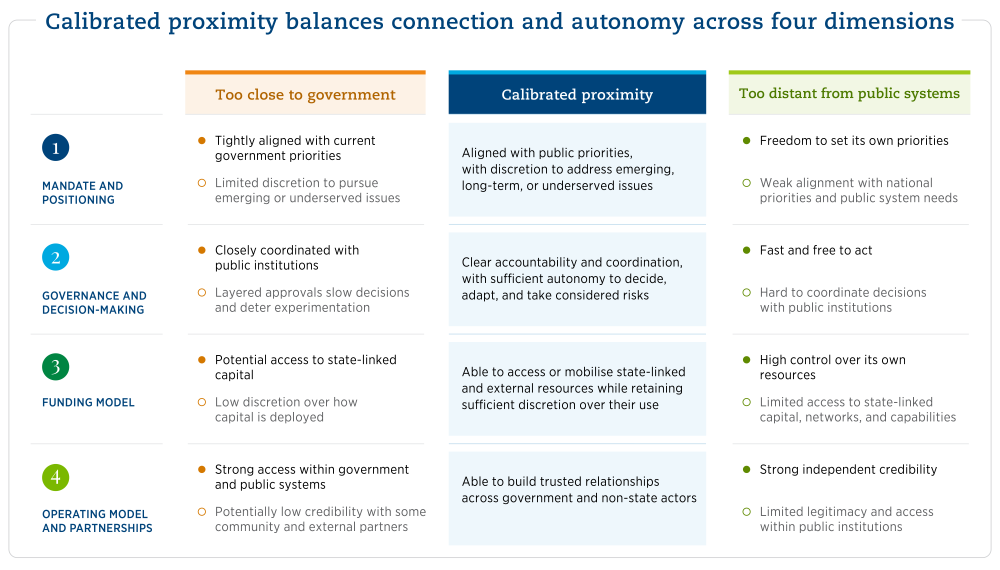
Calibrated proximity is not a fixed midpoint between closeness and independence. It is an active balance designed into state-linked philanthropic institutions and continually managed by them across different national, organisational, and programmatic contexts. When managed well, calibrated proximity provides two broad advantages.
First, state-linked philanthropies have the political legitimacy to access, and build trusted relationships with, government, communities, civil society, philanthropy, research institutions, and business. This strengthens their ability to convene actors, coordinate action, and connect promising approaches to public systems.
Second, they have access to patient, stable capital, enabling them to support experimentation, build institutional capacity, and develop ecosystem infrastructure – all of which may take years to yield results.
What distinguishes state-linked philanthropies is their potential to combine both advantages – trusted relationships and patient capital – in ways that reinforce each other and expand their capacity for impact.
What distinct roles can calibrated proximity enable?
We identified five roles through which state-linked philanthropies can translate these advantages into social impact. State-linked philanthropy institutions may play different combinations of these roles depending on their purpose and context.
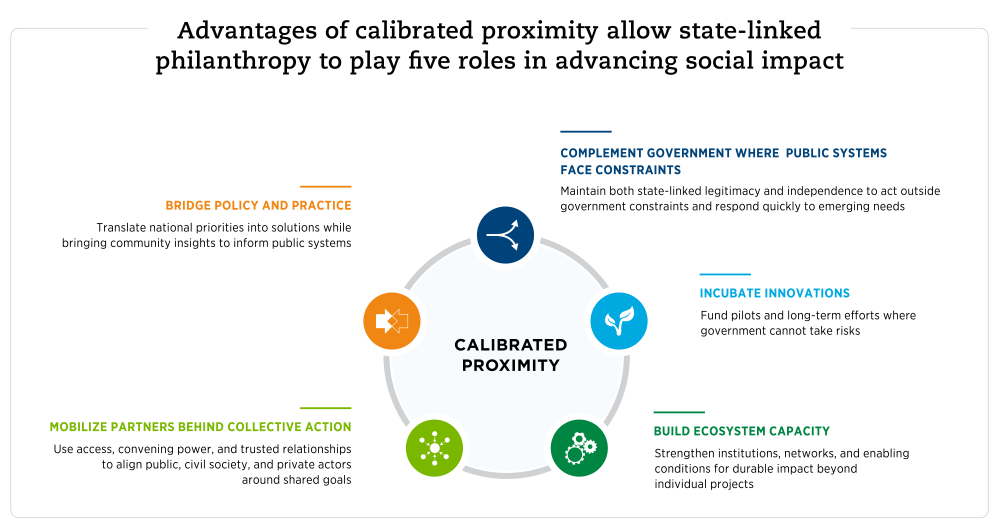
1) Complement government where public systems face constraints
Community-based organisations hold the trust and local knowledge needed to reach underserved populations, while private philanthropy and business bring flexible capital, market access, or specialised expertise. Yet no single actor possesses all the resources, relationships, and access needed to connect these efforts to public systems. And government agencies operate within defined mandates, formal processes, and public accountabilities that can limit their own ability to act flexibly.
When state-linked philanthropies combine close relationships with government with sufficient autonomy to act flexibly, they help bridge these gaps. They can mobilise resources across sectors, work through trusted community partners, and maintain a pathway for successful approaches to connect with public systems.
An Asia-based institution’s response during the COVID-19 pandemic – supporting remote and marginalised communities with healthcare, food, and basic necessities – illustrates how public and corporate resources can be mobilised through trusted community-based organisations to reach populations that formal delivery systems struggled to serve.
2) Bridge policy and practice
Governments often struggle to translate national priorities into effective implementation, while community-based organisations may have deep knowledge of what works in practice but limited opportunities to shape policy.
State-linked philanthropies can create a two-way pathway between policy and practice: translating public priorities into implementable approaches while bringing evidence and insights from implementation back to policymakers.
A Southeast Asia-based institution offers an example through its support for a maternal and child health programme. A pilot developed with public health institutions was later expanded to additional public healthcare facilities, illustrating how philanthropic support can help test and scale new approaches within public systems.
3) Mobilise partners behind collective action
Complex social challenges often require coordinated action amongst government, philanthropy, civil society, communities, research institutions, and business. Fragmented responsibilities, competing priorities, and the absence of a trusted convener can make sustained collaboration difficult.
That’s where state-linked philanthropies fit in. By contributing capital, convening power, relationships, and coordination mechanisms, they help actors align on shared goals.
An Africa-based institution demonstrated this role by bringing together government agencies, private-sector partners, media organisations, and community actors to strengthen vaccine delivery during the COVID-19 pandemic.
4) Build ecosystem capacity
Governments and nonprofit organisations often need to prioritise immediate services and programme delivery. As a result, investment in institutions, talent, research, networks, and the shared infrastructure required for long-term systemic impact may remain limited. When they invest over a longer time horizon, state-linked philanthropies strengthen this wider enabling environment.
A Middle East-based institution exemplifies this role through its sustained investments in institutions, talent, data, infrastructure, and research partnerships within the country’s personalised medicine ecosystem. It has built capabilities that extend beyond any single programme.
5) Incubate innovations
Governments have limited budgets and appetite for risk; private philanthropies that support innovation often lack the relationships needed to embed successful approaches in public systems. By contrast, state-linked philanthropies can fund experimentation, engage public institutions from the outset, generate evidence, and create pathways to wider implementation.
Take an Asia-based institution’s support for a vulnerable infant support programme, for example. Patient funding enabled the service to be established, tested, and strengthened for more than five years before it was expanded to serve vulnerable infants across the country’s hospitals and in the community.
Designing for calibrated proximity
Calibrated proximity is not an automatic consequence of being state-linked. It is shaped by institutional choices that determine how closely an organisation aligns with public priorities, how independently it can act, and how effectively it can work across sectors.
Across our research, four recurring areas of institutional choice emerged:
- Define a clear mandate and a distinctive position relative to central government. State-linked philanthropies create the greatest value when their mandate connects to public priorities but is not identical to government’s remit. This allows them to focus on gaps where their capital, relationships, time horizon, and flexibility can add distinct value.
- Clarify governance and decision making. Clear roles and decision rights can help institutions remain connected to public priorities while preserving sufficient room for professional judgement, continuity, partnership, and responsiveness to emerging needs.
- Structure a sustainable funding model that balances stability and flexibility. Institutions need sufficient access to capital to sustain long-term commitments, as well as sufficient discretion to protect their missions, support experimentation, and respond to changing needs.
- Build an operating model and partnerships aligned with the institution’s role. Leaders need to determine what the institution should do itself, which capabilities it needs to build internally, and where government, civil society, communities, philanthropy, research institutions, or business can partner and are better placed to lead.
No single model fits in every context. The appropriate choices depend on an institution’s purpose, national context, maturity, and intended role. The full report explores the practical questions leaders can consider within each area.
Looking ahead
State-linked philanthropy remains a developing field. The roles and institutional choices identified in this research are not intended to be comprehensive or prescriptive. Rather, they offer a shared language and practical starting point for leaders designing, leading, or partnering with these institutions.
The research suggests that what distinguishes state-linked philanthropy is not a connection to government alone, but the potential to combine patient capital, access to public systems, trusted relationships across sectors, and sufficient autonomy to act where government or conventional philanthropy face constraints.
Philanthropy is also one lever within a broader state-linked impact ecosystem. State-linked institutions can use a spectrum of capital and investment approaches – including grants, catalytic capital, impact investment, and structured finance – alongside their capabilities, relationships, and influence to advance public purpose. Partnerships with other actors are also key: implementing organizations, non-state-linked philanthropists, and other donors in the space.
The opportunity, therefore, is not simply to establish more philanthropic institutions. It is to consider more intentionally how state-linked institutions can use their full range of financial and nonfinancial assets – and how thoughtful institutional design can help convert that potential into lasting social and environmental impact.
Please enter your email address below to be notified when our report is available. Thank you!
If you are interested to learn more about a community of practice for senior leaders of state-linked philanthropies, please share your contact information here.