
Civil society actors in the United States are operating amid profound change. Political coalitions are shifting, public trust in institutions has eroded, and long-standing relationships among nonprofits, government, and philanthropy are breaking down. Leaders across the social sector are feeling deeply uncertain about the sector’s future. (While similar dynamics are unfolding globally, this memo focuses specifically on the United States.)
We see and feel this challenge at The Bridgespan Group. As we reflected on how best to support organizations in this environment, we spoke with a range of leaders and scholars and originally wrote this memo as an internal resource. By publishing it externally, we hope to help social-sector leaders as they consider how their strategies may need to shift. Below, we (briefly) describe the history of civil society in the United States, the assumptions that shaped its modern form, the turbulent crosscurrents that have upended the sector, and competing visions that point to different paths for how civil society may evolve.
We close by outlining a set of questions for leaders. There are no easy answers, but we hope that making the fundamental questions explicit will be useful for leaders grappling with their own versions of what comes next.
Civil Society and Its Early Evolution
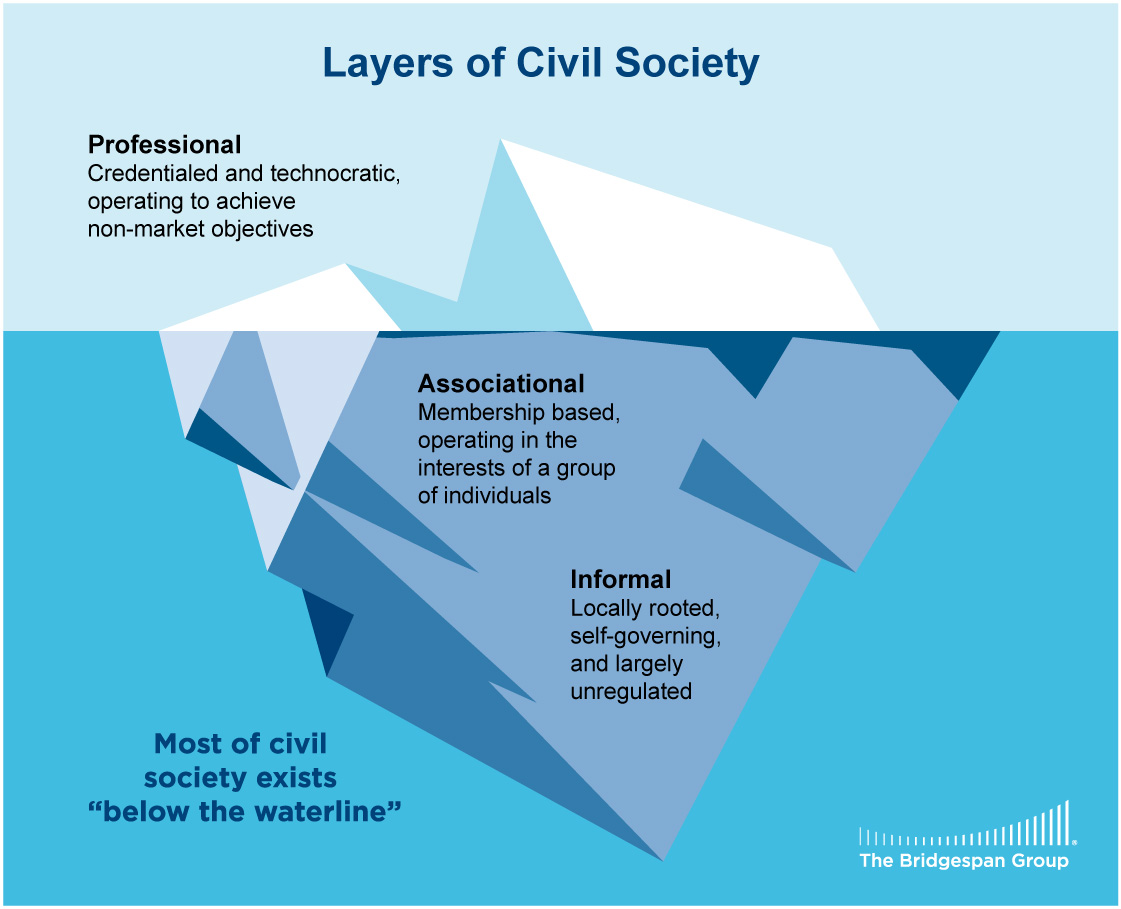
Civil society is the realm of associations and activities, outside of government and business, where people come together to “develop and express shared values and take collective action” for the public good, as AEI Senior Fellow Daniel Stid described. It operates at multiple layers, from a largely informal layer of mutual aid groups, faith communities, and local civic committees; to an associational layer that includes unions, membership organizations, and clubs formed to aggregate interests and mobilize constituencies; to a professional layer of nonprofit organizations, human-service providers, multi-service organizations, philanthropies, universities, and advocacy groups, including many operating at a large enough scale to work substantively with public- and private-sector institutions.
The structure and role of civil society in American life have not been static. As relationships among individuals, the private sector, and the public sector have changed, so, too, have the relative influence and shape of civil society’s informal, associational, and professional layers. What many leaders today take to be the familiar configuration of civil society is the product of particular political and economic conditions of our time, just as the configurations of earlier eras were shaped by their times.