
America’s great experiment in democracy is showing its age. Today, nearly two out of three Americans say they are dissatisfied with how democracy is working, according to surveys by Gallup and the Pew Research Center. This widespread discontent reflects a downward trend that began more than two decades ago. For their part, foundations have taken notice: institutional funders channeled $7.3 billion into a wide range of projects to support a healthy democracy in 2024, according to the U.S. Democracy Hub, a data collection platform.
Increasingly, individual funders have turned to us for advice on how they, too, can engage in this work. Whether they are concerned about political polarization, declining civic engagement, or the erosion of democratic institutions and processes, funders have a wide range of choices.
While elections, court decisions, and policy debates grab most of the media attention, a healthy democracy also relies on year-round civic engagement that encourages people to participate, connect, and build the institutions and relationships democratic life requires. As we described in a report on how to support a multiracial, pluralistic democracy, much of that work focuses on ensuring communities are heard and included in decision making.
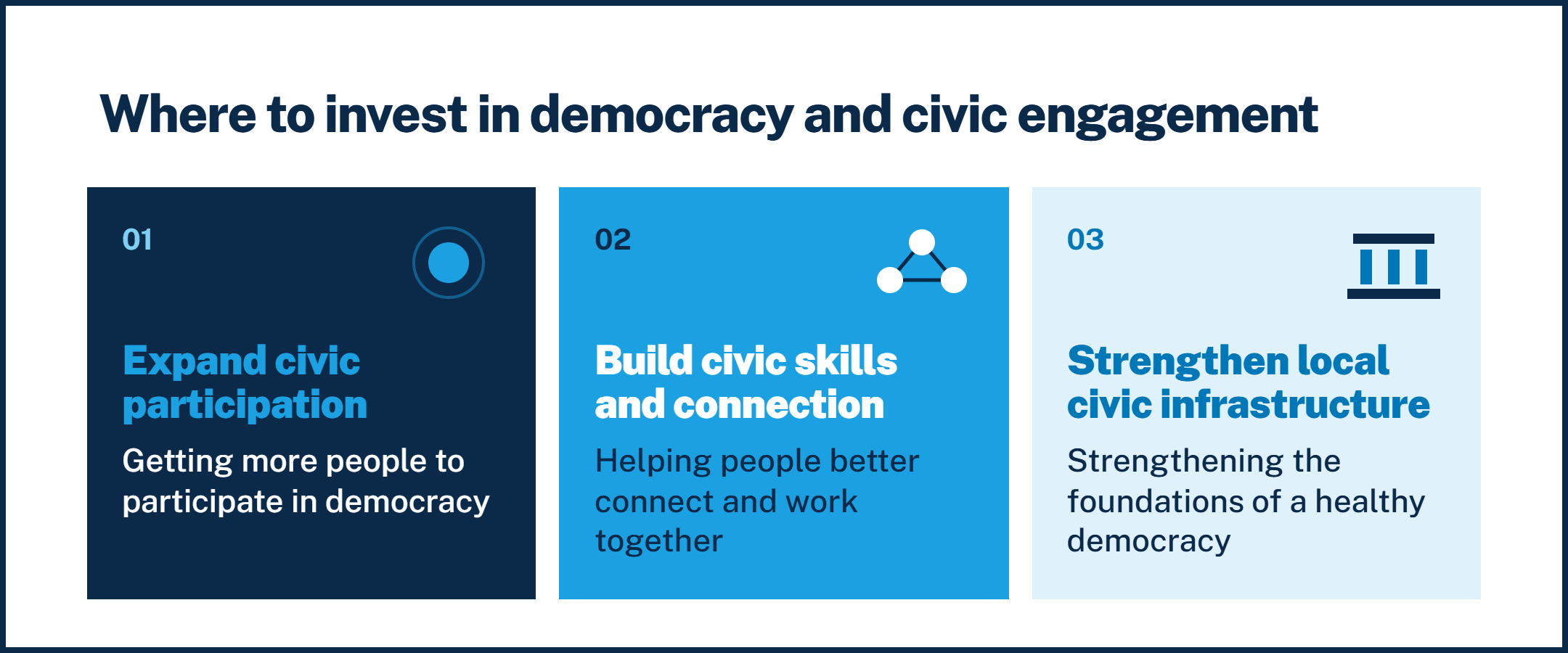
Here, we describe three practical approaches for those new to democracy funding and those looking to get involved: expanding civic participation, building civic skills and connection, and strengthening local civic infrastructure. Each approach fosters civic participation, “the glue that holds self-government together,” as the Brookings Institution observes in its publication of 76 things you can do to boost civic engagement. Civic action, writes Brookings, “is essential to maintaining the foundations of our democracy, no matter which political party happens to be in power.”
Expand civic participation
This approach helps more people participate in democratic processes as voters, community members, and leaders. For example, Vot-ER partners with more than 80,000 health care professionals at 2,000 participating sites to integrate nonpartisan voter registration and civic engagement into health care settings. Patients can scan the QR code on a provider’s badge to check their voter registration status, request a mail-in ballot, or register to vote via a secure platform.
Other organizations focus on communities whose voices and leadership have historically been underrepresented. Higher Heights Leadership Fund works to strengthen Black women’s civic participation and to develop a leadership pipeline for Black women in politics. All Voting is Local is a nonpartisan organization that works with officials in nine states to prevent election interference, advance fair and inclusive voter registration rules, and remove barriers that keep eligible Americans from voting—particularly Black, Latino, Native American, and other historically excluded communities.
The civic participation approach provides donors with measurable results, such as the number of new voters registered or new leaders trained and elected to office. It can also help donors see how funding can strengthen the practices and systems that enable people to participate in public decision making. The deeper promise of this work is the possibility of making participation more accessible, representative, and routine, so that more people have meaningful opportunities to shape the decisions that affect their lives.
Build civic skills and connection
This approach builds the habits and capabilities that strengthen democracy: listening, deliberating, engaging across differences, evaluating information, and taking responsibility for shared problems. These habits do not develop automatically. They need to be taught, modeled, practiced, and reinforced. Examples include civic education programs, youth leadership initiatives, service-year models, and cross-partisan leadership programs.
The American Exchange Project, for instance, brings recent high school graduates to communities different from their own, creating opportunities to build relationships across geographic, economic, and cultural lines. Future Caucus works with Gen Z and millennial elected officials at the state and federal levels, helping them build bipartisan relationships and collaborate across party lines. These approaches differ in audience and format, but both aim to give people opportunities to practice the skills and build the relationships that civic life requires.
Generation Citizen provides civics education with an equity-centered approach to more than 25,000 students each year in 150 schools across eight states. It also leads advocacy efforts to advance legislation prioritizing equitable civic education and fosters collaboration through youth leadership development.
This approach appeals to donors concerned about polarization, social fragmentation, or the next generation of civic leadership. The results may be less immediate than those of a voter registration campaign, but the long-term goal is foundational—helping the next generation build the skills and relationships needed to deliberate, disagree, and act together.
Strengthen local civic infrastructure
This approach invests in trusted local institutions and networks that help people gather, build relationships, access information, develop leadership, and act together on shared concerns. These institutions can take many forms: libraries, faith communities, neighborhood associations, YMCAs, and youth-serving organizations such as 4-H and the National FFA Organization. What connects them is their role in community life. They create spaces where people encounter one another, build trust, identify shared priorities, and develop the leadership and relationships needed for collective action.
The Trust for Civic Life pools philanthropic funding to support community-led efforts that bring people together, strengthen participation, and solve shared problems. The Trust invests in historically underserved regions experiencing persistent poverty or rapid economic or demographic transitions, which are often overlooked by national philanthropy. Better Together America supports a national network of local and regional “civic hubs” that convene residents and organizations around community priorities and collaborative problem-solving. The Village Square creates opportunities for people across political and social divides to engage one another through dialogue and shared community experiences. Together, these models offer donors ways to strengthen locally rooted civic capacity while also supporting learning and connection across communities.
Much of this work may not be labeled “democracy.” Yet the community groups, institutions, and networks that create “civic infrastructure” are foundational to democratic life. This approach appeals to donors interested in durable, place-based opportunities for people to come together to solve common problems.
How to get started
The examples above are representative of the hundreds of nonprofits dedicated to strengthening civic engagement in support of American democracy. Finding organizations that most closely fit your philanthropic aspirations is less daunting than it seems. Two searchable databases list organizations that expand participation, build civic skills and connections, and strengthen local civic infrastructure. The U.S. Democracy Hub features free data on some 23,000 funders and more than 4,200 nonprofits involved in the democracy field. The National Civic League’s Healthy Democracy Ecosystem Map lists organizations, networks, and coalitions nationwide working to promote healthy democracy.
Civic engagement is not a quick fix. Some of its most important outcomes can take years to develop and may be difficult to measure. The practices below can help you stay the course:
- Collaborate with others who know the field. Pooled funds, intermediaries, field experts, and philanthropic collaboratives help donors learn from peers and practitioners, reduce duplication of effort, and provide more flexible, sustained support.
- Get closer to the work. Focusing on a specific community, state, population, or institution deepens understanding of how civic life functions in practice.
- Take a longer view on measurement. Some of the most important outcomes of civic engagement unfold over time and may not lend themselves to short-term metrics. Work with grantees to identify meaningful indicators of progress while avoiding measurement expectations that favor what is easier to count over what matters most.
- Adopt a learning mindset. Civic engagement is relational and context-specific. Approach the work with a willingness to experiment, learn alongside practitioners, and adapt strategies to fit what works across different communities.
Democracy is not only about voting every few years. It’s about something people practice together every day. By investing in civic engagement, donors can help strengthen the conditions that make democracy more participatory, responsive, and resilient, not only during election years but also in the everyday places where civic life is built.
Edited by Robyn Porteous and Roger Thompson.
The authors thank Iman Jaroudi, a Bridgespan alum, for her invaluable contributions to the research.