
A mother in Brownsville, Brooklyn, pays for another load in the washer and sorts socks with her young son, slowly counting each pair, engaging him in simple math ideas. A laundromat as a learning laboratory? It turns out it can be an ideal place for parents to introduce early-math concepts and increase a child’s school readiness. Too Small to Fail, the early childhood learning initiative and Heising-Simons Foundation (HSF) grantee, partnered with more than 400 laundromats across the country to turn those idle hours into opportunities for preschool learning. In 2019, three New York City coin-operated laundromats, including one in Brownsville, carved out small, dedicated learning spaces with colorful rugs, bookshelves, and even a few puppets.1
HSF sees improvement in early math as a critical pathway to achieving its long-term education goal of a nation where all young children thrive. To help realize that population-level goal, the foundation invests in building the field of early math learning. Learning in laundromats was just one of the innovative and pioneering projects HSF supported. Others included a multi-institution research collaborative, curriculum development, and professional development for teachers and administrators. From 2011 to 2023, HSF made 194 grants to 84 organizations, totaling roughly $107 million. Many grantees received multiple grants over those years, reflecting HSF’s commitment to long-term partnership.
“It’s been really interesting to think about systems-level change,” says Patti Miller, CEO of Too Small to Fail.
But achieving systems change through field building does not happen within a typical grant cycle. It can take decades, even a generation. With such a long-term approach, funders face a tough challenge: How do you know if you’re making progress? How do you know that, say, a $100 million investment was worth it, and how can you tell whether another $100 million is the way to go?
Indeed, measurement remains a primary area of inquiry that we hear from funders curious about investing in field building. Rigorous measurement of field-building, systems-change work will always prove complex and challenging. At its essence, it reframes a core question asked by funders: Did we solve this? Instead, measurement through a field-building lens asks: Are we helping build the conditions for many actors to solve this together?
Because we believe reframing can be worthwhile, we examined four recent evaluations of field-building efforts, including a deep look into HSF’s investment in early math, to better understand the measurement and evaluation of such long-term efforts and to help determine practical advice for funders that can be used today.
“There is rigor to this,” says Kimberly Brenneman, Heising-Simons program officer for education. “There is a way to think about field-building investments that allows you to see progress, and the places where progress is not yet being made.”
Measuring Field-level Progress: Complex and Critical
It can be hard to imagine how fledgling even the term “early math” was, much less the field, when HSF began investing more than 15 years ago. Historically, when it comes to early education, reading has received the spotlight. At first, with such a limited evidence base in early math research, it was unclear to HSF which approaches were ready to scale.
Its initial investments focused on expanding the knowledge base on effective early math learning and on bringing new actors—with a variety of perspectives—into the field. In 2014, HSF launched Development and Research in Early Math Education (DREME) at Stanford University, a network that brought together members from 12 universities to develop research and resources informed by their diverse expertise.2
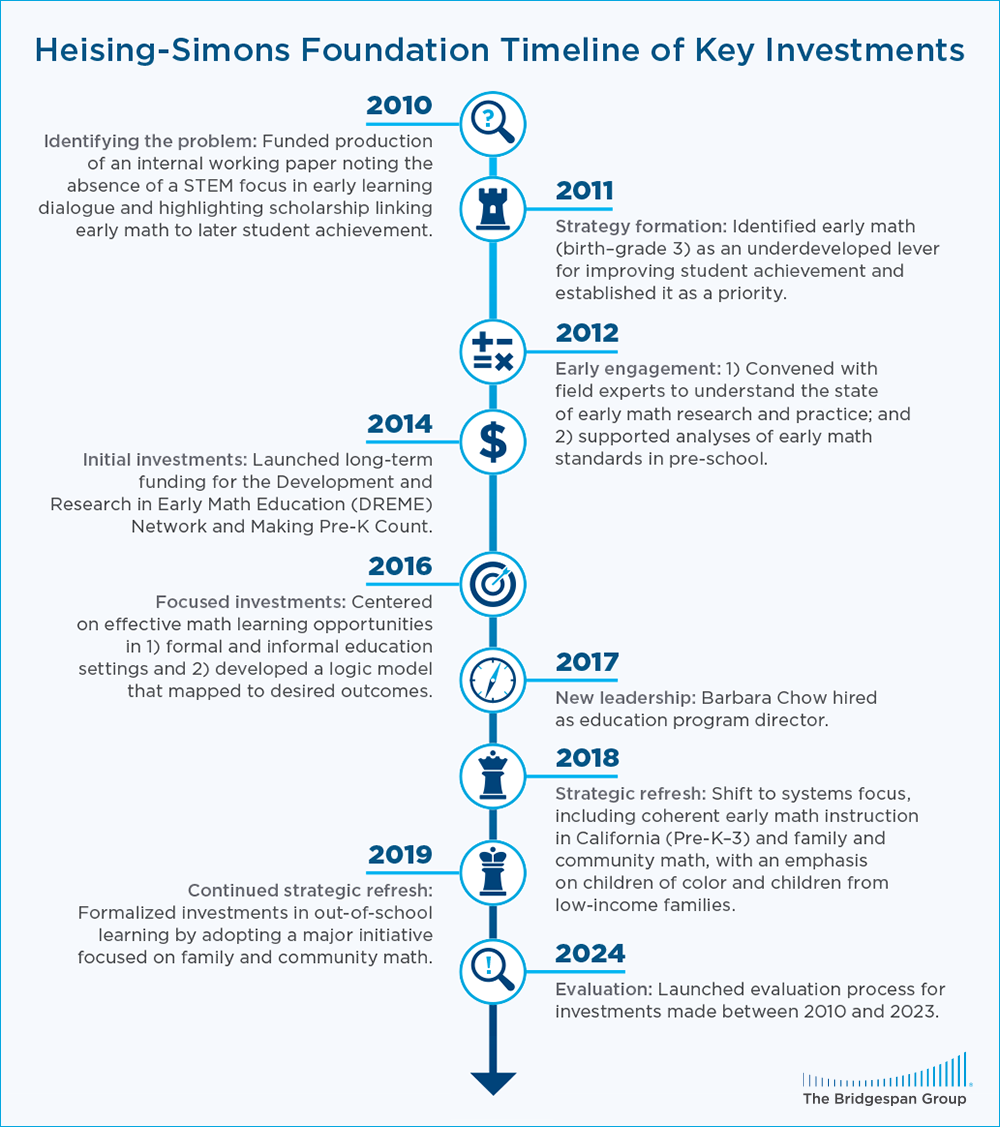
But the early math investment was not a leap of faith. Cumulatively, HSF was following a central hypothesis: that addressing root systems and structures would be critical to meeting population-level education goals.
Funders who invest in field building face a particularly complex reality in measurement, evaluation, and learning (MEL). Traditional evaluation tools that focus on discrete outcomes and clear attribution provide, at best, a partial view. At worst, they can be misleading.3 Furthermore, the daunting nature of these measurement challenges often dissuades funders from investing in field building.
"Some funders look at field building and say, ‘It’s hard to measure, so it’s hard to invest in.’ At the same time, those of us focused on long-term systems change sometimes use complexity as a reason not to measure anything. I think both of those instincts can hold us back."
“Some funders look at field building and say, ‘It’s hard to measure, so it’s hard to invest in,’” says Zoë Stemm-Calderon, executive director of the Raikes Foundation, another funder that invests in field building. “At the same time, those of us focused on long-term systems change sometimes use complexity as a reason not to measure anything. I think both of those instincts can hold us back.”
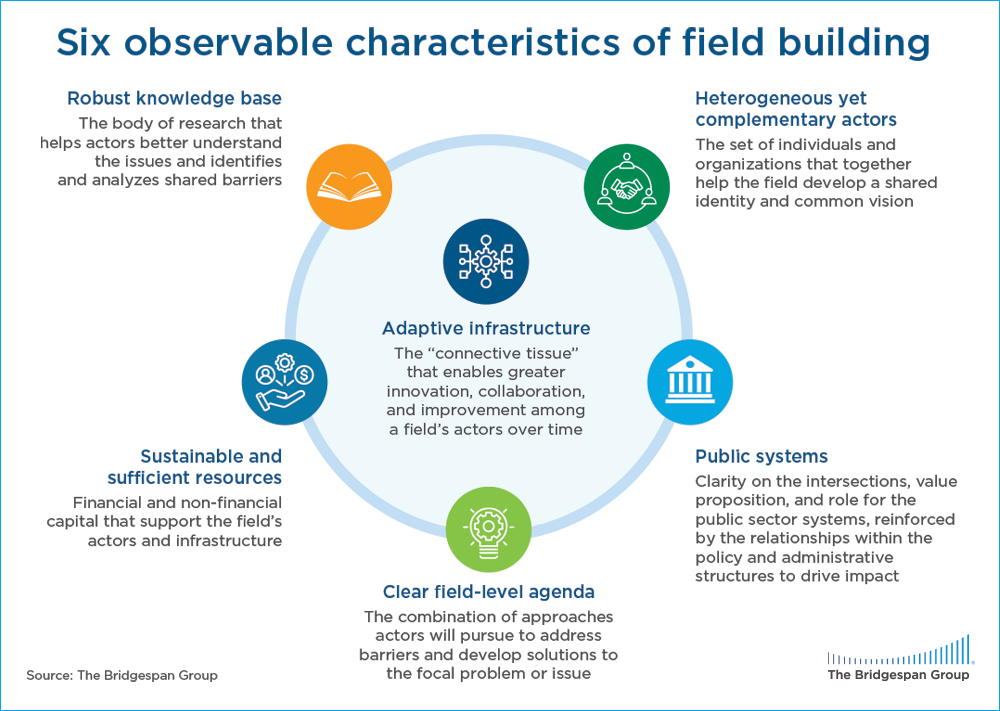
In 2023, HSF worked with Kelefors Education Partners on a rigorous mixed-methods evaluation to try to understand how it all added up. Guided by Bridgespan’s field-building frameworks,4 the evaluation looked not only at student outcomes but also at the state of the early math field itself: specific dimensions of progress within its knowledge base, key actors, field-level agenda, infrastructure, and resources. This evaluation approach is a practical example of how a funder—engaged in helping to build any field—can gauge progress toward a population-level goal. The approach can also surface evidence of impact that might otherwise have been overlooked or show the path forward for a whole ecosystem of actors. It can even be an act of field building itself.
To test and validate the insights we developed in our analysis of HSF’s evaluation with Kelefors, we reviewed several other field evaluations and interviewed those involved. These include the Student Experience Research Network (SERN) evaluation of the field of “student experience,” 5 Liberation Ventures’ evaluation of the movement for reparations,6 and the Andrew Carnegie Foundation’s (formerly the Carnegie Corporation of New York) evaluation of the field of “family engagement.”7 Evaluators in each of these cases relied on different field-building frameworks, including the Emergent Learning framework8 and another from Bridgespan, as tools. Each of these evaluations shows that rigorous measurement of field building is both feasible and valuable.
Anatomy of a Field-Building Evaluation
Kelefors’ evaluation of HSF was concerned with three central questions:
- What changed in the early math field in California and nationally from 2011 to 2023?
- How have HSF’s investments contributed to those changes?
- How is racial equity showing up in the portfolio and the broader field?
Bridgespan’s field-building framework covers six observable characteristics. We drew on a range of fields—including marriage equality, tobacco control, and criminal justice reform—each of which has successfully achieved population-level change over decades of efforts. Evaluators noted that using this framework allowed for a nuanced approach to interviews, covering a range of field-building activities for different actors, including how field building applies to curriculum development, public awareness efforts, and narrative change.
In the case of early math, a complex picture emerged. While fourth-grade math scores remained largely flat or declined in recent years, including a sharp drop after COVID-19, the evaluation showed steady, tangible shifts in how the early math field is organized, resourced, and supported. Key field leaders view this progress as a critical foundation for and momentum toward eventual population-level outcomes—such as improved fourth-grade math scores.
Unexpected Evidence of Impact
In its evaluation, Kelefors characterized early math as an emerging field. HSF had essentially put it on the map only a decade earlier. While the field now has recognizable actors, growing activity, and early forms of infrastructure, its practice and impact remain uneven and not yet consistent at scale. This is what Bridgespan has seen in its research across a range of emerging fields.9
Still, even within this nascent context, the evaluation highlighted meaningful shifts in the field. Most HSF education grantee survey respondents agreed that early math is now a higher public policy priority (59 percent) and a higher educational research priority (79 percent) than a decade ago. Most believe children are more likely to experience meaningful math learning opportunities today than they were 10 years ago—across formal early-learning settings (70 percent), primary school grades (57 percent), and out-of-school environments (57 percent).
DREME network researchers also found substantial growth in the research and knowledge base surrounding early math since 2011. The number of early-math-related research published in prominent early childhood education journals increased from 50 in the five years leading up to 2012 to 304 from 2018 to 2022, a six-fold increase.
Similarly, the SERN evaluation of the student experience field also found measurable expansion of key actors, knowledge base, and connectivity. “Over the course of several years, what had started as a relatively small group of researchers studying mindset interventions became a ‘big tent’ hub of relationship-building, knowledge generation, and research mobilization that engaged a more heterogeneous group of hundreds of influential education actors across research, practice, policy, and philanthropy,” wrote the evaluation team.
These evaluations highlight the importance of a relational, ecosystem approach and a sustained commitment to the field. How a funder shows up is as important as what it funds. They underscore that fields benefit from bringing together people with diverse yet compatible perspectives, and that field-building funders have a unique vantage point from which to see intersections and orchestrate connections.
"HSF supported an entire ecosystem—research, practice, communications, tools, convenings, not a single silver bullet."
“HSF supported an entire ecosystem—research, practice, communications, tools, convenings, not a single silver bullet,” says Savitha Moorthy, former executive director of Tandem, Partners in Early Learning, a longtime grantee in the HSF early math portfolio. “They invested early and steadily. That stability allows organizations like ours to commit to the work.” HSF took risks and created room for experimentation. HSF also didn’t immediately push for easily quantifiable outcomes. This patient, trusting funding approach remains rare in philanthropy.10
The evaluation reinforced a recurring truth about systems-change work: no single funder can claim or be held responsible for population-level impact. That is generational and collective work. Instead, funders can meaningfully contribute to the conditions that enable long-term change, even when outcomes such as state or nationwide fourth-grade math scores remain out of reach for the time being.
Such a dichotomy highlights how putting too much weight on a single metric can be unhelpful. When it comes to moving fourth-grade math scores nationally, a nationally recognized early education and early math learning expert says: “That would be a very high bar for any one foundation. ... Think of how big this country is, or even how big the state of California is. Moving that needle takes more than one foundation.”
Instead, HSF was playing the long game and embracing contribution over attribution—both of which can be uncomfortable for some funders. The evaluation found that the clearest, most attributable effects of HSF’s investments were advancing specific components of its theory of action, such as the longer-term goal of improving early math proficiency outcomes nationwide.
For example, HSF strengthened the field's research and practical knowledge base by supporting new research and practice collaborations such as DREME at Stanford University and the Center for Family Math. These initiatives have been instrumental in attracting a broader, more diverse set of researchers and practitioners to the field. Investments in high-quality, standards-aligned curricula and instructional materials have helped early-grade math teachers provide coherent, effective instruction from school entry to third grade.
The foundation also wielded its power as a convener and connector to elevate early math as a legitimate field of practice and to encourage a wider array of funders and practitioners to invest resources in the space. These contributions helped lay the groundwork, build momentum, and build an evidence base, positioning the field to progress toward the next level of impact at scale.
Coalescing such peer funders is a critical component of field-building work. In the Center for Public Research and Leadership’s evaluation of the Andrew Carnegie Foundation’s work to help build the field of “family engagement”—the movement to improve the home-to-school connection—researchers also picked up on this theme. “It showed that Carnegie did play a leadership role in field building in the role as a convener,” says Ambika Kapur, a program director in Carnegie's education program. “It validated the role a funder can play with fewer dollars. Our former president used to say, ‘we have more cachet than cash.’”
That rings true for Ayeola Kinlaw, author of the Carnegie evaluation. “It turned out Carnegie was super influential, both in setting the table for other funders to coalesce around, and in inspiring the establishment of key infrastructure organizations in family engagement,” she says. “As a total amount of spend, they weren’t spending all that much.”
"It’s hard for any one foundation to carry and invest in a field by themselves. What are the ways that different foundations can come in and support different pieces of that field? How does a collective of funders support field building? Some of the work of field building might feel unsexy—it might feel like it’s behind the scenes."
Wielding influence to bring other funders along is key in field building. Those relational contributions show up in each of the evaluations we looked at. “It's hard for any one foundation to carry and invest in a field by themselves,” says Robert Medina, director of policy and advocacy at Sobrato Philanthropies, a collaborator in HSF’s efforts to improve learning outcomes for young multilingual learners. “What are the ways that different foundations can come in and support different pieces of that field? How does a collective of funders support field building? Some of the work of field building might feel unsexy—it might feel like it's behind the scenes. You're thinking about different vehicles for change.”
Striking the right balance is also important. Frontline Solutions, the team that evaluated Liberation Ventures’ impact on the reparations movement, underscored the value of this kind of relational field-building work. It found that Liberation Ventures was able to introduce the conversation about reparations into “new spaces”—philanthropy and high-net-worth individuals—and mobilize funds. However, a tension exists there as well. Evaluators also noted a potential risk: that Liberation Ventures could become a gatekeeper within the field, overshadowing the contributions of grassroots groups and movement partners.
Top 10 Tips on Measurement, Evaluation, and Learning for Field-Building Funders
Kelefors’ evaluation of HSF shows that measuring field-level impact is possible, but it’s not the stuff of a typical foundation impact report. The evaluation, along with the others we examined, balanced qualitative and quantitative analysis with equal rigor to paint a more complete portrait of impact. It takes both stories and numbers to create a full picture of the multiple dimensions necessary to achieve enduring impact.
Each of these evaluations also relied on a set of thoughtful advisors and some engaged peer funders to support the design and sensemaking of the results. Those additional perspectives bring a critical eye and inform judgments about whether a set of efforts is moving things in the right direction, whether the investment is appropriately proportional to the amount of progress, and what future results could be expected.
Importantly, these evaluations also proved valuable in informing strategy and approach. “There were two levels of things we were trying to understand,” says Aria Florant, CEO of Liberation Ventures. “Is the work impactful? Have we been doing work that is accelerating the movement? But we also wanted information about ‘the how’—how are we doing the work? What feedback do people have about how we do our work?"
For funders working toward systems change in any field, HSF’s experience offers both encouragement and a practical roadmap. Based on our interviews, casework, and evaluation analysis, here are 10 pieces of advice for field-building funders—those just starting out and those looking to deepen their engagement—on measurement and evaluation.
- Find your benchmark: Whether starting from scratch or refreshing an existing strategy, begin with a field assessment to understand key needs and guide investment priorities. Ideally, evaluations should not require participants to reflect over a decade of work without the benefit of that initial baseline assessment. It can be very challenging for people to describe how field conditions were a decade ago.
- Beyond the dollar: A field-building frame helps to show the impact of financial capital, as well as nonfinancial support and differentiated approaches, such as strategic communications and convening and connecting key actors. This was true in each evaluation.
- Know what’s in and what’s out: It can be helpful to narrow a field’s scope to assess impact. Evaluators noted the challenge of assessing a field that is, in reality, several interlocking fields. In the HSF case, these included California and national education systems, as well as family math and school math. So, narrowing the scope is one approach; treating each of these as distinct fields would be another.
- See the trees and the forest: Recognize impacts on specific dimensions of the field as intermediate outcomes toward long-term goals. Those outcomes provide valuable indicators of progress and lay a durable foundation for long-term change. Sometimes, leading indicators are measurable earlier than you think, Lisa Quay, former executive director of the SERN, which sunsetted in 2023, suggests.11 “We had these other sources of information we'd been gathering all along, and we just hadn't been thinking about them as part of the leading indicators we monitored,” she says. “Like a significant difference in the resourcing of the field: who was giving and receiving funding and how this was shifting over time. It wasn't a systems-change outcome yet, but it was a significant change at the field level that was necessary to achieve the broader systems outcomes we cared about.”
- Many hands: Some evaluations assembled a set of advisors—a diverse group of grantees and funders—to vet the evaluation design and the findings. Investments in MEL for field building can engage an entire field and become an opportunity to learn together. Liberation Ventures gathered five of its funders to meet with the evaluators “in the beginning, middle, and end,” says Florant. “I wanted to lift up the hood and let people in. If we find things that aren’t good, then fine, let’s learn all together. Funders can have a hard time figuring out how to evaluate our work, so why not just bring them into the process?"
- Measure what matters—for everyone: Assess where the field has the metrics and scorecards it needs, where those are missing, and build them—but not for yourself. “The scorecards and metrics make the biggest difference when they belong to the field,” says Stemm-Calderon of Raikes. “You have to invest in them, so the field can understand what's changing and whether it's making progress. That's where the real value is. It turns measurement from a reporting exercise into a tool for learning and improvement for the people who are leading the change.”
- Meet the field where it is: That set of thoughtful advisors mentioned above should agree on population-level change metrics and a timeline in which to implement them. Different stages of a field’s progress need different kinds of philanthropic support, and rigorous MEL clarifies a field’s progression. Funders should be prepared to meet the field where it is.
- Use it as a tool: Use the evaluation as a means of influence and as an act of field building, to galvanize and engage others to move toward the next stage of progress. Furthermore, field-building evaluations benefit both funders and field leaders, unlike traditional funder landscape analyses that primarily serve funders. “It can help field leaders diagnose what’s missing or make the case for what they need,” says Kinlaw, author of the Carnegie evaluation.
- Spark new investment: An evaluation like this can serve as a powerful call to action to build on a funder’s foundational investment. Bridgespan has found that sharing field-level learnings broadly can be a powerful way to attract new funders to the field.
- Spread the word: HSF shared the final evaluation with a subset of core advisors and grantees, has made the summary public, and is considering whether and how to disseminate the detailed findings more broadly. It is worth noting that each of the other evaluations we looked at was also disseminated broadly. “Whatever our learnings were, we decided to make them publicly available to make it practical and available for their funders,” says Kapur from Carnegie. Liberation Ventures took things a step further by embracing a learning-in-public approach that is quite rare. It issued a letter articulating its plans to adopt or defer each of the evaluation’s recommendations, along with explanations for those decisions.12
Moving Forward
Funders and their boards want to see a demonstrable impact. As HSF’s evaluation experience shows, the tools and methods for measuring field building will look quite different from those used for direct service work. But it can’t be hand-wavy—yardsticks matter. “You can’t improve something if you don't have a way to understand whether it’s getting better,” says Stemm-Calderon of Raikes.
Field building is generational work. To progress from emerging to evolving to sustaining, the field of marriage equality, for example, took over four decades13. Often, this work can be two steps forward and one step back. Even for success stories, challenges and backlash persist. It means the work might never truly be done; it just keeps evolving.
The funders in our examples grapple with such complexities. As SERN’s evaluation shows, its work was critical to helping build the field of student experience. But as the field evolved, its needs changed too, leading SERN to make the tough decision to sunset. The goal of SERN’s strategic sunset was to seed the next generation of field building, including a $3.3 million sunset grant portfolio that brought together dozens of researchers, practitioners, policymakers, students, and other actors to address key needs and opportunities in the field.14 Liberation Ventures identifies as a field catalyst, and mobilizing resources for the reparations movement is only part of what the organization does. As its evaluation raised, and our own research on field catalysts has explored, there is a delicate tension to navigate when a field catalyst is also a funder.15 For HSF, the evaluation’s documentation of impact is a great benefit to both the foundation and the field. It has helped shape the funder’s investment in the field going forward. HSF is using the recommendations to guide exploratory and new grantmaking in early math narrative change and to leverage medical infrastructure to support early learning.
Field building for population-level change is not only generational and complex work but also collective work. Just as raising fourth-grade math scores is never work one funder can do alone, it is a reminder that measurement through a field-building lens asks: Are we helping build the conditions for many actors to solve this together?
1. “Laundromats Support Early Literacy, Finds NYU Steinhardt Professor,” New York University, March 26, 2019.
2. “Inspiring Joy and Curiosity in Early Math Learning,” Heising-Simons Foundation, November 14, 2025.
3. Lija McHugh Farnham, Emma Nothmann, Kevin Crouch, Isaiah Baker, and Bradley Seeman, Measurement, Evaluation, and Learning: A Guide for Field Catalysts, The Bridgespan Group, December 12, 2024.
4. Lija McHugh Farnham, Emma Nothmann, and Cora Daniels, Field Building for Population-Level Change, The Bridgespan Group, March 27, 2020.
5. The Evolution and Impact of Student Experience Research Network, Student Experience Research Network (SERN), May 2023.
6. Frontline Solutions, Liberation Ventures Impact Report: Reflecting on Five Years, Liberation Ventures.
7. Center for Public Research and Leadership, Forward Together: Building a Field that Works for Families, Columbia Law School, January 5, 2022.
8. Marilyn Darling, Heidi Guber, Jillaine Smith, and James Stiles, “Emergent Learning: A Framework for Whole-System Strategy, Learning, and Adaptation," The Foundation Review 8, no. 1 (March 2016): 59-73.
9. Lija McHugh Farnham et. al., Field Building for Population-Level Change.
10. Jeff Bradach, Kathleen Fleming, Preeta Nayak, and Zach Slobig, “The Trust-Based Philanthropy Conundrum: Toward Donor-Doer Relationships That Drive Impact,” The Bridgespan Group, April 30, 2024.
11. “Reflections from a Strategic Sunset,” SERN, May 2023.
13. Phil Dearing and Andrew Flamang, “Marriage Equality,” The Bridgespan Group, August 10, 2017.
15. Lija McHugh Farnham, Emma Nothmann, Kevin Crouch, and Cora Daniels, Equitable Systems Change: Funding Field Catalysts from Origins to Revolutionizing the World, The Bridgespan Group, March 21, 2023.