
In 2024, the world lost 6.7 million hectares of primary rainforest—an area equal to 18 soccer fields every minute and nearly double the rate of loss from the previous year. It’s a striking statistic and so much more: it signals that the degradation of critical natural systems is accelerating at a time when their resilience is increasingly essential.
Protecting and restoring forests and other natural ecosystems is fundamental to the planet’s stability. Forests absorb billions of tons of carbon dioxide each year, playing a critical role in regulating rainfall, sustaining biodiversity, and supporting the livelihoods of an estimated 1.6 billion rural people. Their loss releases centuries of stored carbon, disrupts weather patterns, and undermines communities and economies.
This growing urgency was acknowledged at the United Nations’ climate talks in Brazil, known as COP30, where heads of state and negotiators announced new commitments to protect forests and other vital ecosystems. Yet even as ambition rises, the distance between pledges and tangible progress remains wide. Governments set targets while communities bear the consequences, but philanthropic and impact-focused investment capital can often move first by funding the protection and restoration of natural ecosystems.
Funders increasingly recognize that conserving and restoring nature is a global imperative that requires cross-sector collaboration. Still, the paradox at the heart of the climate crisis persists: despite nature’s immense value, investment in its conservation and restoration remains far below what is needed to meet global goals on climate, biodiversity, and land degradation.
Nature Is Life’s Infrastructure
Every day, forests, grasslands, mangroves, peatlands, and seagrasses sustain life by regulating climate, water, and ecosystems on which people and economies depend. Together, these five terrestrial biomes store vast amounts of the Earth’s carbon—for example, global forests alone hold an estimated 861 gigatons of carbon in biomass and soil—and coastal systems such as mangroves, tidal marshes, and seagrass meadows contribute disproportionately to carbon storage and sequestration relative to their area.
Their benefits, however, extend beyond carbon. Forests and wetlands filter the air and purify the water on which billions depend. Mangroves and seagrasses shield coastal communities from storm surges and flooding. Peatlands and grasslands regulate rainfall, moderate heat extremes, and preserve fertile soils. Roughly 1.3 billion people—around two-fifths of the global workforce—were employed in agrifood systems in 2021, many of them in farming, fishing, and forestry that depend directly on healthy natural ecosystems.
These ecosystems are also deeply intertwined with cultural identity and heritage. For many Indigenous Peoples, who are often the primary stewards of high-value ecosystems, nature is not merely an “asset” or provider of services—it is a living system with inherent value. Their stewardship traditions reflect a deep understanding of the interconnectedness of all living things and remind us that nature’s worth extends beyond economic and environmental function.
Why Nature Is Losing Ground
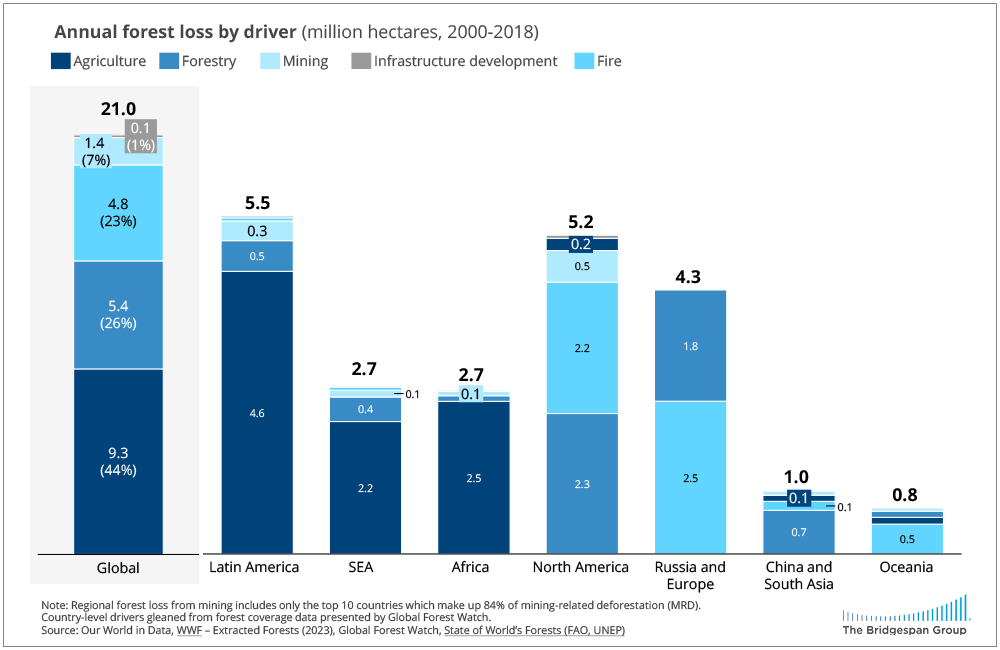
Despite its immense value, nature is under intense pressure. In many places, it remains more profitable to clear forests or drain wetlands, for example, than to keep them intact. Over the past decade, five forces have driven deforestation and land conversion:
- Agriculture (e.g., cattle ranching, soy crops, palm oil plantations, and aquaculture)
- Forestry (e.g., paper and pulp, rubber, timber, and fuelwood)
- Mining (e.g., gold, coal, and other critical minerals)
- Infrastructure development (e.g., roads, cities, and hydroelectric dams)
- Wildfires (both human-induced and natural, made more frequent and intense by rising temperatures)
Across emerging and developing countries, agricultural expansion alone accounts for 90 percent of forest loss. In more industrialized regions, forestry and wildfires are dominant drivers. Notably, nearly 70 percent of land conversion—and the carbon released from it—over the past five years has occurred in countries rich in biodiversity and under-resourced in protection.
These pressures are not inevitable. They stem from policy and investment choices that shape land-use decisions. With different choices and sufficient capital, these pressures can be mitigated, and trends can be slowed, halted, or even reversed. Impact-oriented funders play a critical role.
Five Levers for Action
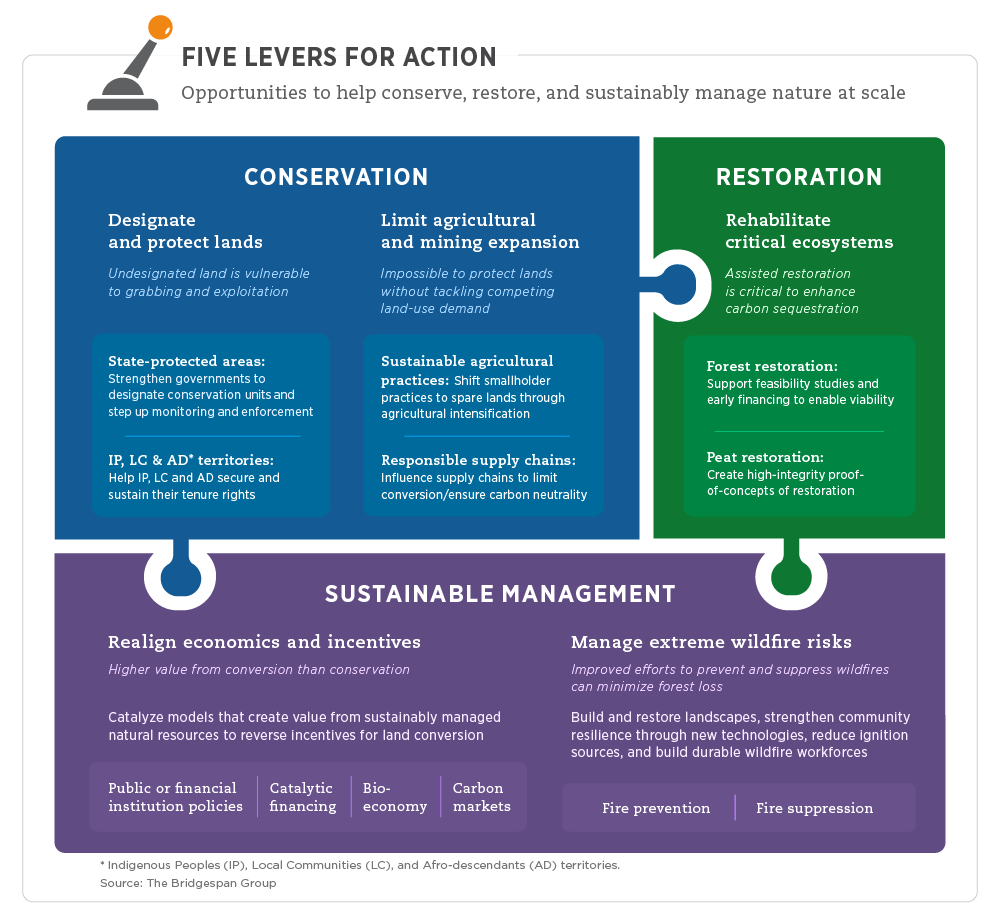
In our work with funders and field partners, we see five interconnected levers that funders can pull to help conserve, restore, and sustainably manage nature. Each offers concrete opportunities for impact-oriented capital. The examples are illustrative and represent a sample of the types of organizations, approaches, and funding opportunities active in this space.
Designate and protect lands
Large areas of critical ecosystems—particularly in the tropics—remain unprotected, lacking legal designation and therefore vulnerable to competing land-use demands and exploitation. Globally, only about one-fifth of forests and peatlands are under formal government protection. Weak land-use policies and unclear concessions further heighten the risk of conversion.
Philanthropy can help by funding land-use planning and tenure mapping (roughly speaking, that means documenting customary land use to support land claims), expanding legal protections for high-carbon and high-biodiversity areas through state-protected areas and other conservation designations, and providing legal and technical support to strengthen Indigenous and community land rights, so local stewards have the authority and security to safeguard territories for the long term.
Example funding opportunities:
- Tenure Facility provides grants and technical support to Indigenous Peoples and local communities across the Amazon, Congo Basin, and tropical Asia to secure and defend land rights.
- The Nature Conservancy advises governments on land-use assessments and policy design to identify priority areas for protection around the world.
- MapBiomas produces high-resolution land-use historical annual maps and weekly deforestation alerts by civil society to inform advocacy and enforcement in 14 countries across Latin America and Indonesia.
Limit agricultural and mining expansion
Commodity-driven agricultural land conversion remains the largest threat to natural ecosystems. Food security needs and economic pressures continue to push farms into forests and peatlands. In the Congo Basin, the “rural complex” of smallholder farming, artisanal forestry, and charcoal and fuelwood production relies on slash-and-burn practices that deplete soils and push cultivation deeper into forests. In the Amazon, cattle and soybean farming are the primary drivers of forest loss, while in Southeast Asia, palm oil plantations are a leading cause of forest and peatland loss. In addition, mining, especially for minerals critical to the clean energy transition, such as lithium, nickel, and cobalt, is expected to grow sharply by 2050, adding new pressures to clear lands for extraction.
A key opportunity to limit expansion is to improve yields and land-use efficiency on existing farmland through sustainable practices that enhance soil health and protect the environment. Agroforestry systems can ease pressure on standing forests while strengthening food security and rural incomes, especially in regions where subsistence farming is prevalent.
In areas dominated by commercial agriculture, however, these approaches must be paired with strong policy safeguards, because higher yields can increase farm profitability and attract new farmers, leading to additional land clearing. Where agriculture or mining is the main driver of land conversion, supply chains can also be reshaped to meet production needs without expanding agricultural land use. This includes advocating for policies that require companies to pursue circularity (i.e., designing products and systems to eliminate waste by keeping materials in use) and resource efficiency, and where conversion is unavoidable, to achieve at least carbon neutrality by fully compensating for land conversion through high-integrity conservation and restoration efforts.
Impact-oriented capital can support farmer transition costs, underwrite sustainable production models, and back companies and coalitions that commit to deforestation-free supply chains.
Example funding opportunities:
- One Acre Fund helps smallholder farmers in sub-Saharan Africa increase yields and diversify incomes through training, improved inputs, and sustainable practices—including agroforestry—that can reduce pressures on forests.
- Fern campaigns with broad coalitions to ensure EU policies protect and restore forests and the rights of communities that depend on them, which has led to new laws such as the EU Deforestation Regulation.
- Mighty Earth uses campaigns, investigations, and technical engagement to shift corporate practices in commodity supply chains that drive land conversion, helping unlock stronger conservation outcomes from the private sector.
- Catalytic Capital for Agriculture Transition uses philanthropic capital to mobilize large-scale private investment into sustainable farming in Brazil, helping align farmer profitability with forest protection and reduced land conversion.
Rehabilitate critical ecosystems
Preventing deforestation is only part of the challenge; restoring degraded and high-carbon landscapes is another. Despite strong global commitments, progress remains limited—only about 4 percent of the land that countries and organizations have pledged to restore has been rehabilitated.
Providing early-stage and catalytic capital for credible, well-designed restoration projects is one approach, which when paired with investments in local skills and institutions, can help to ensure those efforts are effective over time.
Philanthropic funders are well positioned to support this early work, while impact investors can then help scale successful models through dedicated restoration funds and vehicles that link ecological gains with sustainable revenue streams.
Example funding opportunities:
- In the Amazon, firms like re.green and Mombak develop large-scale restoration projects that generate high-quality carbon credits from degraded lands, linking reforestation directly to climate finance.
- Conservation International provides early-stage project finance for nature protection and restoration around the world, covering development costs such as origination, feasibility analysis, design, and validation that can be difficult to fund.
- The African Forest Landscape Restoration Initiative, known as AFR100, mobilizes public, private, and philanthropic investment to restore 100-million hectares of degraded land across Africa by 2030.
Manage extreme wildfire risks
Fires play an important role in some ecosystems. However, extreme wildfires have become a major driver of forest loss across temperate, sub-Arctic, and, increasingly, tropical regions—intensified by rising temperatures, drought, and shifting land-use patterns. In some years, fires in Canada, Australia, and Siberia alone have accounted for more than half of global tree-cover loss, while in 2024 wildfires were a primary driver of forest loss in the Amazon. Taken together, the most extreme wildfires on Earth have more than doubled both their frequency and magnitude over the past two decades. Extreme fire is predicted to increase by 30 percent by 2050 worldwide, with potentially catastrophic impacts on human communities and on both fire-adapted and fire-sensitive ecosystems.
Proven strategies to manage these risks include building and restoring landscape resilience and readiness to receive ecologically beneficial fires, making homes and communities more fire-resilient, cutting high-risk ignitions, building durable wildfire workforces, accelerating knowledge transfer between existing and emerging fire-prone geographies, aligning market incentives, and deploying new technologies that allow communities to better detect, respond to, and manage wildfire.
Grants can support Indigenous fire stewardship, fire management training, capacity building for firefighting agencies, and community resilience. Catalytic capital can help scale new modeling, detection and tracking technologies, and resilience infrastructure in high-risk regions.
Example funding opportunities:
- Earth Fire Alliance is enabling a step-change in wildfire detection and management with FireSat, a purpose-built satellite constellation that will detect fire ignitions as small as five square meters anywhere on Earth and provide real-time intelligence to responders and scientists.
- Resources Legacy Fund’s Wildfire Program advances policies and funding to ensure that communities and landscapes in the United States can both withstand wildfire and successfully integrate its beneficial use.
- Renaissance Philanthropy’s South American Fire Fund supports integrated, sub-national response systems that bring together governments, the private sector, civil society, Indigenous brigades, and local communities to reduce the likelihood of wildfires, improve fire management and response, and accelerate post-fire stewardship.
- Western Fire & Forest Resilience Collaborative aims to reduce fire risk in the Western United States by identifying forest resilience mechanisms, tracking changing forest conditions and fire regimes, and understanding how current actions shape future ecosystems through data and projections.
Realign economics and incentives
Today, economic incentives to convert natural land far outweigh those to conserve it. In 2022, an estimated $1.7 trillion in global investment and subsidies flowed to agriculture, forestry, and mining—far exceeding funding directed toward conservation and restoration.
Realigning these incentives begins with making sustainably managed natural landscapes economically viable. A variety of approaches might come into play. In some cases, this means reforming policies and subsidies so conservation can compete financially with land conversion. In others, structured financing approaches can help unlock additional public and private capital by shifting risk to investors better positioned to bear it.
High-integrity carbon markets can also play a role by channelling reliable, long-term funding to conservation at scale—provided they are supported by clear accounting rules, credible safeguards, and policies that ensure a meaningful share of revenues reaches high-impact, verifiable nature-based solutions. Emerging bioeconomy approaches offer another pathway, creating value through nature-based products and services.
Impact-oriented funders can help make these approaches viable by designing and testing new mechanisms, underwriting early-stage transactions, and supporting the data, governance, and standard-setting work that gives mainstream investors the confidence to follow suit.
Example funding opportunities:
- Forests and Finance assesses how banks and investors finance commodity production across geographies, including Southeast Asia, Africa, and Latin America, and offers evidence to strengthen financial regulation.
- The Amazon Region Protected Areas Program—a partnership between the Brazilian government, Global Environment Facility, the World Bank, German Development Bank (known as KfW), and a coalition of philanthropic funders including Bezos Earth Fund, Margaret A. Cargill Philanthropies, the Gordon and Betty Moore Foundation, Sall Family Foundation, and Walmart Foundation—supports over 60 million hectares of protected areas through an endowment-style trust fund.
- The Integrity Council for the Voluntary Carbon Market establishes rigorous Core Carbon Principles to raise the bar for high-integrity carbon credits.
- The Central African Forest Initiatives (also known as CAFI) in the Democratic Republic of the Congo employs payments for environmental services to reward rural communities for maintaining forest cover and restoring degraded peatlands and forests.
- The Arapyaú Institute pairs concessional capital with technical support for smallholder cocoa farmers in Brazil, helping them boost yields on existing land and restore degraded areas through agroforestry.
* * *
Nature is one of the world’s most powerful climate solutions, yet it remains profoundly underfunded even as the risks of inaction rise. Today, less than 5 percent of global climate finance flows to nature, even though it accounts for more than one-third of the most cost-effective mitigation potential. For institutional foundations, family offices, and impact investors, directing capital toward nature offers rare alignment between environmental, social, and in some cases, economic returns. Investing in conservation, restoration, and sustainable management, impact capital can help to secure the natural systems that support life for generations to come.
The authors extend heartfelt thanks to the readers who provided input and the dedicated team that developed this research, including Brian Burwell, Bruno Moschetta, Chen Hui, Denise Chew, Elisabeth Makumbi, Gwendolyn Lim, Julia Finnerty, and Ying Yap.
Disclaimer: Impact investing services are provided by Bridgespan Social Impact, Inc., a wholly owned subsidiary of The Bridgespan Group