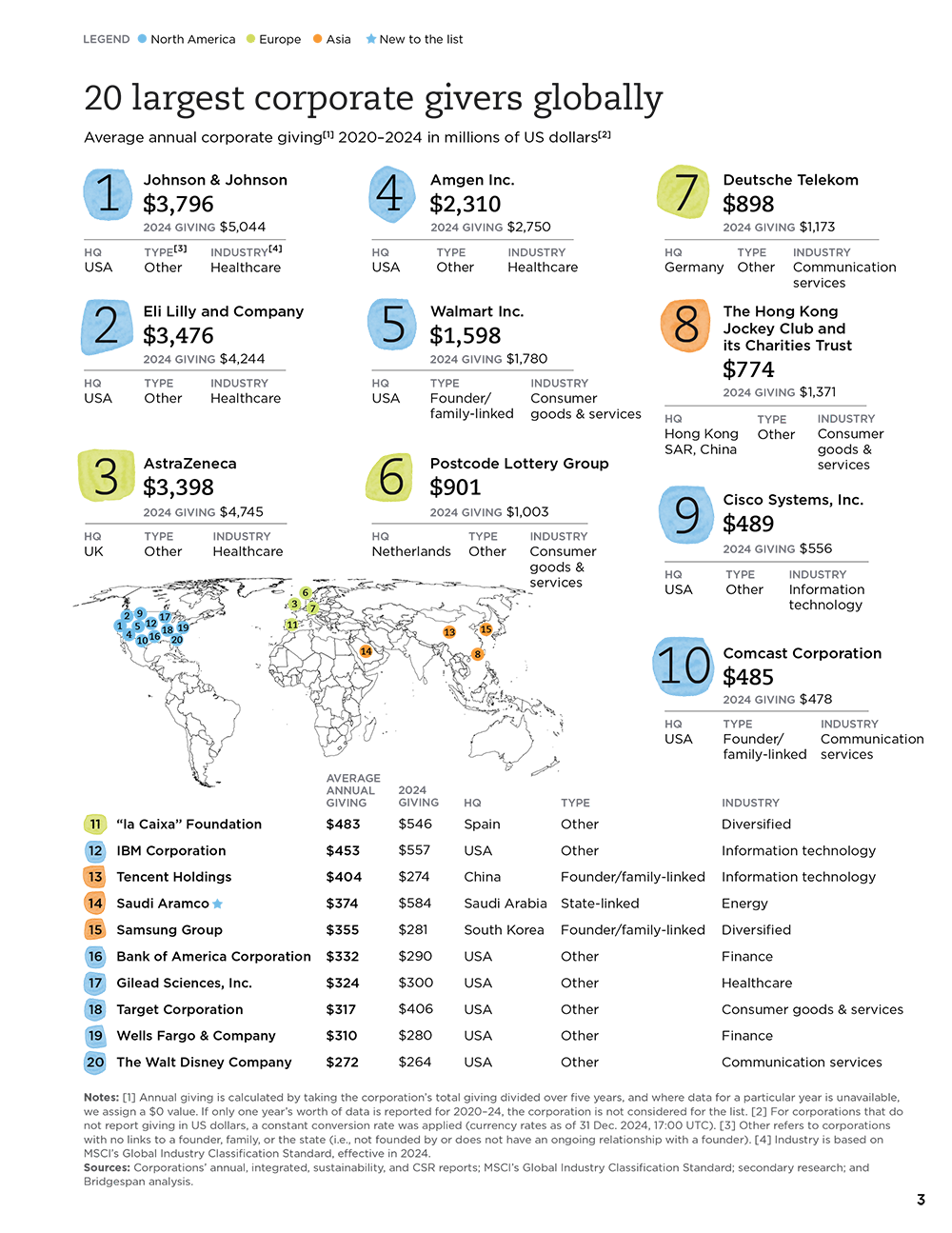
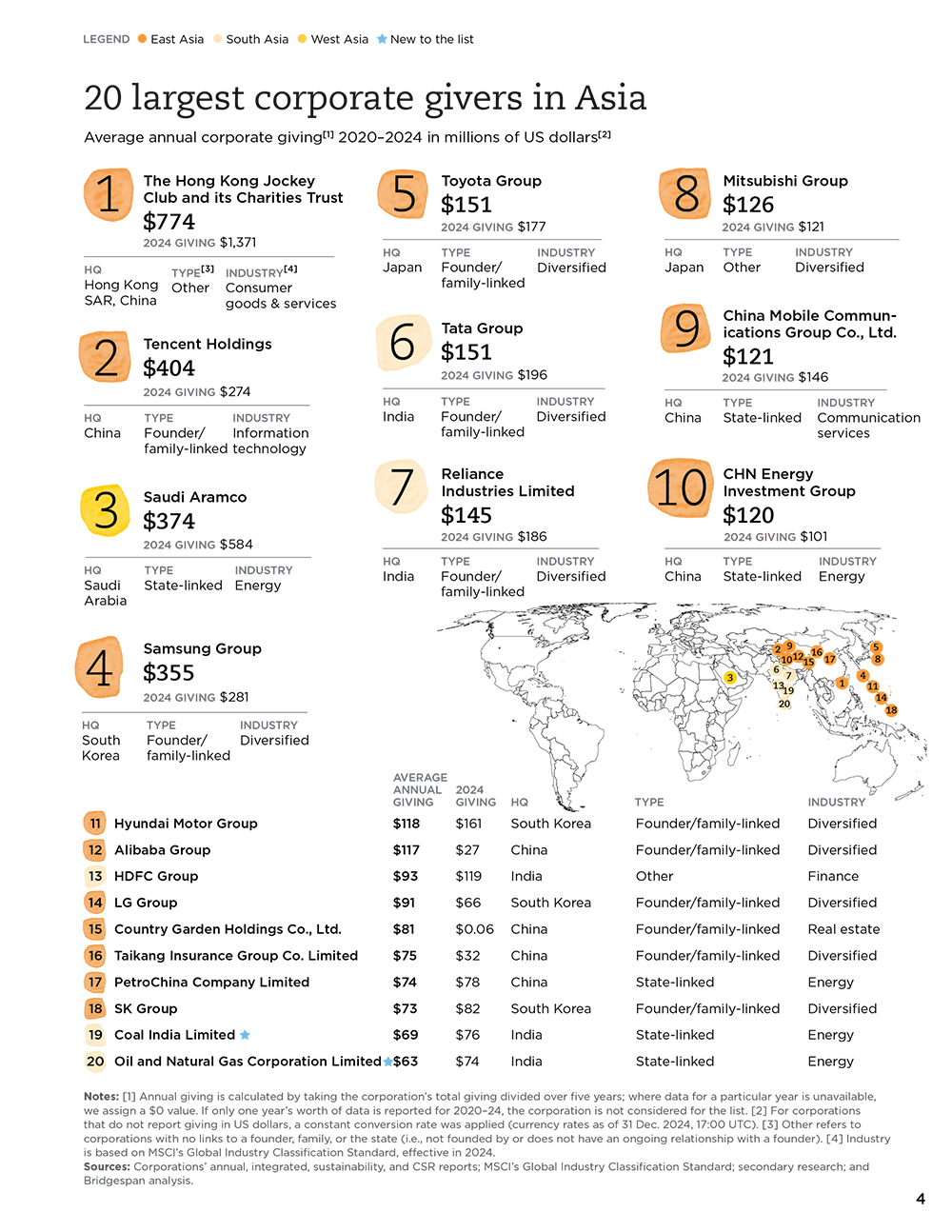
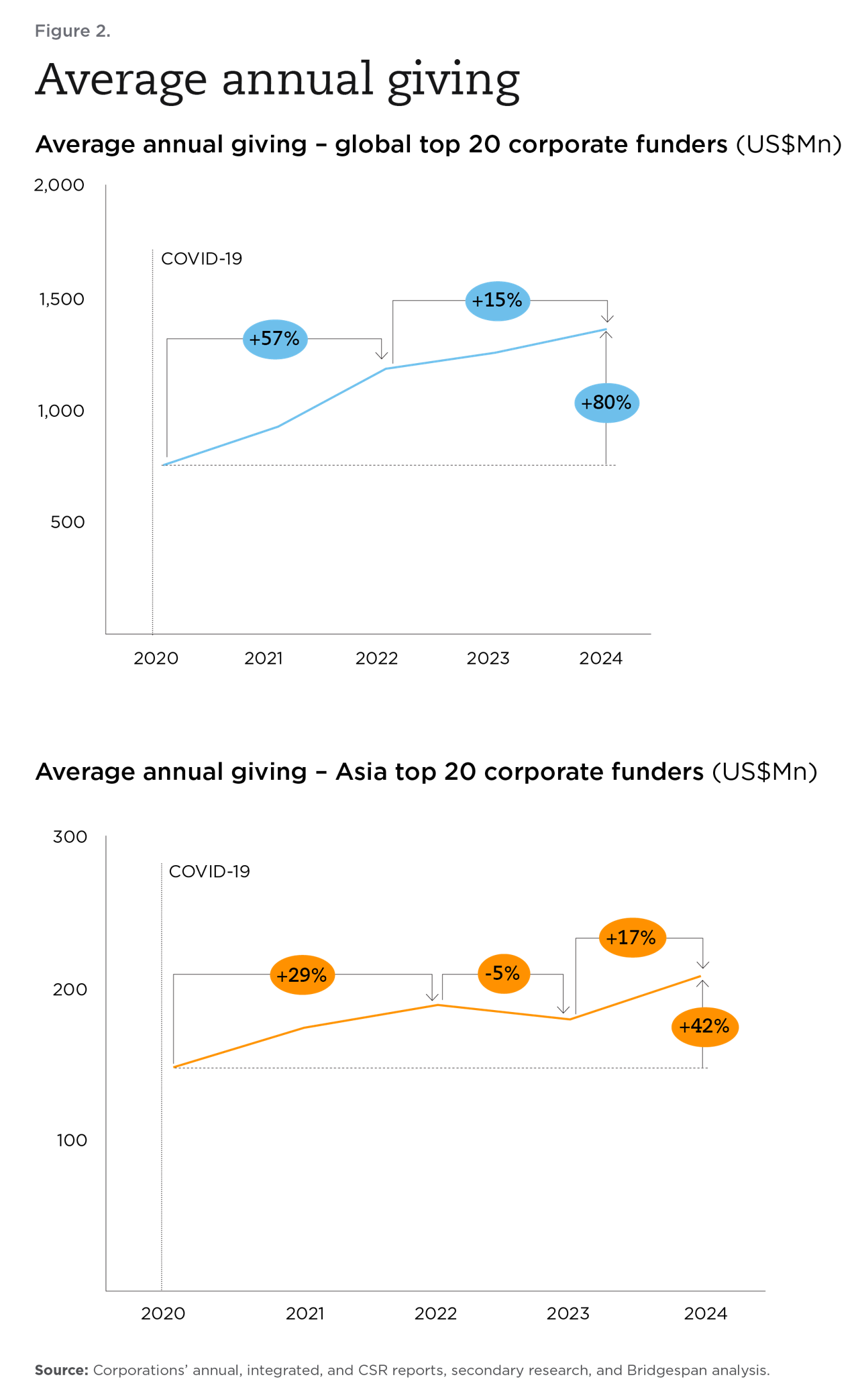
The 20 largest corporate givers globally increased their total annual contributions to initiatives supporting charitable activities by 80 percent between 2020 and 2024, significantly outpacing broader economic growth over the same period. Concurrently, average annual giving by the largest corporate givers in Asia grew by 42 percent over that period, despite a temporary 5 percent decline in 2023. This upward trajectory underscores the continued importance of corporate capital in addressing social and environmental challenges.
Additional Resources
"The Largest Institutional Philanthropies Expand Giving Amidst Global Challenges"
How the World’s Wealthiest Families Give
High-Impact Family Philanthropy: What Makes Family Giving Distinctive
These are the key findings from The Bridgespan Group’s second survey of the largest corporate funders globally and in Asia. The research is supported by our Funders Council – the Institute of Philanthropy, the Gates Foundation, and The Rockefeller Foundation. We define corporate giving as initiatives that support charitable activities contributing positively to social and environmental outcomes. We chose “corporate giving” rather than “corporate philanthropy” to include a broader range of giving beyond grants from corporate foundations. (See “Methodology” below.)
In 2024, 65 percent of the largest corporate funders globally and 60 percent of the largest corporate funders in Asia increased their giving from 2023. The growth indicates that many of the world’s largest corporate funders, which increased their spending during the COVID-19 pandemic, sustained their social investments even amidst a period of considerable economic and geopolitical uncertainty.
The lists of the 20 leading corporate funders in 2020–2024 remain largely unchanged from 2019–23 across both the global and Asian lists. Saudi Aramco was the only new entrant on the global list, and Coal India and Oil and Natural Gas Corporation Limited joined the 20 largest corporate givers in Asia.
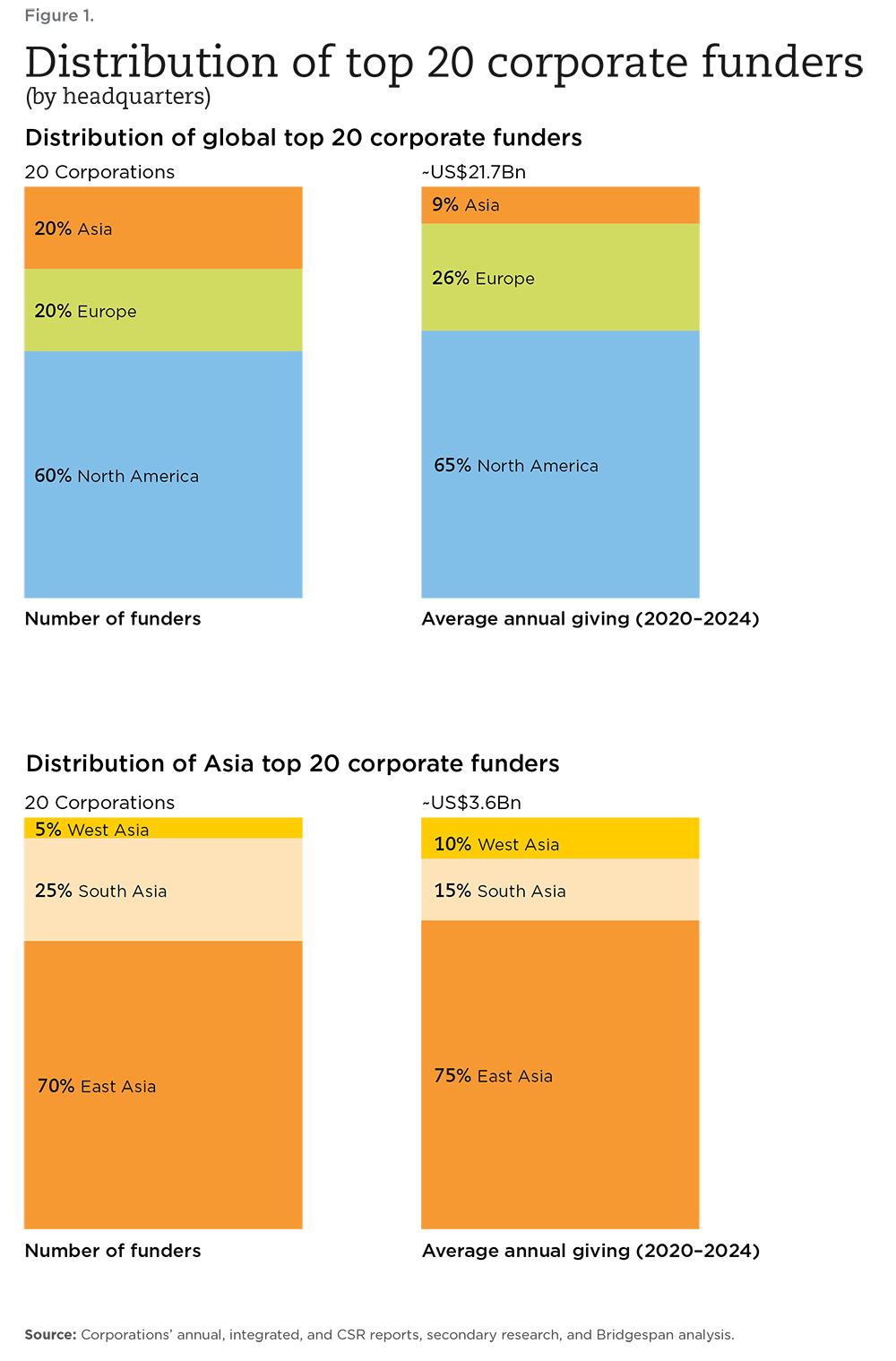
Corporate giving remains concentrated geographically. North America accounts for 65 percent of giving amongst the largest global funders, while East Asia accounts for 75 percent of giving amongst Asia’s largest corporate funders. This reflects the concentration of both corporate scale and philanthropic infrastructure in those regions.
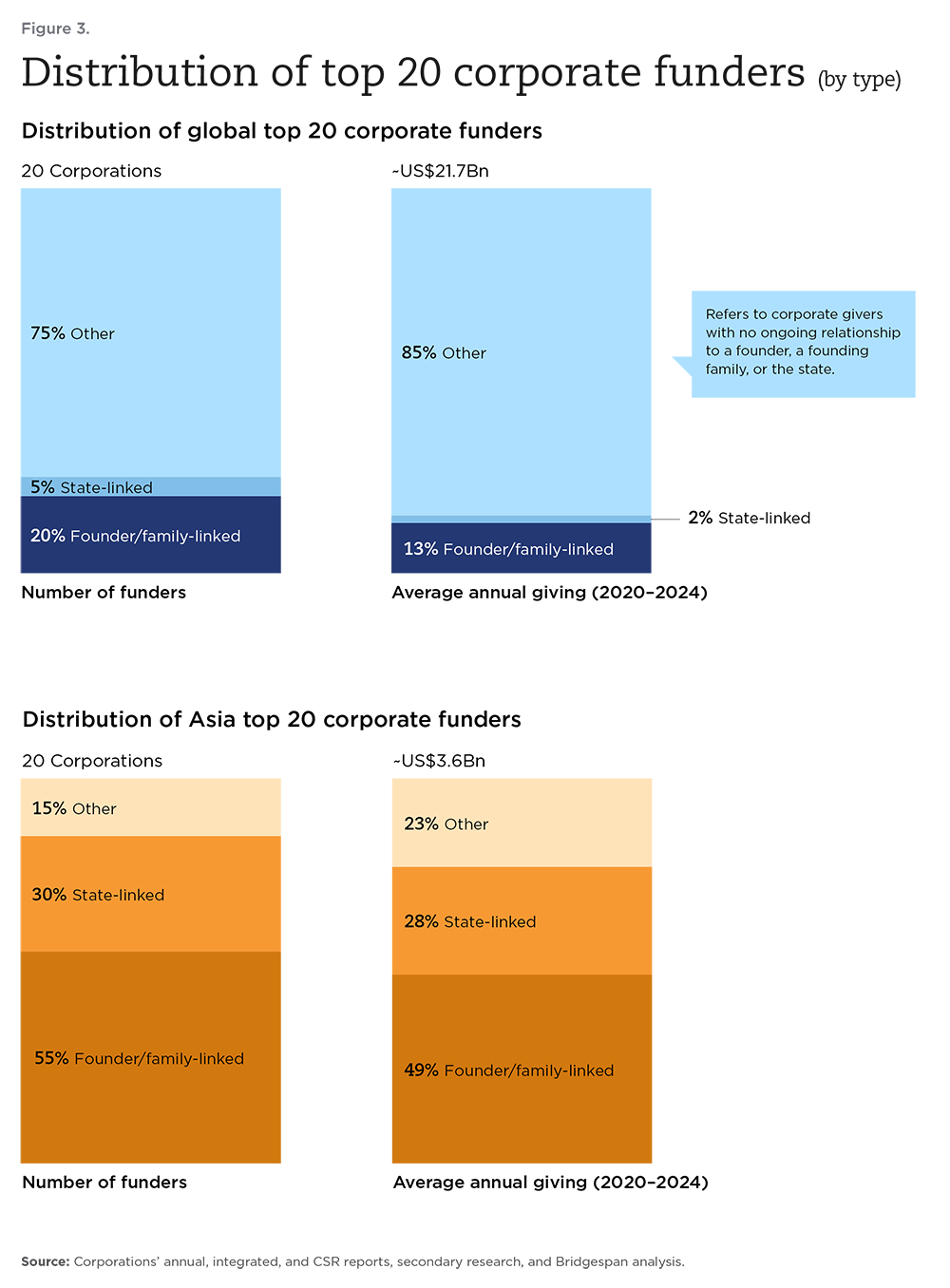
Globally, founder- or family-linked corporations represent 20 percent of the largest funders but contribute 13 percent of annual giving. In Asia, the dynamic is different. Founder- or family-linked companies account for 55 percent of the 20 largest corporate funders in Asia and 49 percent of total giving. We highlight these and other key characteristics of global and Asian corporate giving in the charts below.
As social and environmental challenges continue to grow in scale and complexity, the practices of the world’s largest corporate funders provide examples of high-impact corporate giving that others can follow to create meaningful and enduring change.
In Asia, corporate decisions about philanthropy strongly intersect with family ownership, as many founders or second-generation owners continue to manage enterprises that generated their wealth. The prominence of families reflects the significant overlap amongst business, family, and philanthropy in many Asian economies, a pattern that differs markedly from that in the United States and Europe. To learn more about family-controlled giving globally, a new Bridgespan report examines what makes family philanthropy distinctive and provides examples of three approaches that families are well positioned to pursue to achieve meaningful impact.
Methodology | Corporate funders
For the 20 largest corporate givers lists, we researched giving from all types of companies, including publicly listed and private companies; founder- or family-linked and state-linked companies; enterprise foundation-owned companies; and conglomerates. For the Asia list, only corporations with global headquarters in the geographic region of Asia (including the Middle East) were considered.
To build the 20 largest lists, we examined over 300 of the world’s largest companies by market capitalisation and profitability across various industries. In corporate giving, scale matters because annual spending is typically constrained by a company’s profits.
We obtained annual giving information for each company from 2020 to 2024, relying on publicly available data from annual or sustainability reports, plus documents submitted to governments or other disclosures. We excluded employee or customer contributions, impact investments, the provision of discounted products, contributions that cannot be monetised, and internal sustainability efforts, such as operational decarbonisation initiatives, supply chain improvements, or employee well-being programmes. Whilst important, these efforts are either challenging to quantify or primarily aimed at mitigating business risks or enhancing long-term competitiveness, rather than constituting external philanthropic or community-driven contributions.
We ranked companies based on average annual giving over the five-year period. Corporate givers that do not publicly report their giving were excluded.
For conglomerates, we aggregated giving across all companies within the group for which data were available. For companies which give through one or more affiliated foundations, we included foundation giving as part of the company’s overall giving, while ensuring that the giving was not double-counted. For companies with incomplete data, we assumed their giving was zero in years in which data were unavailable and took an average over five years.
We did not include institutional philanthropy unrelated to a business enterprise. We also excluded giving by enterprise foundations that own major enterprises, such as Novo Nordisk, IKEA, and Lego, which have indicated that their foundations operate at arm’s length from their companies. These enterprise foundations have unique operating models that combine company ownership with social purpose.
After identifying a shortlist of the largest corporate givers, we reached out to each to confirm their annual giving information. Not all replied. We are grateful to those which did and shared publicly available information to confirm and/or clarify our numbers. In addition, we reached out to large companies which do not publish data, to request information on their annual giving. These companies declined to share information with us.
The authors are grateful for the indispensable help of Bridgespan partners Jeff Bradach in San Francisco and Pritha Venkatachalam in Singapore.