The largest institutional funders worldwide significantly increased their giving between 2020 and 2024, a period marked by the COVID-19 pandemic, climate and weather disasters, interstate conflicts, and growing demands on governments and civil society.
Additional Resources
"The Largest Corporate Funders Significantly Increase Their Giving"
How the World’s Wealthiest Families Give
High-Impact Family Philanthropy: What Makes Family Giving Distinctive
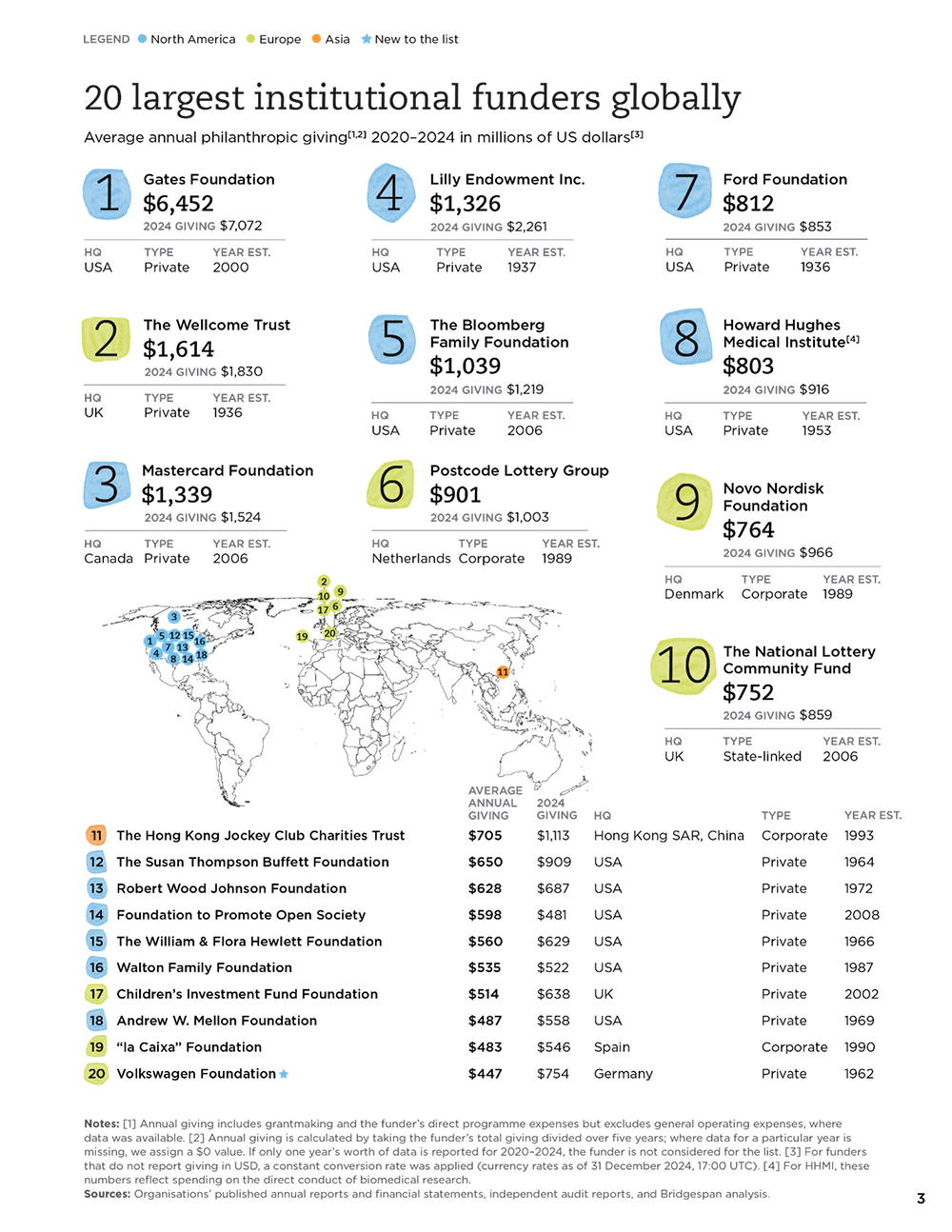
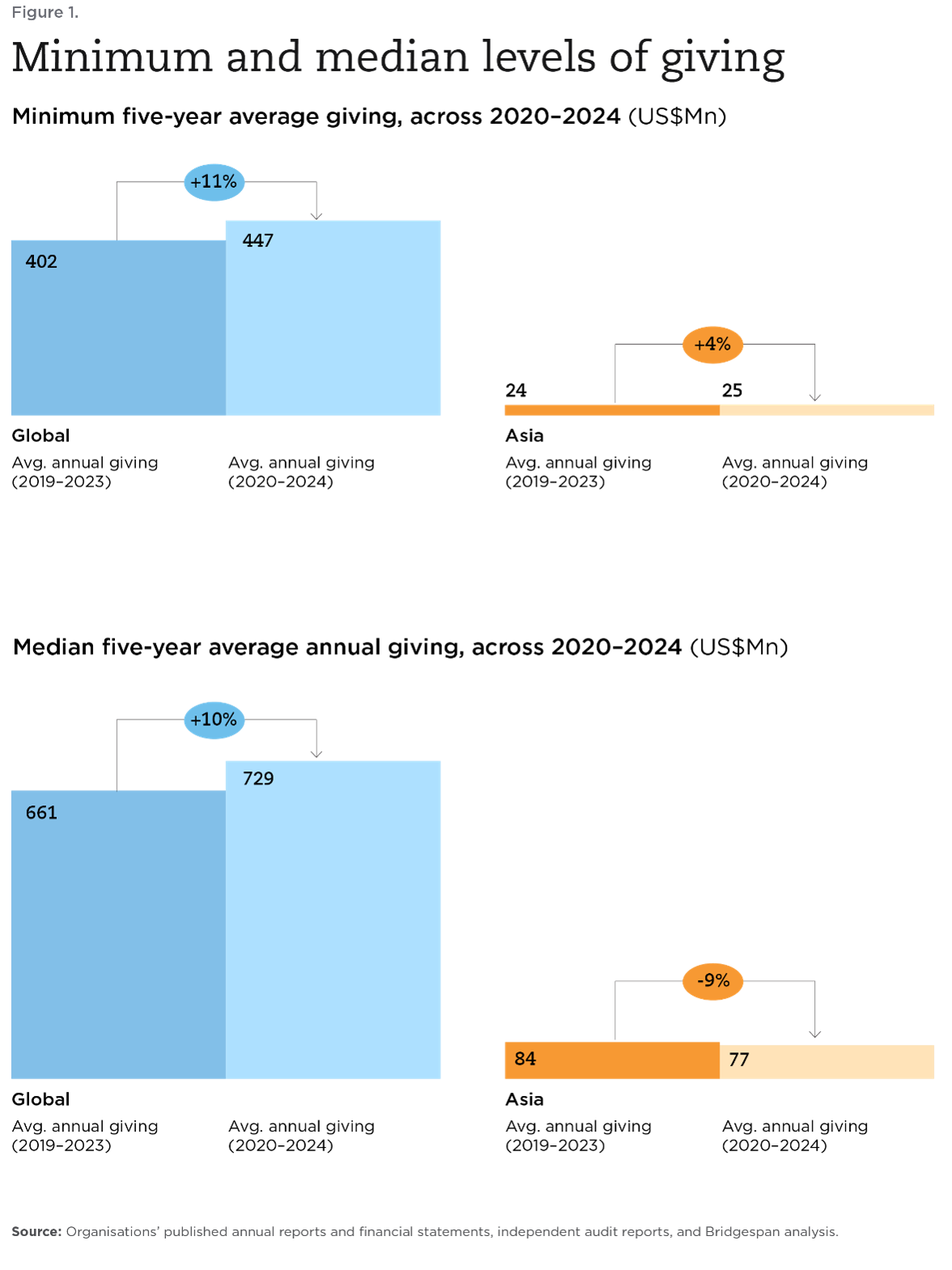
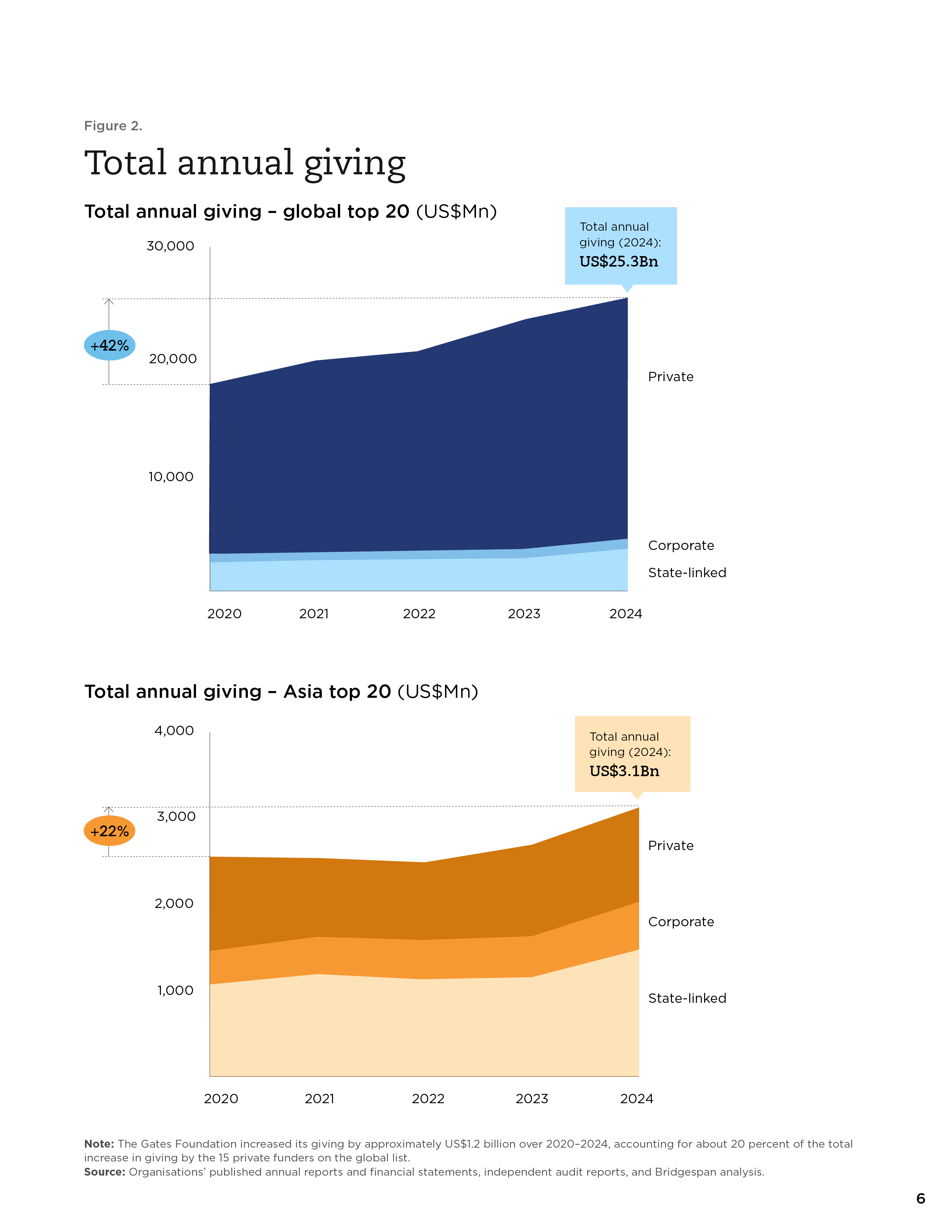
Total annual giving by the 20 largest institutional funders in the world grew 42 percent over the period. In 2024 alone, giving by this group topped US$25 billion. Eighty-five percent stepped up their average annual giving over 2020–2024, compared to 2019–2023, but most of the increase came from a handful of funders. The five largest institutional funders globally accounted for 60 percent of the increase in giving by the 20 largest institutional funders between 2020 and 2024. The Gates Foundation alone accounted for about 20 percent of the increase among the 15 private funders on the global list.
The upward trend reflects the willingness of many of the world’s largest institutional philanthropies to maintain or expand their commitments amid considerable global disruption. At the same time, the aggregate figures mask significant variation across funders, regions, and institutional types, highlighting the diversity of approaches within institutional philanthropy.
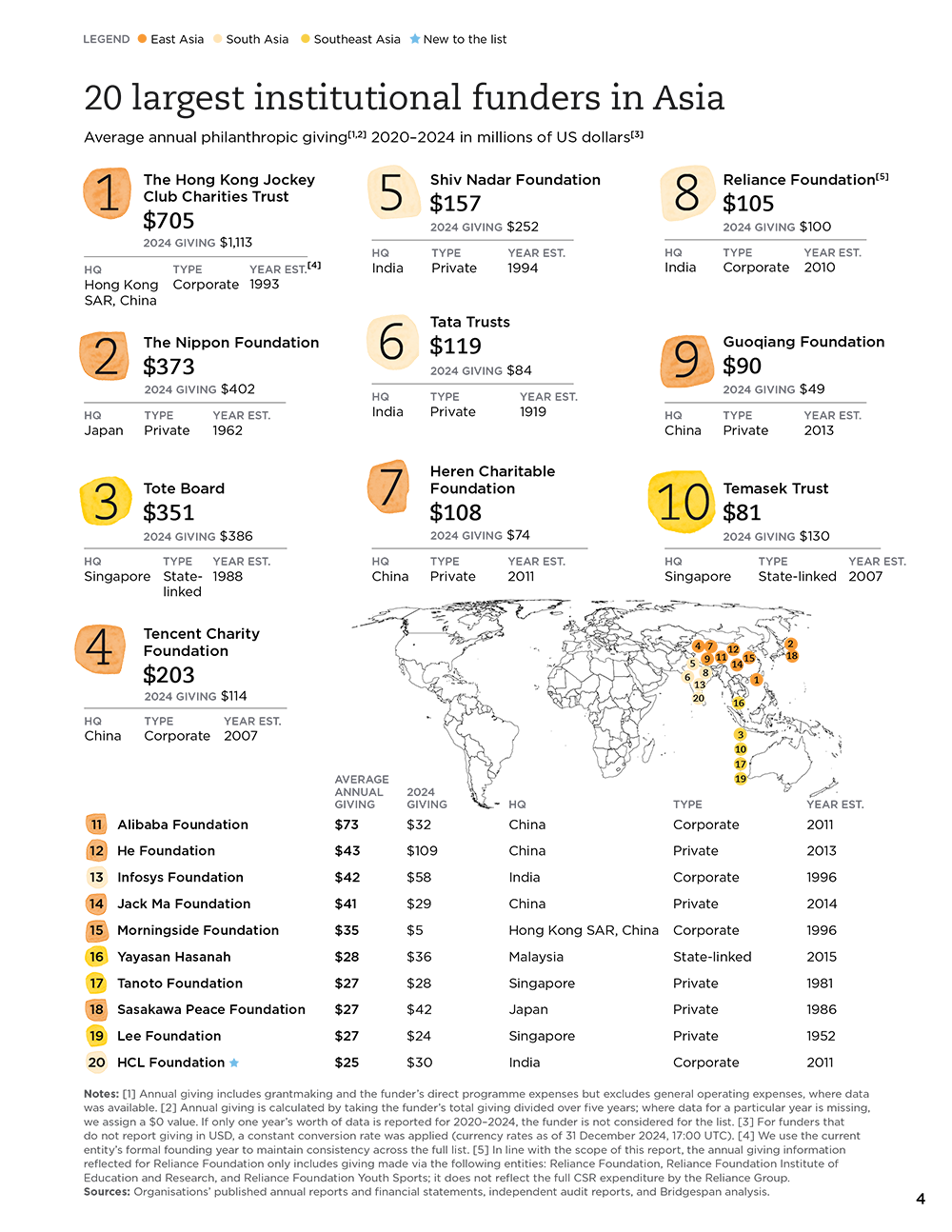
Total annual giving by the 20 largest institutional funders in Asia grew by more than 22 percent between 2020 and 2024, reaching US$3.1 billion. Half of these funders increased their giving, while the other half reduced it. The region has a higher share of corporate and state-linked funders; their giving tends to move with business cycles and policy windows, rather than steady endowment payouts.
These are the key findings of The Bridgespan Group’s third survey of the largest global and Asian institutional funders, supported by our Funders Council: the Institute of Philanthropy, the Gates Foundation, and The Rockefeller Foundation. We define institutional funders as private foundations, corporate foundations, and state-linked entities focused on philanthropic work. They may operate as grantmakers, or design and implement their own programmes. Most do both. Institutional philanthropies that do not publicly report expenditures were not included.
Eleven of the 20 largest institutional funders globally are based in the United States. The Hong Kong Jockey Club Charities Trust, ranked No. 11, is the sole Asian funder on the global list. It is joined on the list of the 20 largest institutional funders in Asia by an additional funder based in Hong Kong and six funders from China. Five funders from India feature on the Asian list, along with four from Singapore.
Both the global and Asian lists had one new entrant. The Volkswagen Foundation, from Germany, and HCL Foundation, from India, entered the global and Asian lists, respectively at No. 20.
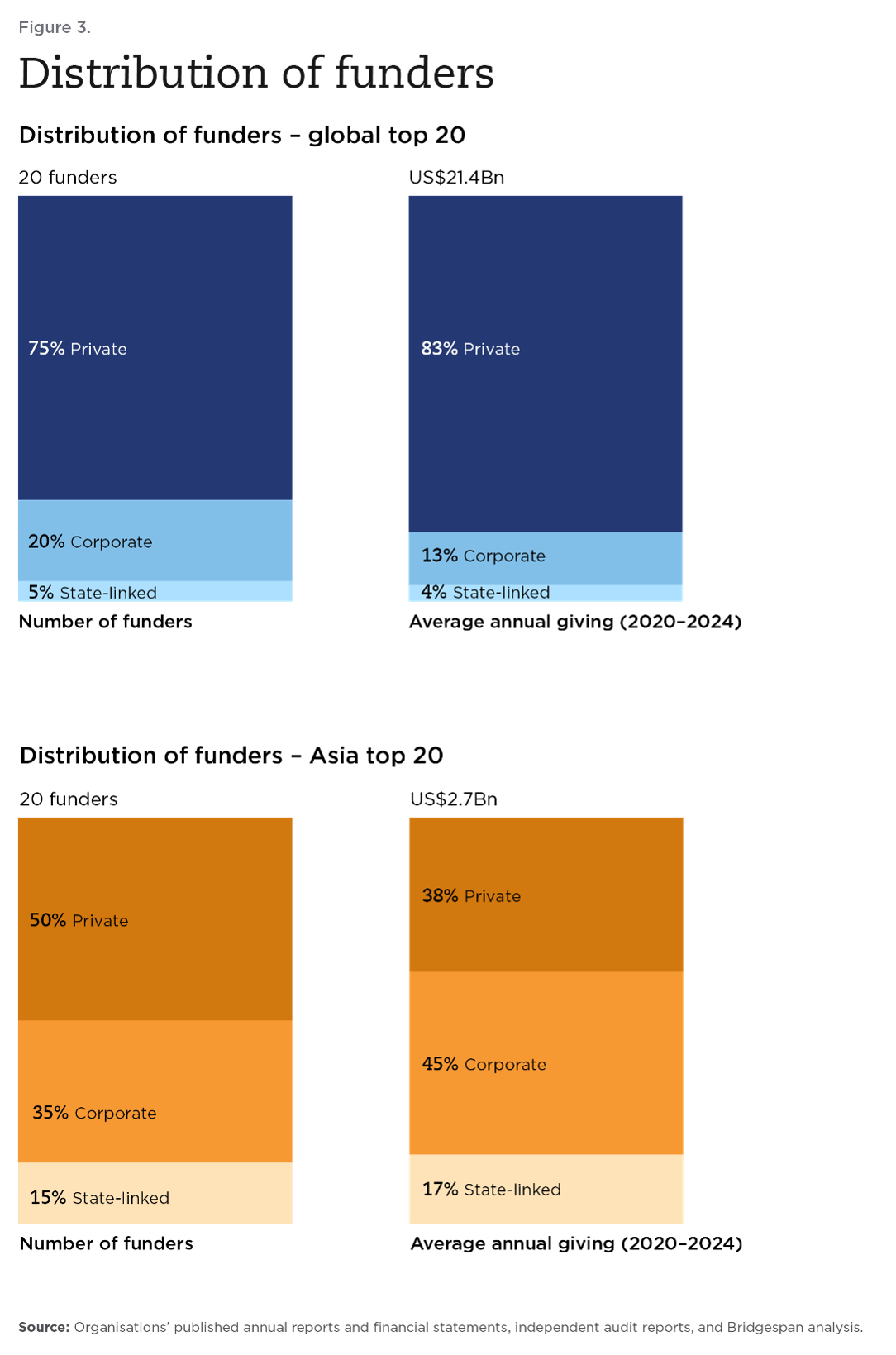
Globally, 75 percent of the 20 largest institutional funders are private foundations. In Asia, the share is 50 percent, with corporate funders (35 percent) and state-linked institutions (15 percent) making up the remainder. We highlight these and other key characteristics of global and Asian institutional philanthropy in the charts below.
As governments, markets, and civil society continue to confront increasingly complex challenges, institutional philanthropies remain an important source of flexible capital capable of supporting long-term social and environmental progress. What sets Asia’s largest institutional funders apart is structural: a heavier presence of corporate and state-linked institutions, and a substantial share of giving tied to family-owned businesses and the wealth that built them.
A Bridgespan report on high-impact family philanthropy takes up that thread, examining what distinguishes family-controlled giving and the approaches families are well-positioned to pursue.
Methodology
We focused on institutional philanthropies that predominantly rely on a single, private source of funds, including contributions from an individual or family, a corporation, charity lotteries, or endowments. This excludes funders reliant on public fundraising, including donor-advised funds and community foundations. We also excluded state-linked institutions which (a) manage foreign aid or official development assistance and (b) are not philanthropy-focused organisations. The global list includes all economies; for Asia, only those within the United Nations-defined geographic region were included.
We determined the 20 largest institutional philanthropies based on the average of their annual giving over a five-year period from 2020 to 2024. For institutions with incomplete data, we assumed their giving was zero for the years which data were unavailable and took an average over five years.
We defined annual giving as charitable expenditures, which include grants disbursed and expenses incurred for programmes operated directly by the institution. We excluded grants awarded or committed but not disbursed, as well as general operating expenses (e.g. administrative costs, depreciation, and all other costs not related to programme implementation). When information was insufficient to determine the purpose of the costs incurred, we excluded those amounts to avoid overestimating organisations’ annual giving.
To the extent possible, we relied on audited annual giving data from publicly available sources, such as annual reports or reports submitted to the government for compliance purposes. In addition, we requested information on annual giving from institutions known for their generosity but that do not publish data. These funders declined to share that information with us. Institutional philanthropies that do not publicly report expenditures were excluded, along with private giving not managed by a foundation and giving facilitated via corporate social responsibility (CSR) programmes.
We recognise that the annual giving reported for institutional funders likely underestimates the total giving from a source of wealth. Individuals, families, and corporations give through multiple avenues, including personal gifts, CSR, and corporate and/or private foundations. However, they may not publicly disclose all of their giving. After identifying the largest funders, we reached out to each to confirm or clarify their annual giving information. Not all institutions replied. We are grateful to those that did and were willing to confirm and/or clarify our numbers.
The authors are grateful for the indispensable help of Bridgespan partners Jeff Bradach in San Francisco and Pritha Venkatachalam in Singapore.