
“Not for the fainthearted.”
That’s how three nonprofit chief operating officers (COOs) who responded to our recent survey characterize their jobs, reflecting the significant challenges that face the second-in-command at many nonprofits. The COO position (which goes by other names, such as operations director or deputy director) is often essential for a nonprofit to run effectively. In our research, many COOs are candid about the role’s complexity—yet they still recommend the position to others and recognize the value they bring to their organizations. “If an organization is a machine,” one respondent writes, “I see myself [as] the oil in the machine. Almost invisible but vital to the efficient running of the system.”
Conversation Starter
To build and sustain a high-functioning COO-CEO team, see “Four Conversations to Strengthen COO-CEO Partnerships.”CEOs and executive directors echo this sentiment. “As a founding CEO, I used to have the idea that I should have capabilities to do everything and do it really well,” says Mark Edwards, CEO and co-founder of Upstream USA, a national organization that works to ensure the full range of contraceptive services is available to patients wherever they go. “I came to understand that wasn’t the path to sustainability.” Now Upstream USA has a COO who oversees programs, strategy, and human resources. “It’s night and day from the way it was before. I have someone who can complement my skills, and I have more time to think about how we’re going to innovate and move forward.”
“As a founding CEO, I used to have the idea that I should have capabilities to do everything and do it really well. I came to understand that wasn’t the path to sustainability.”
What we found is that COOs play three subtle but critical roles beyond their functional responsibilities and that there are a few important ways to help COOs succeed.
The COO’s Functional Responsibilities
While the nonprofit COO role comes in many varieties, our survey found a common set of organizational functions for which most in this position are responsible. As shown in Figure 1 below, over 70 percent name strategy, legal compliance/risk, office management, or human resources as areas they oversee. Board management, fundraising, and communications are each named by less than a third of respondents.
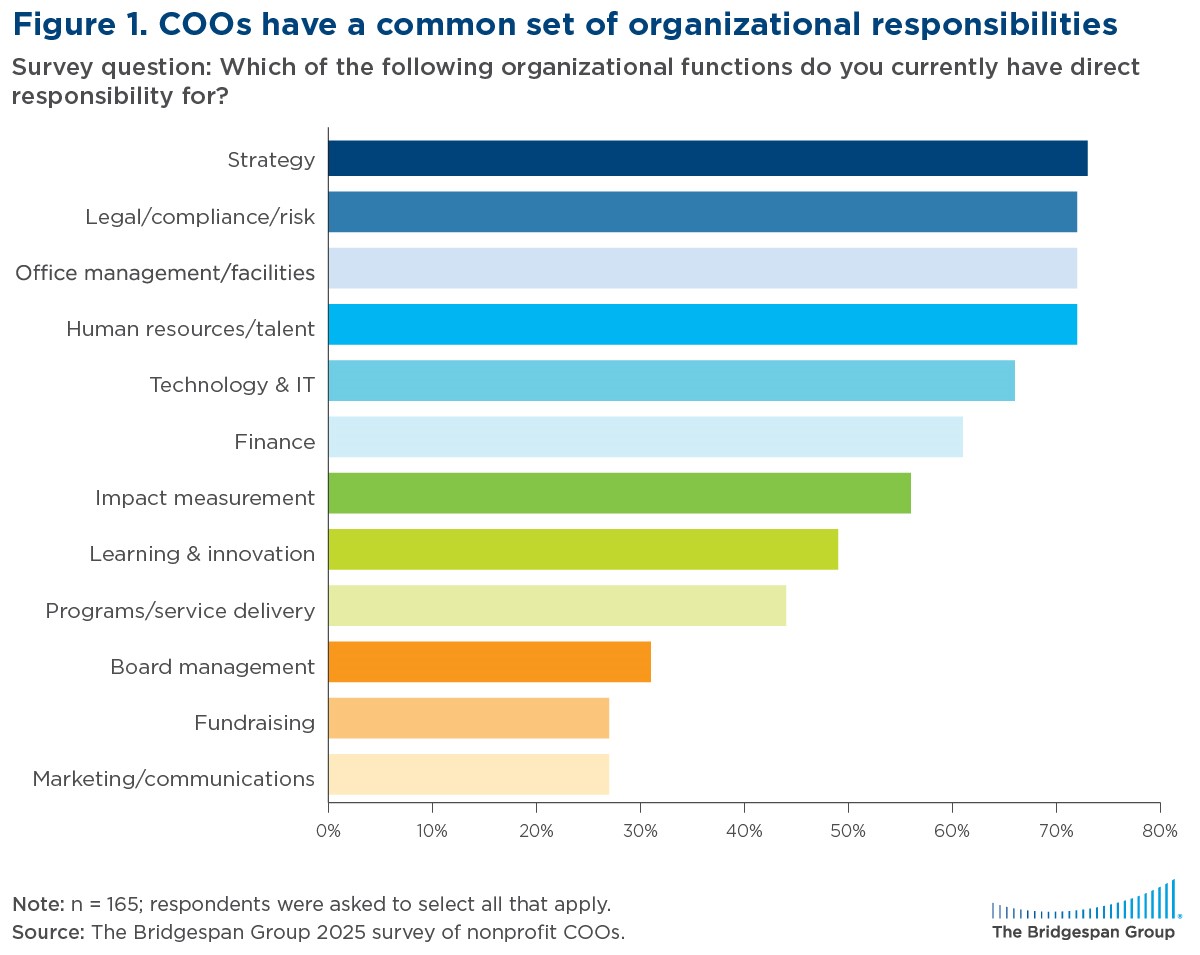
Forty-four percent of respondents oversee programs and services in addition to one or more operational functions. This is the broadest form of the job—in which the COO oversees most staff—and is often meant to free up the CEO to focus primarily on external issues.
The extent to which COOs get into the weeds of the various functions they oversee can depend both on the size of the organization and the skills of those who head those functions. Arthur Mills IV, who has been a COO at two nonprofits, explains, “In my first COO role, I inherited an established team with people who were really good at what they were doing. I could spend more time thinking bigger picture. But in the other job, a smaller, newer nonprofit, I had my hand in almost everything—like figuring out how we moved beyond Excel spreadsheets.”
Who Responded to Our COO Survey?
- Survey respondents are split evenly between having been hired internally and externally into the COO role. Organizations over $10 million in annual revenue are somewhat more likely to hire externally than those under $10 million.
- Forty-six percent of respondents have for-profit career experience, compared to 38 percent who have exclusively worked in the nonprofit sector. Another 16 percent have government experience.
- Thirty-eight percent of respondents have been COO for two years or less; 31 percent for three to five years; and 31 percent for six years or more.
- Sixty-five percent of respondents identify as female; 33 percent as male.
- Eighty-seven percent of respondents are based in the United States. Among them, 58 percent identify as white (non-Hispanic), 12 percent as Black/African American, 8 percent as Asian/Asian American, and 7 percent as Hispanic/Latino. (The gender and race/ethnicity of US-based COOs responding to our survey are generally similar to the demographics of senior nonprofit staff reported by Candid in its 2024 report The State of Diversity in the US Nonprofit Sector.)
The Invisible Roles That COOs Play
Beyond the functions they oversee, many nonprofit COOs play outsized roles in managing their organizations’ overall health and functioning. They help create the conditions for organizations to carry out their strategy and achieve their goals. This aspect of the COO job typically involves three main roles: first responder to urgent issues, copilot and occasional proxy for the CEO, and connector across organizational silos.
First responder
“The COO needs to keep the machine going at very high speed, while also tinkering and tweaking,” says Archana Kannan, COO of Indus Action, which works across India to see that policies designed to transform the social fabric of the country are fully realized. That means the COO often acts as a first responder and chief investigator to tackle operational—or sometimes programmatic—issues, including those that don’t naturally fall under someone else’s purview. Maybe it’s an ad hoc situation that is new to the organization, such as a regulatory change or the possibilities opened up by generative AI. Or maybe something has gone wrong, such as an IT problem or an external event like COVID-19. On average, our survey respondents report that they spend about 25 percent of their time on this first responder role.
“The COO needs to keep the machine going at a very high speed, while also tinkering and tweaking.”
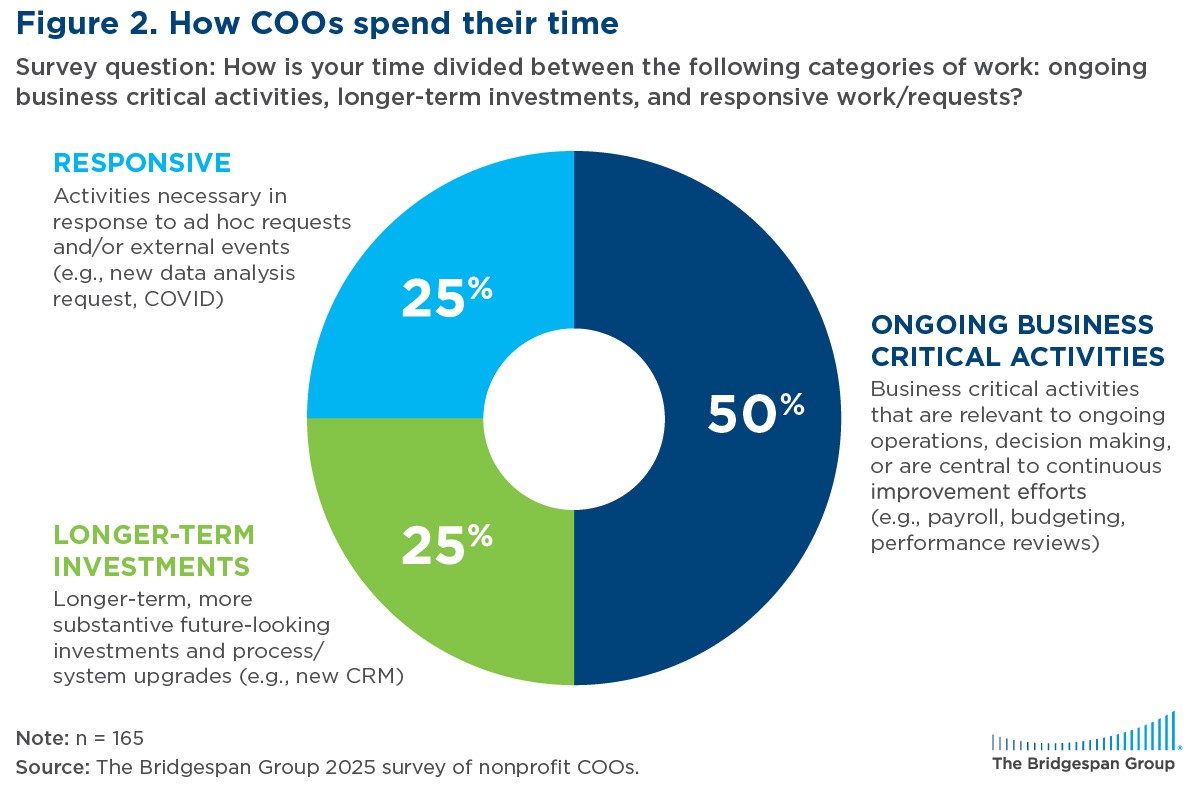
Almost every COO we interviewed talked about how central this work of reacting and responding—whether to funding cuts, major program changes, or what one interviewee describes as the current challenges of “a ridiculously bad software transition”—is to their role.
“You can’t preplan what comes up. It’s a catchall role,” says ST Mayer, COO of The Clean Slate Initiative, which works to pass and implement laws that automatically clear eligible arrest and conviction records and expand who is eligible for record clearance.
That doesn’t mean that the issue has to stay with the COO. A successful COO gets good at learning and delegating. By engaging with an issue enough to understand its nature and implications for the organization, the COO can figure out whether, when, and how it can be assigned effectively to other leaders and staff.
Copilot
“People know Sarah is my final sounding board on everything before we land a decision,” says Drew Furedi, president and chief executive officer at Para Los Niños, referring to Sarah Figueroa-Freeman, the organization’s executive vice president and COO. Para Los Niños serves children, youth, and their families in Los Angeles.
Furedi is speaking to the more nuanced role of the COO acting as a copilot in partnership with the CEO, a role that goes beyond the specific areas of responsibility that other C-suite leaders have. That sometimes takes the form of a sounding board, as Furedi calls it.
“Our CEO is exceptional at fundraising and building awareness. Any time she spends on staffing or resource decisions is time away from doing the things that only she can do.”
At other times, depending on the COO–CEO relationship, the COO is a truth-teller. “You’ve got to be honest about where you see strengths and challenges,” says Lindsay Albright, COO of Episcopal Community Services, whose mission is to reduce intergenerational poverty in Philadelphia. “You need to be able to say, ‘I think there may be a different way to do this.’”
And a COO commonly acts as a proxy for the CEO, a stand-in who can free the CEO to focus on areas where they add the most value. “Our CEO is exceptional at fundraising and building awareness,” explains Clean Slate Initiative COO Mayer. “Any time she spends on staffing or resource decisions is time away from doing the things that only she can do.”
Based on what we heard in interviews with both COOs and CEOs, we found that while each COO–CEO relationship is unique, the most successful relationships have three common elements: the CEO delegates real authority to the COO; the COO and CEO work with staff and other stakeholders with a single voice; and the COO and CEO trust each other and check in regularly to work through challenges and opportunities together.
It’s important that people in an organization understand who is responsible for what. Edwards, the CEO of Upstream, explains that his organization’s COO “has real lines of accountability where she is making decisions independently of me. We try to make that as clear as possible, since there are other areas where I fully own the decisions.”
“Every relationship is important, but if that CEO–COO relationship is broken, it will infect every other relationship,” says Albright, who counts herself fortunate to have had strong working relationships with both the CEOs she has served under.
“Every relationship is important, but if that CEO–COO relationship is broken, it will infect every other relationship.”
Happily, 86 percent of our survey respondents report that their organization’s CEO has a high or very high level of trust in them. And, unsurprisingly, those reporting lower levels of trust were more likely to report lower job satisfaction. In interviews, both COOs and CEOs emphasize the work required to maintain the relationship.
COOs emphasize that the fluid nature of the COO role makes it all the more important for the COO and CEO to work together to define the role and redefine it as first-responder responsibilities evolve.
“The two of us have explicit conversations about that,” CEO Furedi explains of his relationship with COO Figueroa-Freeman at Para Los Niños. “‘Is it clear where you can just go ahead? Are we stepping into things that other people in the organization should be doing?’” The need for explicit conversations—and sometimes more frequent check-ins—can be especially important when a new issue comes along, and it may take some time for the CEO and COO to be sure they’re on the same wavelength.
Disagreements are inevitable, and several of the COOs we interviewed explain that they had to work out differences with their bosses about a significant decision. This kind of conflict can be healthy for an organization—it surfaces issues and options. “Within the executive team, the best way to address a problem is by putting everything on the table and not necessarily being afraid of some tension,” says Albright.
But once a decision is made, COOs and CEOs need to work in unison. “I cannot think of a time when the CEO and I have been externally misaligned,” says Figueroa-Freeman. “We make a decision and then we stand unified by it.”
For more on successful CEO–COO teams, see “Four Conversations That Strengthen CEO–COO Relationships.”
Connector
“[COO Figueroa-Freeman] has interactions with everybody. So, I rely on her a lot when it comes to integrating our strategy and improving how we operate,” says Furedi, CEO of Para Los Niños. While other leadership positions are naturally more focused on their specific functions, COOs are uniquely positioned to connect the dots across issues and organizational silos. Sitting at the intersection of strategy, operations, and sometimes programs, they see patterns, linkages, and gaps—and opportunities to help the organization operate more coherently.
“In the same way you invest in the CEO relationship, you invest in the peers you work most closely with.”
In instances where coordination across departments and/or programs is a key organizational priority, the COO is often the obvious leader of that work. “Our CEO wants to better integrate our work across programs. This is very high on his agenda now,” says Joe St. John, who has been COO at Koreatown Youth + Community Center in Los Angeles since 2007. St. John, who oversees both operations and programs, explains, “And I have a lot of responsibility for figuring out how we achieve that integration.”
“It’s very easy to get into the ‘I’m making decisions solo’ headspace. But I learned the hard way that being an effective COO is rooted in relationships and bringing people along in the decision making, especially if they are impacted by the decision.”
Much of the COO’s time will be spent working with other members of the leadership team, both those who are direct reports and those with whom they have collegial or dotted-line relationships. “In the same way you invest in the CEO relationship,” explains Albright of Episcopal Community Services, “you invest in the peers you work most closely with. And since things can change and relationships can erode over time, you need to keep investing in them.”
Being successful in the connector role requires a talent for relationships and for helping people in the organization get comfortable with the decisions that result. “It’s very easy to get into the ‘I’m making decisions solo’ headspace,” says Figueroa-Freeman. “But I learned the hard way that being an effective COO is rooted in relationships and bringing people along in the decision making, especially if they are impacted by the decision.”
Like many of the COOs we interviewed, Figueroa-Freeman underlines the importance of communicating across the organization. For example, she maps out which people and programs will be affected by a decision, which helps her know whom to engage along the way. “If you fail to take the organization’s culture into account and you try to impose decisions on people without bringing them into the loop, it results in people feeling excluded and decisions not sticking.”
Within the leadership team, the work of the COO to connect the dots may not always be welcome. One COO of a growing organization recalls that as the leadership team grew, “new members had the experience of struggling to break into the COO/CEO show. We didn’t plan in advance how to solve for that. It took time for them to build relationships with the CEO. And some of them wanted to know why I was looking over their shoulder and following up on their business?”
One context in which the connector role can be especially tricky is when the COO position is new. “The transition from not having a COO to having one can be very difficult,” says Archana Kannan, COO of Indus Action. “When a COO comes in, it can feel like there’s now a layer between the CEO and the rest of the organization. My reports used to report to the CEO and at first, they were grieving the loss of proximity to him.” Kannan worked to build relationships and notes that the leaders who report to her have come to feel more assured about their place in the organization.
“The transition from not having a COO to having one can be very difficult. When a COO comes in, it can feel like there’s now a layer between the CEO and the rest of the organization.”
Helping COOs Succeed
As challenging as the nonprofit COO job is, it doesn’t seem that current COOs are rushing for the exits. We asked survey respondents if they see themselves still being COO of their organizations in two years, and a substantial majority (59 percent) say that they would likely or would definitely still be in the position. Only 19 percent indicate that they would not be in the job, while the remainder are unsure of their aspirations. (By way of comparison, a 2015 survey we conducted revealed that one-third of C-suite leaders said that they intended to leave their organizations in the next two years.)
Are COOs sticking around to be nominated as the next CEO? Not necessarily. In our survey, 39 percent of COOs see themselves as future nonprofit CEOs or executive directors—roughly the same percentage as those who do not envision that career path. Those without CEO aspirations spend a little less time with external responsibilities than other COOs. But otherwise, their roles are similar.
That extra visibility externally could be important for those aspiring to the top spot. One concern that some COOs name is that much of their work is unsung and somewhat invisible. “It feels like a side-of-desk job without firm support and commitment at various levels of the organization,” writes one survey respondent.
Survey respondents and interviewees are clear that CEOs and often boards have a vital role to play in supporting their COOs and helping them succeed. Mark Edwards explains that when Upstream USA created and hired a new COO, “The board established our number one goal for the year was to set her up for success.”
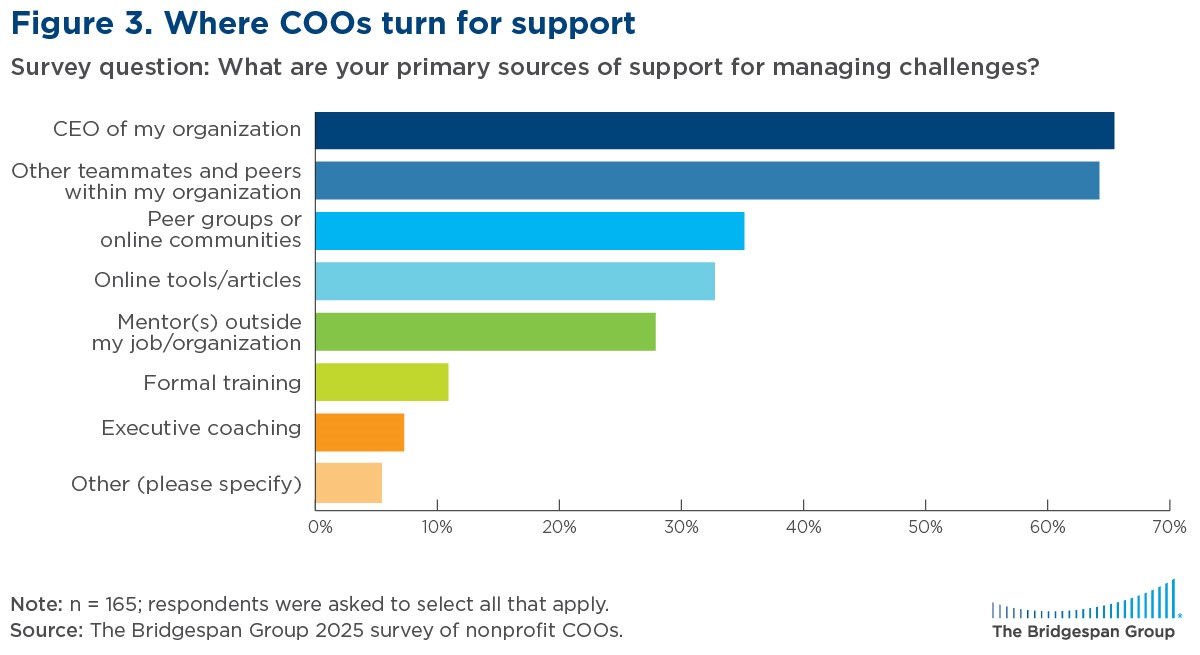
In our survey, we asked COOs about the primary supports they rely on when facing challenges. Nearly two-thirds cite the CEO or other teammates. (See Figure 3.) Other supports mentioned by at least one-quarter of respondents are COO peer groups, articles and online resources, and mentors. Several of the COOs we interviewed stress that their unique position in the organization means that they have no true peers—so they find it especially helpful to be able to discuss challenges and get ideas from COOs of other nonprofits.
As one COO who isn’t part of a COO peer group tells us, “In this environment, I’m really missing that kind of sounding board where I can share information and ask—what are you hearing? What are you preparing for?”
***
First responders, copilots, connectors. The roles adapt as circumstances change, and inevitably, circumstances will change. “The COO role has always been whatever it needs to be to meet current organizational needs,” says St. John of Koreatown Youth + Community Center. “As people with different strengths come and go from director positions, I always need to focus my attention on whichever areas need the most help at that moment.”
COOs aren’t fainthearted. Neither are they superheroes. But with support from their CEOs and peers, they can thrive in their multifaceted roles and unlock potential for their organizations. As one survey respondent puts it, “I love what I do and feel it is what keeps an organization working at its optimum.”
For guidance on creating and hiring a COO position, see: