
In the arid expanses of Morocco’s Drâa-Tafilalet region, salt once defined prosperity. For centuries, the region’s fortunes rose and fell with the trans-Saharan salt trade – the “white gold” that connected Africa’s interior to the Mediterranean. Today, that same landscape is generating a new kind of wealth.
The Noor Ouarzazate Solar Complex, one of the world’s largest concentrated solar power plants, captures the sun’s intensity with parabolic mirrors that heat molten salt to over 500°C. That stored heat powers turbines long after sunset, delivering clean energy to more than a million people. Noor Ouarzazate is more than an engineering triumph; it is a symbol of a larger transformation underway across Africa: a shift from extractive, resource-based economies to regenerative prosperity.
Africa has a substantial gap in access to energy (see “A Snapshot of the Energy Landscape in Africa”). There is an opportunity right now to close that gap—while simultaneously creating jobs, strengthening resilience, and ensuring that communities reliant on fossil-fuel industries are not left behind. That kind of win-win scenario would constitute a “just transition” to renewable energy.
Such a transformation matters far beyond Africa’s borders. The continent is home to 16 of the world’s 20 fastest-growing national populations and will drive a significant share of global energy demand in the decades to come. How that demand is met will shape development trajectories across the continent and climate outcomes globally.
Renewable energy presents one of the most promising pathways to achieve this. Philanthropic capital and impact investments can support the institutions, markets, and communities that will make the just transition happen. Funders can shape those outcomes through targeted investments that catalyse private capital in five distinct ways. Early initiatives signal how these investments can unfold across Africa’s different regions.
A Snapshot of the Energy Landscape in Africa
Nearly 600 million people in Africa – about 43 percent of the population – still live without electricity. Meanwhile, the continent added only around 6.5 gigawatts of new renewable capacity in 2024, one-third of what India added that year. With demand steadily rising, investment simply isn’t keeping pace: sub-Saharan Africa received only about 3 percent of global climate finance in 2011-22. Climate finance across the continent totals about $43.7 billion a year, against needs of roughly $190 billion.How Funders Can Catalyse Progress
Philanthropy alone cannot close Africa’s climate financing gap. But it can take early risks, help clear bottlenecks, unlock larger pools of capital, strengthen enabling ecosystems, and help innovators move from pilot to scale on renewable energy. This includes supporting both centralised and decentralised energy solutions, each of which plays a critical role as the continent transitions. Importantly, funders can contribute far more than capital: they can use their technical expertise, networks, convening power, and organisational capabilities to accelerate progress and support a just transition.
Support African-led policy implementation and market clarity
Policy and regulatory conditions vary widely across the continent. In some markets, clearer targets and stronger frameworks have helped attract early investment. Yet even where policy direction is improving, slow permitting, unclear tariffs, and overlapping responsibilities across agencies can delay projects and raise costs. In many countries, the dominant role of state utilities, evolving regulatory frameworks, and periodic institutional restructuring add uncertainty that complicates long-term project planning. Even in markets with strong renewable potential, investors hesitate when rules are unclear, responsibilities are fragmented, or regulatory decisions are slow.
Funders can help governments create clearer, more predictable rules that attract investment. Supporting African organisations can strengthen permitting processes, planning tools, grid-connection processes, and market structures for both centralised and decentralised systems, making renewable projects easier to build and finance. Funders can also lend analytical capabilities, convening power, and strategic support to strengthen planning and coordination across institutions.
Use blended finance to reduce risk and attract more funding
Political and economic uncertainty, currency volatility, and limited market data raise the cost of capital. Across many African markets, risks reflect a mix of real structural challenges and perceived uncertainties that are harder to quantify or insure against due to limited long-term data, small project scale, and high currency volatility. These dynamics inflate risk premia for financing even well-designed projects.
Renewable energy projects often require affordable, long-term financing. With some exceptions, such as South Africa, African countries have structurally smaller banking sectors, with shorter loan maturities and limited experience in financing renewable energy projects. In markets such as West Africa, weak utility balance sheets raise risk for local lenders, limiting available capital in already resource-constrained environments. As a result, developers often struggle to secure financing on terms that match the needs of the project, such as for off-grid and community solutions that require early-stage, flexible financing.
Blended-finance initiatives use funders’ commitments of early-stage and often concessional capital to reduce perceived risks and encourage private investors to participate. These financing structures could help scale off-grid and distributed renewable energy solutions in markets that commercial investors often overlook. For example, guarantees or results-based financing could attract private investment in mini-grid deployment or pay-as-you-go solar energy systems in low-income or remote communities, where demand risk and high upfront costs would otherwise deter purely commercial financing.
Build local capabilities to deliver projects
Skilled people and strong institutions are essential. Funders can support training programmes for engineers, project developers, grid operators, and community energy leaders, and contribute technical expertise or in-kind support through partnerships and corporate skill-sharing initiatives to ensure projects are well designed, locally led, and sustainable.
Africa’s Renewable Energy Pathways
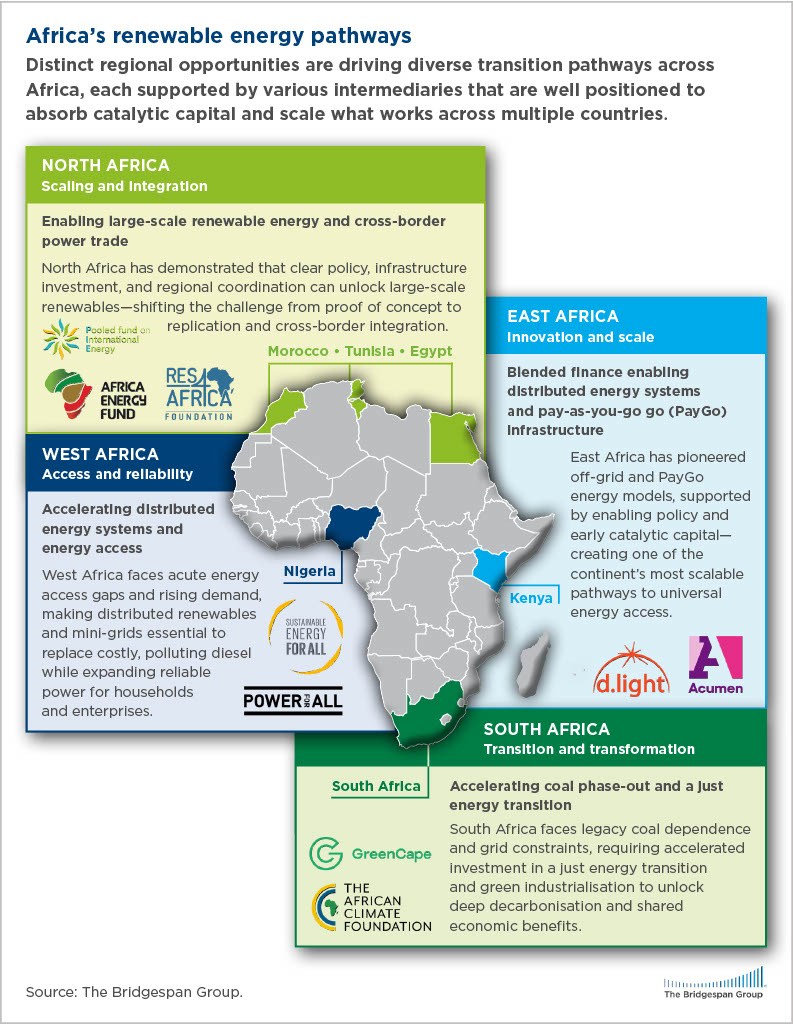
Click the image to download.
Organisations in Africa that are well positioned to help scale renewable energy opportunities across the continent.
Work through trusted African intermediaries
Local regrantors, community trusts, and blended-finance intermediaries often have the deepest understanding of local conditions and where capital may have the greatest impact. Partnering with these institutions increases transparency, deepens community ownership, and ensures benefits reach the people they are intended to serve. These partnerships can extend beyond funding to include capacity-building, technical support, and platforms that amplify community voice and participation.
Regional Spotlights: Where Funders Can Drive the Greatest Impact
A growing set of actors are already demonstrating how philanthropy and impact-oriented investments can accelerate a just energy transition through grants, blended finance, equity, and first-loss capital. Institutions such as The Rockefeller Foundation, Children’s Investment Fund Foundation, and Mulago Foundation are reducing risk and mobilising more capital behind them. The way the story is unfolding varies regionally.
North Africa: Scaling Proven Models
North Africa has shown what is possible when clear policy direction and infrastructure investment align. Governments in Morocco, Egypt, and Tunisia have made clear commitments to large-scale renewables, supported by state policies and infrastructure. The region’s challenge is no longer proof of concept; it’s taking what works and replicating it across borders.
What a sampling of organisations are doing:
- Res4Med/Res4Africa works with governments and industry to improve policy, regulation, and technical capacity. Programmes in Morocco and Egypt help design clearer market rules and train the local engineers and grid operators who keep renewable energy systems running.
- African Energy Efficiency Fund, supported by regional financial institutions, provides technical expertise and early-stage capital for renewable projects, enabling them to move from concept to construction. This support reduces risk in project development and helps developers overcome hurdles that can stall project pipelines.
- The Pooled Fund on International Energy (PIE) is a philanthropic collaborative working to advance a just energy transition and address cross-border energy challenges. Through initiatives such as TeraMed across North Africa, the Middle East, and Europe, PIE coordinates partners working on renewable energy exports to Europe, green industrialisation, and shared infrastructure planning.
By supporting the expansion of large-scale solar, cross-border energy cooperation, and institutions that guide market reform, funders can demonstrate how coordinated policy and investment unlock broader deployment.
West and Central Africa: Unlocking Local Markets
West and Central Africa – especially Nigeria – sit at the centre of the continent’s toughest energy-access challenges. Long-term grid expansion is vital, but millions of homes and businesses need reliable power today. With around 83 million Nigerians – about 43 percent of the population – lacking dependable electricity, and many relying on costly, polluting diesel generators, decentralised renewable energy systems have become critical. The region is navigating a dual challenge: rapidly expanding access while transitioning economies away from fossil fuel dependence.
What a sampling of organisations are doing:
- Sustainable Energy for All works with governments to develop and strengthen policies and create data-driven pathways that make it easier for developing countries to pursue energy access, transition, and development goals with clean energy solutions. Its work aims to ensure energy systems are built around the needs of communities, not the constraints of the grid.
- Power for All takes a systems-change approach by conducting research, running campaigns, and building cross-sector coalitions that elevate distributed renewables as a fast and cost-effective way to expand access. Its efforts help address the barriers that keep off-grid solutions from scaling.
These organisations help unlock local energy markets by strengthening policy and planning frameworks, improving market visibility, and elevating distributed renewables as a credible pathway to energy access. Funders have a meaningful opportunity to help expand energy access by supporting scalable off-grid and mini-grid models, enabling inclusive financing mechanisms – such as pay-as-you-go energy providers – and strengthening local manufacturing and installation capacity.
East Africa: Pioneering Off-Grid Innovation
East Africa has become one of the most dynamic renewable energy markets. Kenya, Tanzania, and Ethiopia benefit from clear regulations, strong donor engagement, and early private investment – a combination that has turned the region into a proving ground for innovative distributed energy models. East Africa has distinguished itself by attracting early capital and by building the policy environment needed for these models to scale.
What a sampling of organisations are doing:
- d.light has brought affordable solar solutions and energy-efficient appliances to millions of low-income households. It shows that when products are reliable and financing is accessible, clean energy adoption can quickly grow.
- Acumen is helping expand the distributed energy ecosystem by providing capital to early-stage enterprises. Through recent efforts to mobilise nearly $250 million for clean energy access in Africa, Acumen blends concessional capital with commercial investment, absorbing early-stage risk, strengthening balance sheets, and crowding in private capital to scale off-grid solutions.
- Funders can help off-grid and mini-grid models reach full scale by investing through blended-finance platforms, such as Renew 2030, supporting policy stability, and backing enterprises that expand access to affordable clean energy across the region.
Philanthropic and impact investments can help expand access by supporting end-user affordability, backing distributed solar and productive-use technologies, and helping enterprises reach scale. The region’s supportive policy landscape continues to fuel innovation. Measures, such as Kenya’s net-metering framework and Tanzania’s mini-grid guidelines, give developers the confidence to invest and scale.
Southern Africa: From Maturity to Transformation
Southern Africa – and South Africa in particular – has one of the continent’s most established renewable energy markets. Yet the region faces a deeper challenge: moving away from coal while supporting workers and local communities, and operating an ageing, overburdened grid that limits the pace of renewable integration.
What a sampling of organisations are doing:
- Infra Impact Investment Managers: Infra Impact’s Local Community Trust Debt Fund provides competitively priced refinancing to community investment vehicles that hold equity stakes in operational renewable energy projects. By replacing high-cost legacy debt with more affordable, community-friendly financing, the fund increases cash flows available for local development initiatives, such as education, healthcare, and economic empowerment, while strengthening accountability and supporting the deployment of community benefits.
- African Climate Foundation (ACF) links African energy and development priorities with global climate action. Operating across multiple regions, ACF brings a continent-wide perspective to its research, technical support, and advocacy to help governments design transition pathways that reduce emissions, mobilise capital for scalable investment, and strengthen long-term economic resilience.
- GreenCape works at the intersection of government, business, and academia to remove barriers to green-economy solutions. Its technical expertise helps accelerate renewable energy deployment, industrial decarbonisation, and market development across South Africa and the broader region.
Funders can help Southern Africa shift from a coal-dependent system to a clean-energy economy by supporting community ownership models and industrial transitions. Adapting proven South African approaches – such as community trust structures, procurement mechanisms, and transition planning tools – for use in neighbouring countries can accelerate a just transition with widespread social and economic benefits.
***
Africa’s renewable transition is both a climate imperative and a development opportunity. To be sure, there are systemic headwinds for renewable energy projects in Africa. For one thing, most power grids on the continent lack the capacity to transmit electricity over the long distances that separate where demand is growing and where grid-scale energy is sited. In several countries, promising electricity generation projects are stalled because of limited grid capacity. What’s more, Africa relies on imported solar panels, turbines, batteries, and other technologies. Import dependence not only increases costs and slows deployment but also limits job creation in manufacturing and industrial benefits.
Still, with the right partnerships, funders can support energy systems that expand access, grow local economies, and reduce emissions. This can deliver meaningful benefits and widespread access while helping to shape a more sustainable and equitable future for the continent and those who call it home.
Africa has demonstrated its ability to leapfrog legacy systems, most famously in mobile banking. Its energy transition holds similar potential. With the right investment and policy environment, the continent can build resilient, low-carbon power systems from the ground up – systems that not only expand access and support growth but also offer models the world can learn from.