
National Domestic Workers Alliance (NDWA) has always been willing to pair technology with the backbone of its strategy: traditional community organizing for domestic workers across the United States. But it approached AI with caution. Given the population it serves, NDWA knew it needed a strong agenda to address harms and create clear guardrails, but it also needed to consider the potential opportunities of AI.
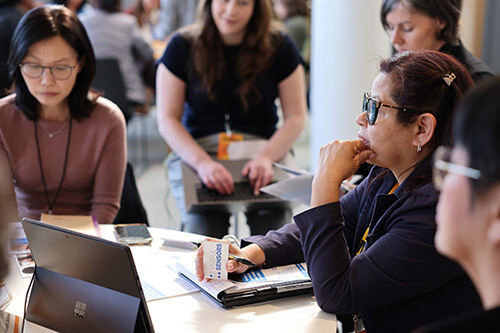 Elza Monteiro (right), an NDWA home care council member and a leader with the Connecticut Workers Center, and Haeyoung Yoon (left), the vice president of policy and advocacy at NDWA, demo innovative technologies in care work during the Care Worker x AI Tour in San Francisco on January 28, 2025. Photo credit: Ting Poo for NDWA In partnership with two consultancies, The Holding Company and IDEO, it took a deep look at its domestic worker constituents’ needs and launched Ask Aya in 2025. The multilingual chatbot helps educate domestic workers on their rights, negotiate pay, and draft job contracts. With data privacy a primary concern, Ask Aya automatically deletes data after a week. Atypical for many AI experiences, it intentionally limits engagement—at certain points, it hands the conversation over to a human.
“It’s helping workers navigate questions around wages and working conditions,” says Alistair Stephenson, NDWA’s chief strategy and impact officer. “It’s even coaching workers through the self-advocacy required to negotiate higher pay. That can be difficult work to scale through traditional organizing alone.”
"Our vision is a dignity-driven AI agenda that goes beyond building tools. We’re focused on making sure workers have power to shape AI, govern its use, bargain over its impact, and ensure the wealth it creates is reinvested in care, dignity, and shared economic security."
Ask Aya is worker-governed from strategic decisions to product design. NDWA has working groups and committees at every level, made up entirely of domestic workers, involved in both planning and design, even down to granular decisions such as designing a logo for Aya depicting a domestic worker wearing a bun in her hair.
“There’s an AI working group at the board level,” says Stephenson. “Our board itself is made up of domestic workers who were elected to those positions. If workers collectively decided tomorrow that they didn’t want us building AI products, we would stop.”
Learn More About Choosing Your AI Path
While many organizations start their AI journey by looking internally, NDWA did not follow that path. “Organizations typically develop policies, governance structures, internal tools, and staff guidance,” says Stephenson. “Eventually, they might build external products. We more or less reversed that process. That has allowed us to learn best practices by doing.”
Some domestic workers remain skeptical of AI. “The AI conversation has become highly polarized and moralized,” he says. “People are rightly cautious. Our vision is a dignity-driven AI agenda that goes beyond building tools. We’re focused on making sure workers have power to shape AI, govern its use, bargain over its impact, and ensure the wealth it creates is reinvested in care, dignity, and shared economic security.”
NDWA’s experience illustrates the nuanced nature of engaging with AI responsibly. It also shows how the three dimensions need not be sequential—how an organization started in Dimension 2 (Advance) and Dimension 3 (Advocate) before looking internally with Dimension 1 (Augment). It also shows what it looks like for a community to take the reins: workers are not simply consulted about an AI product but are governing whether and how it should function. (Anthropic also published a profile of NDWA’s AI use on Claude.com.)
