
Introduction
In 2024, leaders and about a dozen elected worker council members from the National Domestic Workers Alliance (NDWA), which organizes domestic workers in the United States to build power, secure dignity, and win economic and labor justice, traveled to Silicon Valley to better understand how artificial intelligence (AI) might change their field. The group met with representatives from Anthropic and Google, as well as ethicists, scholars, and lawmakers. What they heard was that these emerging systems had the potential to deepen already unequal power dynamics between workers and employers. But they also began to imagine how workers and communities could craft a positive vision for AI to advance their own goals.
“Could this technology, if used responsibly, actually help advance worker power, improve conditions, and support organizing?” asks Alistair Stephenson, chief strategy and impact officer at the NDWA. The alliance’s question reflects the choices facing many nonprofits: Where can AI improve how their organizations work, where can it advance their missions, and how can they help shape how AI is developed and governed? Whether AI could create meaningful opportunities for workers guided the NDWA’s exploration.
“Mission-driven organizations have always been focused on providing quality services to change lives. To continue doing that in a world where AI both makes new things possible and introduces risks, mission-driven organizations must determine the responsible path forward for themselves.”
AI is rapidly reshaping the social sector. It is changing how work is done, how decisions are made, how resources are allocated, and ultimately who benefits. “Mission-driven organizations have always been focused on providing quality services to change lives,” says Afua Bruce, CEO at ANB Advisory Group. “To continue doing that in a world where AI both makes new things possible and introduces risks, mission-driven organizations must determine the responsible path forward for themselves.”
Used well, AI may help organizations reduce administrative burdens, expand access to services, identify patterns in complex information, personalize support, and develop entirely new approaches to advancing impact. Here, we use AI broadly to include generative AI tools (such as ChatGPT and Claude), traditional machine-learning applications, and agentic AI systems that can take actions on a user’s behalf.
AI is also changing the context in which nonprofits operate. Staff are experimenting, funders are asking questions, peer organizations are testing new approaches, and AI is already affecting the communities nonprofits serve. Indeed, for many leaders, AI can feel like something happening to them, a fast-moving force they are expected to understand and adapt to. But its role in the social sector is not predetermined. Its norms, behaviors, and uses are still being formed. So, the social sector has opportunities not only to deploy it responsibly but also to shape its evolution in society in ways that are values-driven and aligned with positive social and environmental outcomes.
Historically, many nonprofits have underinvested in technology infrastructure and staffing, often because of a lack of funding. Those constraints continue to shape how they approach AI today. Leaders are being asked to make consequential choices amid limited staff capacity, insufficient data and technology infrastructure, budget pressures, funder and board expectations, and the needs of communities already facing rapid change. For organizations still building foundational digital capabilities, AI may understandably not be the first or most urgent priority.
Yet resource constraints do not preclude the potential value of AI. If it can reduce time spent on administrative work, under-resourced staff can focus more deeply on relationships, services, and mission. Other applications may enable organizations to reach more people, improve the quality or responsiveness of programs, or pursue impact in new ways.
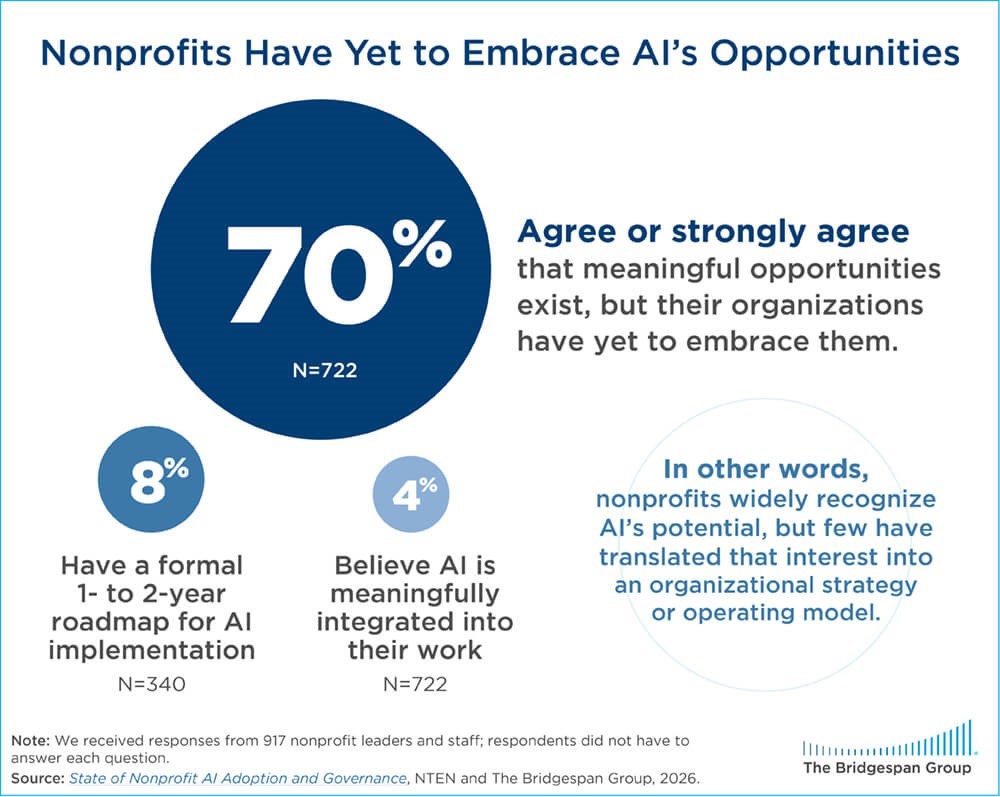
Few organizations are taking advantage right now. For example, in our recent survey, conducted in partnership with Nonprofit Technology Enterprise Network (NTEN), 70 percent of nonprofit leaders and staff globally agree or strongly agree that they are not taking advantage of meaningful opportunities to use AI at their organizations. Only 8 percent report having a formal AI roadmap in place.
To be sure, there are individuals and teams using AI in nonprofits. More than half of the survey respondents report using AI to summarize documents, conduct research, and support administrative and operational tasks. However, organizations have not integrated AI into their operations: only 4 percent of survey respondents indicate that AI is meaningfully embedded in how work is carried out across their organizations.
We also do not want to paint too rosy a picture. AI introduces real risks, including data privacy breaches, adverse environmental impacts, and the potential to amplify bias and reinforce historical inequities. When we zoom out, we can already see how massive AI investments could concentrate benefits among the few who can afford them, how data centers’ environmental impacts are straining communities, and how the digital divide could widen for those without access to electricity and the internet, let alone to these new tools. Choosing not to use AI can be a responsible strategic choice, but choosing to use it should be done responsibly.
These risks also underscore the opportunity for the social sector to take an active role in AI’s future. Social-sector leaders and their boards can help shape the broader AI ecosystem so emerging technologies—and the policies, laws, and regulations that govern them—better reflect the rights, needs, and priorities of the communities they serve. Not every organization will play the same role. But leaders ought to have enough understanding to recognize how external developments affect their missions, staff, and communities, and to determine when partnership, advocacy, or collective action may be warranted.
Starting points will differ. While this article draws on perspectives and examples from multiple geographies, we recognize that the starting point for social-sector leaders varies considerably both within and across regions. These differences reflect institutional context, infrastructure, funding environments, and the respective roles of nonprofits, corporations, and governments. As a result, the conversations leaders have about AI may emphasize different priorities. Depending on the organization and context, leaders may focus on organizational readiness, risk mitigation, and adoption; development priorities and population-level service delivery; strengthening digital public infrastructure; or some combination of these.
For example, in India, many leaders see the future of AI less as a question of individual nonprofit adoption and more as a question of how civil society, government, philanthropy, and technology actors can collaborate around national priorities. Wadhwani AI, for instance, codevelops AI solutions with the government and embeds them into public systems such as education or health care, reaching 190 million people to date. This reflects a starting point of using cross-sector collaboration and shared infrastructure to address large-scale public challenges.
Across these varied contexts, social-sector leaders face several related choices. The framework shared in this article invites them to consider three dimensions: where AI can augment internal capacity, where it can advance mission and impact, and where organizations can advocate when needed for safeguards and accountability. The goal is not to prescribe adoption or imply that every organization must act in the same way. The framework aims to help leaders move beyond broad AI debates, identify their starting points, and make their own choices.
AI Across Three Dimensions: A Framework for Action
AI has the potential to reshape operations, program delivery, and entire fields. Based on our experience helping nonprofits understand how to think more strategically about technology, we see opportunities for nonprofits (and their funders) to engage in AI across three dimensions:
Framework How-To and Other Resources
Download our worksheets to help you apply the framework in a practical way: clarify where AI matters most, determine what choices are needed, and decide what actions to take next.Check out our recent conversation with the Siegel Foundation on lessons about investing in AI for social impact based on its decade of investment in public interest technology.
We also invite you to visit our Social Sector AI Resources page for a broad list of tools and information about effective AI implementation.- Augment: How organizations can use AI to enhance quality, reduce cost, increase speed, optimize decision making, and enable new ways of working
- Advance: How organizations can use AI to advance or reshape their missions—by strengthening, scaling, or creating new services—and respond to changes across their fields
- Advocate: How organizations can influence responsible AI development and adoption through governance, policy, partnerships, research, and engagement with technology builders
Equity considerations are present in all three dimensions. Using AI responsibly includes mitigating the bias that can creep in when AI models are trained on historical data, promoting equitable outcomes across communities, and ensuring that its evolution benefits the public interest. Organizations should consider how AI may disproportionately amplify harms and accelerate gains.
We would not expect organizations to invest equally across all three dimensions. Most will choose one near-term focus based on mission, strategy, capacity, and risk appetite. But leaders should understand all three: where AI could improve internal work, where it could change program or community needs, and their role in shaping broader norms, policies, funding decisions, or market dynamics surrounding it. The goal is to decide where to act now, where to learn, and where to watch. There’s a lot to process.
“It was difficult to talk about using AI to assist with grant writing without the conversation immediately becoming about environmental impacts or data centers,” says Stephenson. “All of those connections are valid, but every conversation became tangled up with every other conversation.”
“It can be overwhelming when big promises of what's possible meet the realities of budget conversations, staffing capacity, funder and board expectations, and community needs,” says Bruce. Organizations could use a practical way to separate what they can use AI for, the benefits and risks involved, the safeguards they need, and who decides how they should proceed.
Starting Points
At a high level, leaders can start by taking inventory of where AI is already affecting their organizations, communities, and fields. From there, they might choose one primary near-term focus. In the following, we outline several conditions that can help an organization determine where to start.
Augment may be the right starting point if:
- Teams are already experimenting with AI or showing interest in using it.
- There is openness to rethinking how work gets done, not just adding tools to existing processes.
- Staff are tied up in repetitive and time-consuming tasks.
Advance may be the right starting point if:
- There is a clear opportunity to significantly improve outcomes, serve more people, or create new AI-enabled programs, services, or supports that would not have been possible before.
- There is a willingness to invest in sustained program or service transformation, not just short-term experimentation.
- AI is changing the needs or priorities of the field in ways that may require the organization to evolve its role, services, or mission.
Advocate may be the right starting point if:
- AI developments raise significant risks or ethical concerns, or create the potential for harm in the field or in the communities served.
- Public-interest or underserved perspectives are missing from AI decision making in the field or in the communities served.
- The organization already plays a broader advocacy, research, or coordination role.
- There is an opportunity to help shape emerging AI standards, policies, or norms.
Choosing Your AI Path
To help leaders apply this framework in full, we have developed accompanying worksheets that guide organizations through taking inventory of where AI is affecting their work and field, choosing a primary near-term focus, and identifying practical next steps. Learn more in “Choosing Your AI Path: Applying the Framework for Nonprofits.”Across each dimension, a small number of high-value, lower-risk actions, each with a point person, is a good place to start. A workforce development organization, for example, might Augment by using AI to help prepare participants for changing entry-level roles; and/or Advocate by pushing employers to use AI hiring tools transparently and fairly. Alternatively, an education organization might Augment how its teachers and staff manage enrollment, scheduling, and family communications; Advance by helping learners build AI literacy and judgment; and/or Advocate for policies that protect students from surveillance, bias, or inequitable access.
Even organizations without dedicated technology or AI budgets can get started. (See “No-Regrets Actions for Organizations with Limited Resources.”)
Dimension 1: Augment
What it means
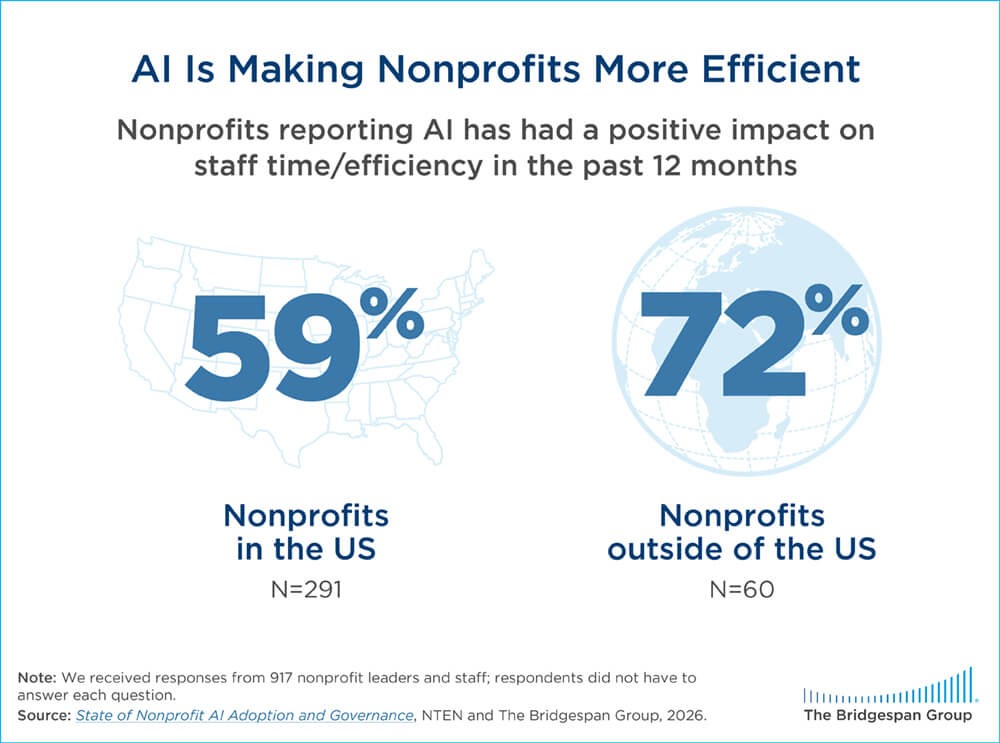
AI tools can improve day-to-day operations, including productivity, knowledge management, decision support, and administrative efficiency. Fifty-nine percent of US-based organizations in our survey report AI’s positive impact on staff time and efficiency. For organizations outside the United States, that number rises to 72 percent. Many Augment uses can begin with commercially available tools, provided organizations establish clear rules for data privacy, sensitive information, human review, and appropriate use.
“Many nonprofit leaders immediately think of the big commercial LLMs [large language models], but that is only one part of the AI landscape,” says Amy Sample Ward, CEO at NTEN. “Depending on the use case, organizations could use off-the-shelf tools with strong guardrails, closed internal models, or purpose-built systems. The important thing is to focus on your goals: meeting your mission and aligning your technical choices and investments to those goals, not the other way around.”
But a lack of clear structure and norms around AI use slows adoption for many nonprofits. Anthropic’s AI Fluency Index suggests that effective AI use depends less on access to tools than on learned habits of collaboration. For small teams already stretched thin, building that fluency can fall to the bottom of an endless to-do list. Our survey research supports this: 34 percent of organizations report a lack of staff capacity or time to learn as a major barrier to AI adoption, and 29 percent name a lack of clear policies, governance, or strategy, both ahead of cost (27 percent).
Organizations using AI strategically are not simply adding tools. They are identifying where AI could create operational value, redesigning the surrounding processes, and implementing responsible use practices. That includes engaging staff and communities, where appropriate, such as in governance; establishing security measures and responsible-use policies; clarifying when human review is required; and selecting tools that align with organizational values. (See the Center for Employment Opportunities and NDWA spotlight stories below for more on these dynamics.)
Field-level examples
Community Rebuilders is a housing and homelessness services nonprofit in the US state of Michigan (with an annual budget of approximately $5 million). It is using AI to free staff time for relationship-based work; for example, it deployed Microsoft 365 Copilot (via TechSoup) across its approximately 60-person team to automate administrative tasks and draft grant applications and communications. Community Rebuilders reports saving more than 15 hours per week in campaign season, time redirected to calling major donors and strategizing with program staff.
HSF (with an annual budget of approximately $70 million) provides a broad range of programs and support services to more than 40,000 students and parents annually across the United States. HSF is using AI to augment how it operates programs and develops technology products. For example, it has built and leveraged AI tools to verify student documents, manage the distribution of more than 100 million emails and text messages every year, and schedule scholar interviews at conferences in minutes rather than hours. HSF uses code-writing AI agents to build prototypes quickly, while software engineers validate the prototypes and add security features and other guardrails.
Akshaya Patra Foundation (with an annual budget of approximately Rs 86,000 lakh or $90 million*) serves daily meals to 2.35 million children in schools and anganwadis (public rural childcare and mother-care centers) across India. The organization uses AI-powered automation to improve its processes for handling attendance and meal-distribution forms, validating data, updating its enterprise systems, and generating compliance reports. A case study from its technology partner reports that the system has automated reporting for 2,509 schools and recovered 4,403 days of staff time annually.
What an AI strategy for organizations prioritizing Augment might include
- A clear way of identifying, defining, and prioritizing use cases
- A basic responsible-use policy or staff guidance
- Clear rules for sensitive data, personally identifiable information, and human review
- Rapid prototyping of tools to streamline administrative tasks
- A process to track efficiency gains or return on investment
- A way to collect staff feedback and identify risks as use expands
Dimension 2: Advance
What it means
Organizations can use AI to pursue their missions, strengthen their programs and services, and potentially create new ones. Augment work focuses on efficiencies. By contrast, Advance work focuses on outcomes: improving quality, expanding reach, improving learning, reducing barriers to access, or creating supports that would not have been feasible before. Because Advance work is often closer to program participants, communities, or high-stakes decisions, it may require custom technologies, including refined implementations of commercial AI tools, closed AI models built on an organization’s internal data, or custom AI systems that reflect the organization’s mission, data environment, and risk tolerance.
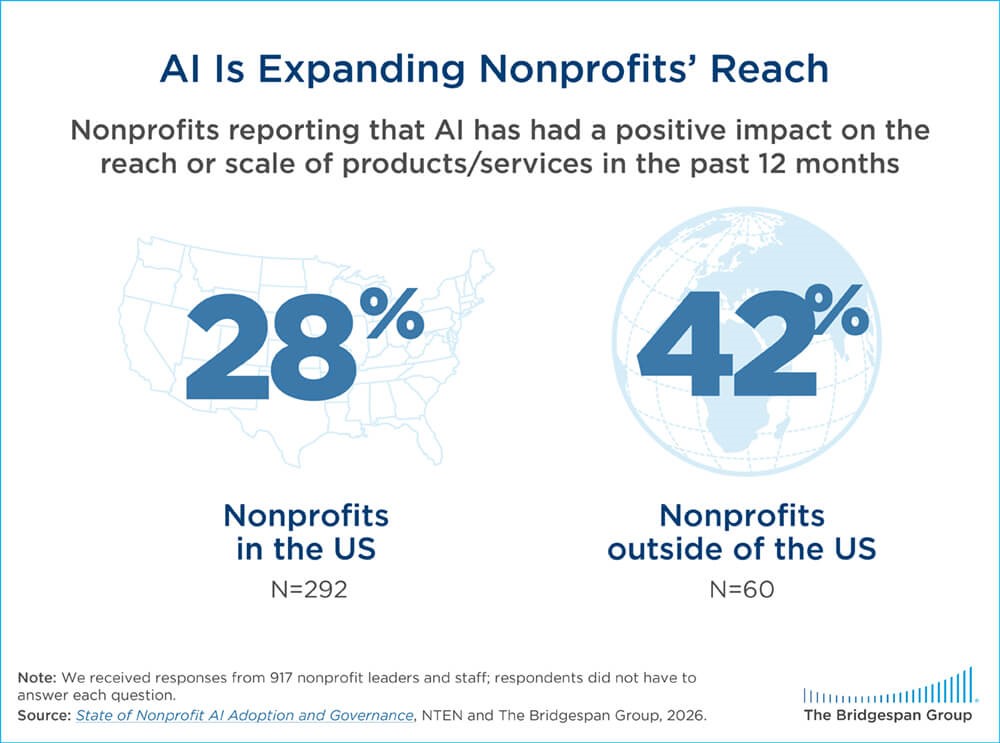
More than a quarter of US-based respondents to our survey already report a positive impact from AI use on the reach or scale of programs and services. For NGOs outside the United States, that number rises to 42 percent. In addition, 43 percent of respondents worldwide expect to see the impact of predictive interventions—machine learning tools that anticipate events and take action before they occur—in the next two years. Imagine, for example, an AI agent that proactively schedules an appointment with a counselor for college students at risk of not completing their degrees.
Advance work often requires upfront and ongoing investment in stronger data readiness and connections to other external data systems, robust technology infrastructure, staff capacity, governance, privacy practices, and meaningful community input. In other words, Advance work tends to incur more capacity-building and strategy investment than Augment work.
Because of that deeper investment, organizations have been selective in where they’ve applied AI. “Our focus is first on what problem we’re trying to solve and identifying the biggest bottlenecks,” says Emilie Chambert, CEO of Living Goods, headquartered in Nairobi, Kenya. “Then we have clear criteria to prioritize those problems, and then we brainstorm internally on potential solutions.” (See the Living Goods spotlight story below for a closer look.)
Field-level examples
International Rescue Committee (IRC) is a global organization (with an annual budget of approximately $1.3 billion) that provides humanitarian services to the world’s 118 million displaced people. It is embedding AI across its services to reduce response times and scale its ability to support refugees.
IRC uses tools including Signpost, an AI platform that answers urgent questions on aid, legal rights, and documentation via WhatsApp, Facebook, and the web in multiple languages; aprendIA, an OpenAI-built educational chatbot for crisis-affected classrooms; and Match, an AI-powered jobs-matching tool for Syrian refugees in Jordan.
IRC aims to keep barriers low and protection high. That includes data minimization, strict data-sharing limits, tools that run on basic phones and common platforms with no app download, and an explicit policy that AI supports caseworkers rather than replacing their judgment.
Mobile Pathways is an immigration nonprofit (with an annual budget of approximately $1 million) helping immigrants to the United States and their advocates navigate the legal system. Its agentic AI Pathfinder platform allows vetted legal aid workers to enter an immigrant’s government-issued identification number to instantly synthesize publicly available government records into a legal history and case snapshot. Always-on AI agents track every case and wider patterns, keeping guidance current. More than 80 percent of users said Pathfinder improved their understanding of cases and their ability to explain status and next steps to clients.
Mobile Pathways has paid close attention to safety and access. Its approach includes cybersecurity testing, expert review, user vetting, feedback mechanisms, and guardrails tailored to whether a user is asking general questions or case-specific ones.
What an AI strategy for organizations prioritizing Advance might include
- A clear problem statement and criteria for deciding whether AI is the right solution
- Ways to collect meaningful community and staff input on the needs of and risks to the community, and what it would take for them to trust AI tools
- A plan for human judgment, consent, privacy, data protection, feedback mechanisms, and escalation in high-stakes contexts
- A path from pilot to sustained operations, including funding, staffing, evaluation, and ownership
Dimension 3: Advocate
What it means
The social sector has an opportunity to shape AI’s future in society. Some organizations have the credibility, evidence, and relationships to shape how AI is developed, governed, funded, and used. Advocate is the dimension for organizations positioned to influence governance, norms, safeguards, accountability, and digital public infrastructure.
The need for that role is clear. A vast majority of leaders in the sector—74 percent of survey respondents—rate the misuse of powerful AI systems as a very urgent issue for civil society to address. Yet only 41 percent of respondents report participating in peer groups or coalitions.
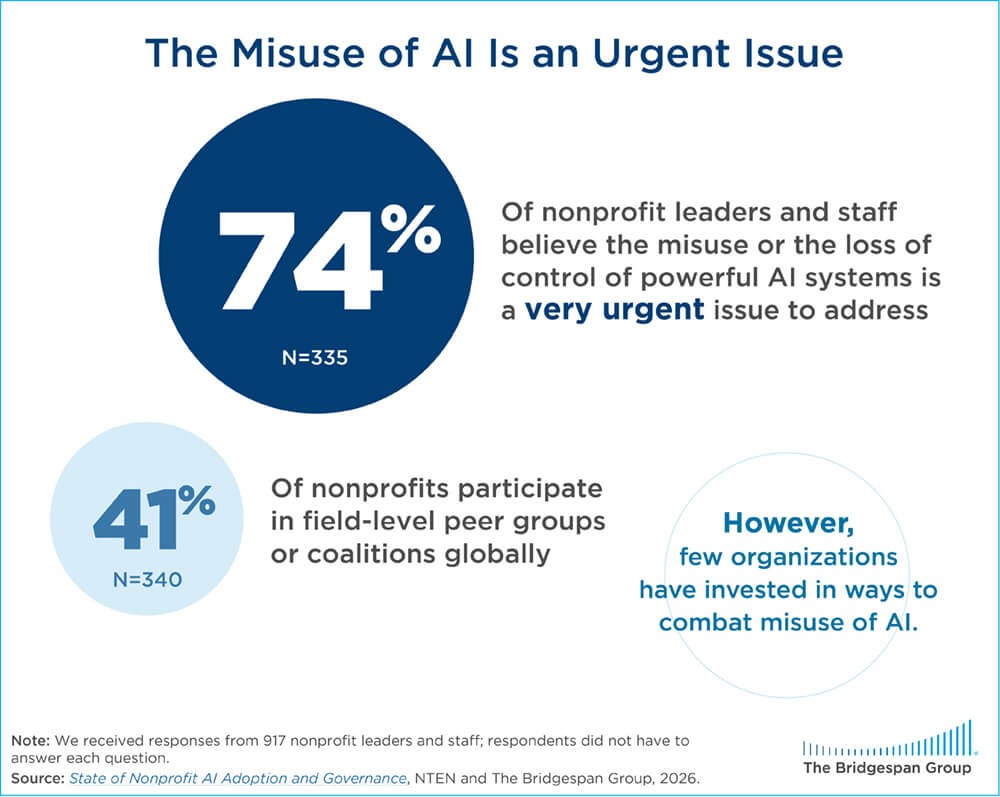
This does not mean every organization should take on an AI advocacy role. But it does suggest that leaders need to understand where AI-related decisions, policies, and norms could affect their missions, communities, or fields, and whether their organizations have roles to play in shaping them.
That role will look different across organizations. For all organizations, Advocate work may begin with staying aware of the AI capabilities, risks, policies, and field shifts that could affect their work or communities. For a smaller subset, Advocate work may mean actively conducting research and shaping policies and regulations, or finding other ways to get involved. (See the NDWA and James Irvine Foundation spotlight stories below for more.)
“By the 2028 election cycle, AI is likely to become a major political issue alongside affordability, foreign policy, and other core concerns,” says Stephenson. “Policymakers will be looking for coherent agendas. They’ll be looking for organizations that have thought deeply about these questions and can articulate a vision.” Now is the time for social-sector organizations to help inform that vision.
Field-level examples
ACLU of Massachusetts is a civil liberties organization (with an annual budget of approximately $7 million) based in the US state of Massachusetts. It is using litigation and advocacy to protect against the development of AI systems that reinforce discrimination in employment, housing, credit, criminal justice, and surveillance. It partnered with the AI Now Institute to build its own technical understanding and pushes for federal rules requiring notice, audits, and human review when AI makes consequential decisions. It asserts that AI is at risk of disproportionately harming communities of color, low-income people, and immigrants, so it is opposing AI policing and surveillance and pushing for transparency so individuals can assert their rights.
Greenlining Institute is a racial-justice organization based in the US state of California (with an annual budget of approximately $12 million). It is championing a state AI accountability law, AB 1018 (Automated Decision Systems Accountability Act), which would require bias assessments before AI deployment. Greenlining Institute is also asking state policymakers to require community codesign for AI frontier models (those at the leading edge of AI development), and runs the Town Link digital-inclusion program in Oakland.
It advances “algorithmic greenlining” to ensure automated systems benefit rather than harm communities of color. Greenlining Institute asserts that key models, such as those used in the health care and education systems or those that govern credit, must be cocreated with communities that have historically been marginalized by those systems.
Lawyers Hub is an organization in Kenya that connects policymakers, industry, civil society, and startups to shape national AI governance in the public interest (budget not publicly available). It works to ensure that AI policy serves communities rather than primarily reflecting the interests of large technology companies. Lawyers Hub explicitly centers African and Global South perspectives, arguing that governance frameworks shaped largely by US technology companies may not reflect the continent’s diverse cultural, social, and economic contexts.
What an AI strategy for organizations prioritizing Advocate might include
- Clarity on whether the organization is staying aware or actively building evidence and advocating
- A mandate that connects this work to mission and community needs and priorities
- Trusted relationships with communities, peers, policymakers, funders, or technology builders
- An advisory board, potentially, to review the organization’s positions, with a mix of community constituents, board members, and other stakeholders
- Capacity to participate without distracting from higher-priority mission work
In the four spotlights below, we’ll see how organizations—three nonprofits and one funder—implemented these dimensions. Each approached them differently, illustrating that the three dimensions are neither sequential nor isolated. We’ll see how organizations get started, transition across dimensions, and think about resourcing this work. In each case, organizations started with a commitment to values rather than a tool. All insist that AI enhances rather than replaces human relationships.
Spotlights
No-Regrets Actions for Organizations with Limited Resources
Organizations with limited resources do not need to launch separate initiatives across all three dimensions. They can begin with practical actions that help them learn, reduce risk, and make better choices over time. The accompanying worksheet guides organizations through taking inventory of where AI is affecting their work and field, choosing a primary near-term focus, and identifying practical next steps. (See the worksheet “‘No-regrets’ starting points for organizations with limited resources” in “Choosing Your AI Path: Applying the Framework for Nonprofits.”)
Dimension 1: Augment
- Establish internal policies or disclosure practices for responsible AI use
- Take inventory of existing data, workflows, and operational bottlenecks
- Identify one to two low-risk use cases with clear operational value
Dimension 2: Advance
- Learn from peer organizations experimenting with AI in the field
- Explore one to two mission-aligned use cases with potential to improve reach or outcomes
- Explore accelerators, technical assistance, or AI capacity-building opportunities
Dimension 3: Advocate
- Stay informed about emerging AI risks and safeguards relevant to the field
- Share lessons and concerns with peer organizations, intermediaries, funders, and field leaders
Looking Forward
Nonprofit leaders can start with a few simple steps: name who is responsible for AI oversight; clarify where staff can and cannot use AI; identify high-value, lower-risk use cases; and decide what field-level developments they need to monitor.
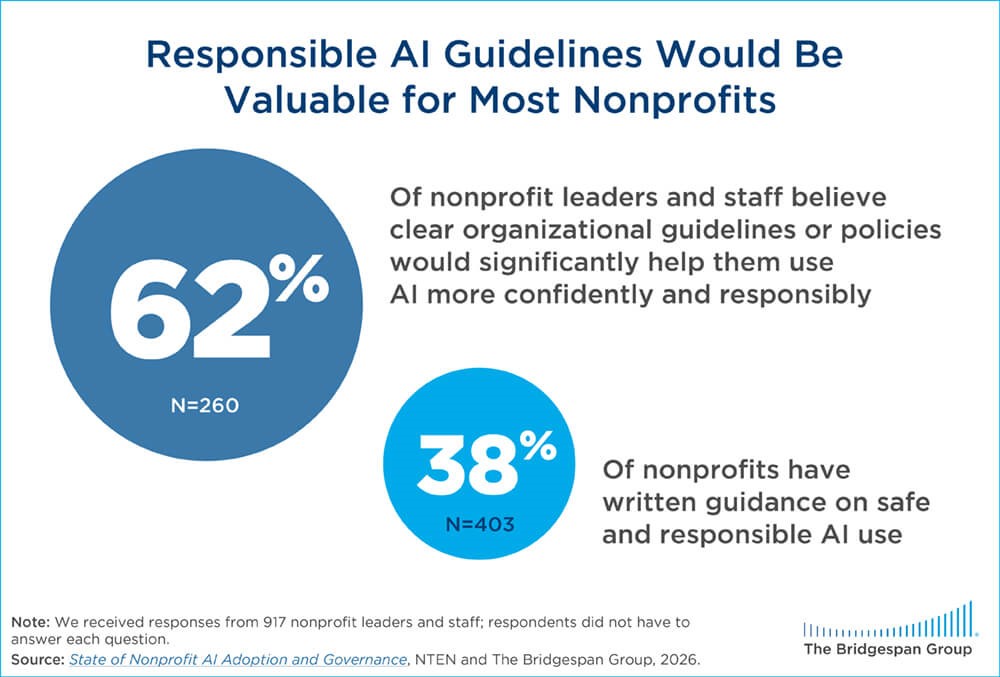
These basics are not yet in place for many organizations. In our survey, 38 percent of organizations report having written guidance on safe and responsible AI use in place, yet 62 percent say that clear organizational guidelines or policies would significantly help them use AI more confidently and responsibly at work. Fifty-seven percent say their organizations have yet to name a group responsible for AI oversight.
The risk of inaction is also real. If leaders do not set direction, staff may still experiment without the guardrails to do so responsibly. Potential increases in impact will go unrealized. Rules and policies—or the absence of them—will affect communities served.
This does not suggest that executive teams and boards need to oversee every use. But they ought to have a shared point of view on risk appetite, decision rights, nonnegotiable red lines, resourcing, and a process for revisiting AI choices over time. They also need to ensure that decisions are grounded in the needs and perspectives of communities served and staff closest to the work.
Boards do have important roles to play. “Staff can start AI, but only boards can scale it,” says Alethea Hannemann, CEO at Board.Dev, a US-based organization that trains nonprofit boards on AI strategy. “The board’s job is to authorize the organization to change: set risk appetite in writing, name what the organization won’t do, fund the capacity the strategy requires, and confirm there’s a view across all three dimensions and a point of view about where to focus.”
The landscape of AI is shifting quickly, and its impacts are far-reaching. The task for nonprofit leaders is not to adopt AI tools for their own sake, but to understand how AI is changing their work, communities, and fields, and then make informed choices. Communities and frontline staff do not need to be AI experts to shape responsible AI choices. They are often best positioned to name the problems worth solving, the risks that matter most, the forms of consent and transparency that would be meaningful, and the conditions under which this technology would build or erode trust.
Humans are creators and users of tools—technologies that maximize our individual and collective potential. The impact of AI will depend on the choices people and institutions make now about how it is designed, deployed, and governed. As the technology continues to evolve, nonprofit leaders have an immediate opportunity not only to apply it to pressing social challenges but also to shape its evolution responsibly and help ensure that its benefits are broadly shared.
Institutional Funders Can Help Grantees Make Responsible AI Choices
For most nonprofits, AI adoption is costly. Doing it responsibly increases upfront costs because it adds layers of complexity. More funding is part of the equation: 69 percent of respondents report no AI-related funding of any kind.
Funders can also help inform responsible choices by creating conditions for practical, equitable, and mission-aligned choices. This is particularly true of institutional philanthropy, notably foundations with program, learning, or capacity-building staff.
“We see AI as a way to enhance capacity and create more equity among organizations with different levels of resources, but that only happens if funders invest in the conditions for using it well, not just the tools themselves,” says Marcus Braxton, chief operating officer at the Greater Washington Community Foundation.
In our research, we heard from funders who are open to listening to and learning alongside grantees, rather than dictating AI adoption. “We believe our role is to help nonprofits make their own informed choices about whether and how AI fits their work, not to prescribe its use,” says Lul Tesfai, director of program development at the James Irvine Foundation. “The starting point should be an organization’s goals, principles, and desired impact. The right solution may involve AI, another organizational change, or some combination of the two.”
Some grantees may be ready to pilot AI-enabled service models, while others may need flexible funding, basic data infrastructure, staff training, or privacy guidance. Some may need space to assess whether and how AI could support their vision for impact. Others may benefit from funder-supported learning spaces and peer connections with other grantees. Still, others may benefit from strategic planning that takes a broader view of technological possibilities. AI can be one component, alongside an understanding of risks, opportunities, and community needs.
In each dimension, there are distinct ways that funders can support their grantees. Gaining clarity on grantees’ needs will inform resourcing decisions. Below are some ideas for funders to consider.
Augment: Support internal readiness and responsible experimentation.
- Help grantees build the capacity to use AI safely and responsibly in internal operations, including grant writing, reporting, communications, knowledge management, and administrative workflows.
- Fund the data and technology foundations that enable high-impact AI, including data infrastructure, cybersecurity, privacy practices, and vendor management.
- Fund staff training, shared learning spaces, technical assistance, data readiness, and clear policies and guidance on privacy, consent, disclosure, and appropriate use.
- Fund self-paced or cohort-based tools that allow teams to work through a curriculum and a set of resources in a structured manner.
- Example: The Greater Washington Community Foundation recently hosted a community training on AI literacy for grantee partners to support their own internal AI capacity-building efforts.
Advance: Help grantees experiment with innovative ways to use AI to advance or reshape their missions.
- Support grantee-identified opportunities to strengthen program delivery, improve learning, or reach more people without compromising trust, quality, or human judgment.
- Fund pilots and the work required to move to sustained operations, such as workflow redesign, staff roles, evaluation, data protection, community engagement, and change management.
- Recognize when AI is not the answer, and when grantees need flexible resources, stronger technology infrastructure, or additional staff capacity.
- Example: The Greater Washington Community Foundation’s Partnership to End Homelessness funded two organizations to pilot Eleos Health’s AI-powered documentation technology with permanent supportive housing providers.
Advocate: Fund field-level learning, safeguards, and accountability.
- Play a convening and field-building role by supporting grantees, community leaders, technical experts, advocates, and other funders to learn together about AI’s implications.
- Fund research, policy, advocacy, worker and community voice, shared standards, responsible procurement practices, and public-interest infrastructure.
- Help fields anticipate how AI may affect workforce needs, service delivery models, data rights, privacy, surveillance, and power.
- Example: The Kapor Foundation released the Responsible AI and Tech Justice guide to help K–12 educators teach the critical interrogation of the ethics and implications of AI.
We focus on institutional philanthropy, but other funders can also advance this work. Smaller foundations and family offices, for example, may choose a narrower role, such as providing flexible support or participating in shared learning spaces. They may be less inclined to build deep in-house expertise on AI, so they might consider funding through intermediaries or collaboratives. Outside the United States, more corporate social responsibility organizations and private foundations operate their own programs and thus might take on more of the work across all three dimensions internally.
The authors thank the numerous readers who provided input, including Afua Bruce at ANB Advisory, Jacob Dwelle at NTEN, David Figueroa at NTEN, Alethea Hannemann at Board.dev, Amy Sample Ward at NTEN, Michelle Shevin, and our colleagues at Bridgespan including Anant Bhagwati, Meera Chary, Marina Fisher, Laura Lanzerotti, Xueling Lee, Kristen Loureiro, Carole Matthews, Mark McKeag, Madhuri Mukherjee, Lyell Sakaue, Bob Searle, Aditi Sharma, and Larry Yu, who offered their perspectives to help shape this work.