
Living Goods helps governments build affordable community health systems. The organization has always been technology-forward, working alongside governments to make community health workers (CHWs) more effective across sub-Saharan Africa. Since its founding, the Kenya-based Living Goods has ensured that CHWs can consistently deliver high-quality care. That commitment has naturally led the organization toward increasingly sophisticated digital systems, including predictive analytics and workflow optimization (i.e., using data to predict likely outcomes and streamline day-to-day processes) to strengthen performance and deliver measurable health outcomes.
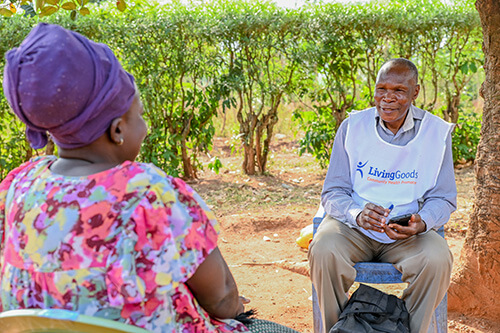 Community Health Promoter Amos Magero uses the eCHIS (Electronic Community Health Information System) workflow on his phone to update information about his client Irene in Munongo, Busia County, Kenya, April 2025. Photo credit: Living Goods“Instead of asking how to digitize individual components, we started asking how all of those components connect and how intelligence could be embedded across the entire system,” says Emilie Chambert, CEO at Living Goods. “We’re constantly asking how technology can help us increase our impact. Given today’s funding environment, it would be easy to jump immediately to AI. Instead, we ask whether AI is actually the right solution.”
Currently, Living Goods is piloting an AI tool—the Next Generation Supervisor App—that helps CHW supervisors work more efficiently by interpreting data and prioritizing care tasks. This way, supervisors can spend more time supporting CHWs through high-value care situations, like difficult pregnancies or critical childbirth cases. The AI tool is interoperable across multiple national health information systems.
“Most supervisory applications are essentially reporting dashboards,” says Kanishka Katara, chief digital health officer at Living Goods. “They present numbers, and then supervisors are expected to figure out for themselves what those numbers mean and what actions they should take.” Rather than simply displaying information, the AI tool now helps supervisors understand what matters most.
"Ask what foundational systems are required for that application to succeed at scale. You can't AI yourself out of a broken system."
Living Goods designed its tools to accommodate the technology infrastructure in sub-Saharan Africa. For instance, it built its own data warehouse in 2025 to ensure its tools could operate consistently. And its technologies are generally designed as offline-first, which is important for last-mile health care, where there may be no internet connectivity.
Learn More About Choosing Your AI Path
To strengthen the broader ecosystem, Living Goods works closely with governments and ministries of health. “We paint a picture of what the future could look like while simultaneously generating evidence that demonstrates how these ideas work in practice,” says Katara. “We work both at the national level, where policy and standards are established, and at the personal level, where implementation actually happens.”
The Living Goods team remains cautious amid the current AI hype cycle—while it engages thoughtfully across all three dimensions, it keeps its mission and impact at the center and always thinks systemically. “Don’t focus only on the shiny application,” says Chambert. “Ask what foundational systems are required for that application to succeed at scale. You can't AI yourself out of a broken system.”
Living Goods’ experience shows that AI strategy may vary across different contexts. In some settings, the central question is not whether a nonprofit should adopt an AI tool (Augment), but how AI might support population-level impact, public systems, and field-wide collaboration (Advance and Advocate).
