
Financial resilience refers to a nonprofit’s ability to sustain its operations over the long term and withstand external stresses and shocks (e.g. the COVID-19 pandemic, the end of a key funder’s support). Nonprofits boost their long-term stability by developing prudent financial plans, monitoring financial performance, growing reserve funds, and diversifying their funder base.
“We believe that, along with core cost support, organisations need to also build financial resilience. We support this through capital and connections to other funders, peers, and the larger ecosystem that we have access to.”
Note that the previously described OD investment approaches apply here, allowing funders to support their nonprofit partners in strengthening their financial management capabilities. In addition, funders can more directly boost financial resilience by contributing to reserves and making introductions to new funders.
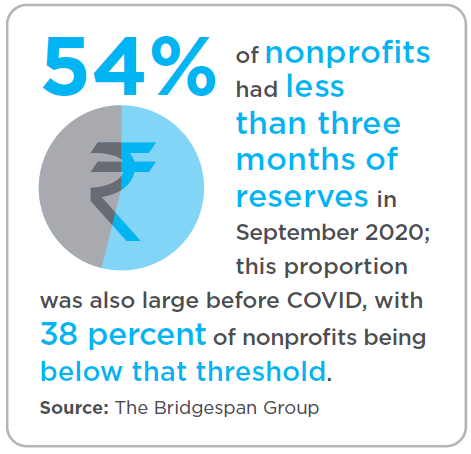
Our 2021–2022 research indicates that just 9 percent of funders provided direct support for building nonprofits’ reserves (corpus). That level is low in part given legal barriers, as by law CSR programmes cannot contribute to a nonprofit’s reserves. However, domestic foundations and high-net-worth individuals face no such barriers.
 Azim Premji Foundation believes that financial resilience allows nonprofits to strengthen long-term planning and build capacity. It also enables the leadership to effectively focus on delivering impact rather than disproportionately investing time on fundraising. It supports nonprofit partners to build financial resilience by providing corpus grants, which help create a steady income for nonprofits to tide over unforeseen risks.[16]
Funders more commonly support their nonprofit partners in accumulating an operating surplus that the nonprofit can then transfer to its reserves. The Income Tax Act allows up to 15 percent of an organisation’s income to be transferred to a nonprofit’s reserve fund.[17]
Provide grants for reserves
Rohini Nilekani Philanthropies provides grants to select nonprofits to build their reserves. Grant size depends upon the size and scale of the nonprofit’s operations. The foundation also allows nonprofits to use a certain percentage of unrestricted grants for building reserves.
Make introductions to new funders
Mariwala Health Initiative often is the first institutional funder for its grantees. As it plans to exit a nonprofit partnership, it identifies and connects the nonprofit to mission-aligned funders who can step in with grant support. Other funders that connect their nonprofit partners with new funders are A.T.E. Chandra Foundation, EdelGive Foundation, LGT Venture Philanthropy, and Rohini Nilekani Philanthropies.
