
After a recent conference panel on gender equity, one of us (Nidhi) was debriefing with a prominent funder during a walk. The funder recounted driving her college-aged daughter and her teenage son to the airport, listening to a podcast that put human faces on the data about how social media harms adolescent girls. The mood was somber, and she felt a lot of empathy for all the girls who were brave enough to tell their stories on the podcast. Then her son asked quietly from the backseat: “But do they care enough about us to look at the data on what it’s doing to boys?”
His question wasn’t a rebuttal to caring about girls. It was a signal and a reminder that gender equity rises or falls on the relationships, norms, and systems that shape everyone. Supporting boys and men isn’t separate from gender equity for women and girls; it’s part of what makes progress sustainable and inclusive.
At The Bridgespan Group, we work on gender equity around the world, focusing much of our time on women and girls, and gender-diverse people, given persistent inequality and documented backsliding on women’s rights in many places. That focus remains essential.
At the same time, advancing gender equity requires paying attention to the conditions shaping boys and men. Entrenched expectations about masculinity can both impede progress for women and girls and narrow boys’ and men’s own well-being and opportunities. When boys and men lose connection, purpose, or hope, the effects can be profound—and they don’t stop with them. The effects show up in families, in relationships, and in the conditions in which women and girls live every day. Let’s look at the data.
The Warning Signs Are Converging
Across many communities, men and boys are struggling with mental health, belonging, and finding a purpose that can meaningfully guide them through life stages, including educational attainment, stable work, and healthy relationships.
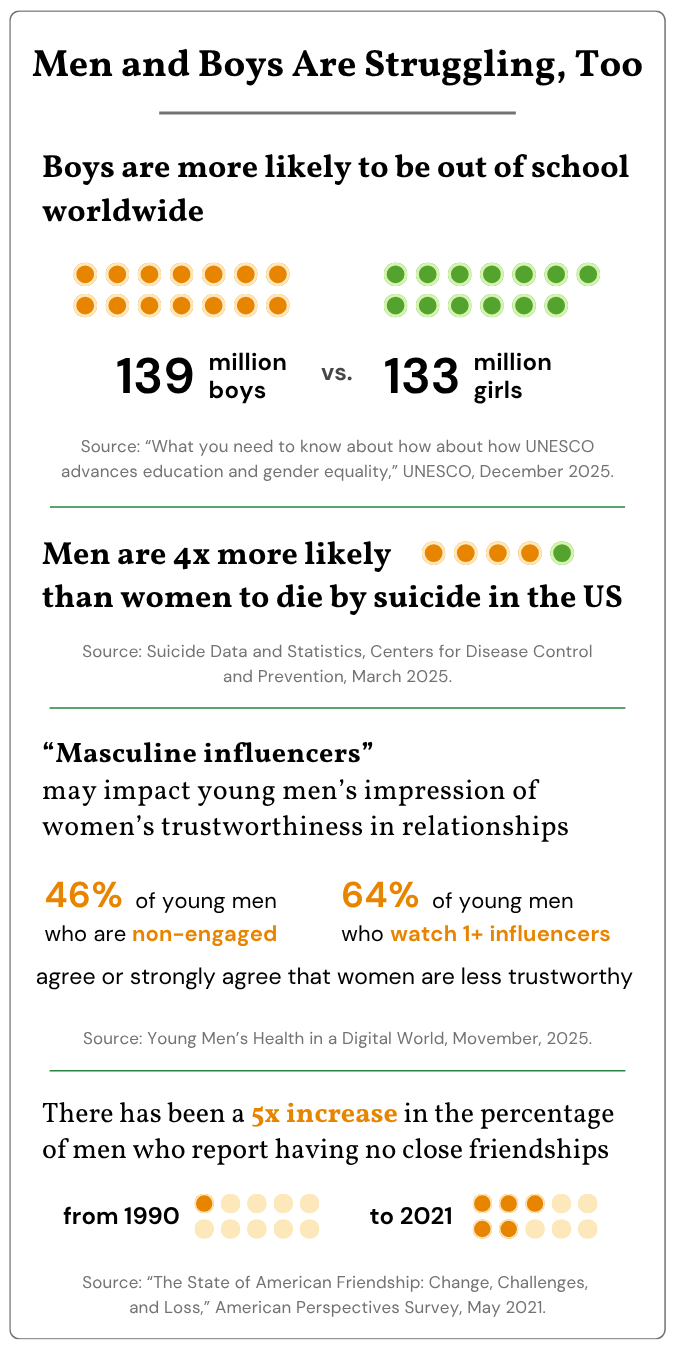
The numbers are sobering. UNESCO estimates that 139 million boys are out of school worldwide. That’s slightly more than the estimated 133 million girls who are out of school, and it accounts for more than half of all out-of-school youth. In the United States in 2023, about 49,000 people died by suicide; roughly 80 percent of them were men. A similar gender disparity exists in other countries, even as overall suicide rates and the causes behind the tragic circumstances differ.
Isolation is part of the picture. Analysis of the American Perspectives Survey found that 15 percent of men report having no close friendships—a fivefold increase since 1990. Online, loneliness and isolation are colliding with digital spaces that favor outrage and grievance over connection. Ofcom’s 2025 research on the “manosphere” describes a fragmented ecosystem (not all of it extreme) and notes that socially isolated individuals may be at greater risk of adopting harmful mindsets in closed online communities. A 2025 study from Movember found that young men who follow masculine influencers are 18 percentage points more likely than their peers outside the manosphere to believe that, in a relationship, women are less trustworthy than men. Offline, the consequences may include depression, substance misuse, or violence directed inward or outward.
And as technology—including AI—reshapes labor markets, young men who already feel replaceable may face intensifying pressure on identity and purpose, which can be closely tied to career prospects and a sense of direction. This is the urgency: when uncertainty rises and grievance is actively cultivated online, loneliness can be manipulated at scale. No society is safe—or equal—when that happens. If we want gender equity to endure, we need to care for the daughters and the sons, and support the mothers and the fathers.
These pressures aren’t evenly distributed. In the United States, for boys and men marginalized by their racial or ethnic identities and at high risk of criminalization, the combination of economic exclusion, surveillance, and insecurity can deepen stress, isolation, and a sense of futility, shrinking real pathways to finding their purpose. As Jimmie Briggs, an essayist, journalist, and advocate for racial and gender equity, put it in a recent conversation with one of us (Debby), “If we want better outcomes for boys and men, we need a different frame—one that takes power, race, history, and gender seriously. Without that, we’re treating symptoms while leaving the underlying conditions untouched.”
It is worth noting: the aim shouldn’t be to replace one rigid set of roles with another. It’s to expand what is possible. A healthier future makes room for many ways of being: men who are strong and emotionally present; boys who are both ambitious and kind; women who lead without apology and still define femininity on their own terms; girls who pursue power, beauty, or both—or neither.
When that freedom is missing, the consequences for men and boys don’t stay contained. In some places, disconnected men aren’t just struggling—they’re being drawn into grievance-based movements that blame women’s progress and promise status through control. That dynamic can strain families, increase the risk of harm in relationships, and weaken social trust and civic life.
Advancing Gender Equity Means Also Supporting Men and Boys
Progress for women and girls has been significant and hard-fought, and support for women, girls, and gender-diverse people must continue and grow. And it will be harder to sustain if boys and men are isolated, economically excluded, or pulled into adopting identities built on grievance. Thoughtfully supporting boys and men is part of how hard-won gains for women and girls endure.
And just as women, girls, and gender-diverse people deserve to lead safe, connected, and healthy lives, so, too, do men and boys. For years, community-rooted initiatives have approached boys’ and young men’s outcomes as inseparable from the conditions that shape everyone’s lives: safe schools, stable work, mental health support, and opportunity. The false choice—care about women and girls or care about boys and men—stands in the way of progress for all of us.
What Constructive Support Can Look Like
One example comes from Rwanda. In the Bandebereho (“role model”) initiative, expectant and new fathers meet in small groups with their partners to discuss what many families never name or say out loud: who gets up when the baby cries, who controls the money, how conflict escalates, and what care without control can look like. In these sessions, men don’t just learn. They practice a different way of showing up: more confident as caregivers, more connected to their partners and children, and better able to manage conflict without dominance or withdrawal. In other words, Bandebereho aims to improve men’s well-being and relationships, not just their attitudes. And because relationships are shared, those shifts can also mean more shared caregiving, greater day-to-day agency, and, critically, greater safety at home.
Bandebereho is also a reminder that this work can be measured. A randomized controlled trial found meaningful improvements in outcomes reflecting healthier relationships and family functioning among the men who participated, as well as among their families. These included reductions in women’s reports of intimate partner violence alongside gains in maternal health-seeking and couple relations. A six-year follow-up confirmed that the impacts endured—an unusually long lens, and a reminder that changing norms is gradual work that can have a lasting impact.
An Area with Real Strengths—and Real Gaps
Work that supports men and boys as part of gender equity isn’t new. It has a long history—from early youth-development models, such as the Boys’ Club movement (later Boys & Girls Clubs) and the YMCA, which built place-based infrastructure for mentorship and belonging, to transnational networks like MenEngage Alliance, which began in 2003 and now connects more than 1,000 groups across some 80 countries, to more recent public-sector efforts like My Brother’s Keeper.
Many durable approaches have been developed by communities responding to the specific social, economic, and gendered pressures shaping boys’ and men’s lives in their own contexts. Across regions, women leaders, local civil society organizations, and public health practitioners have long understood that men’s well-being is tied to family stability, safety, and opportunity, and they have engaged men accordingly in caregiving, health, and violence prevention efforts.
What’s different now is the scope of the challenge—and the unevenness of the response. There are credible approaches and experienced practitioners across regions, yet the work remains fragmented across entry points (health here, education there, caregiving somewhere else), with uneven funding and initiatives operating in silos. The risk is that this remains siloed across issue areas instead of helping to evolve a gender equity field that includes men and boys alongside women, girls, and gender-diverse people, and that is better able to support everyone’s safety, connection, and thriving.
Still, a growing set of organizations and networks is helping hold this work together across geographies and issue areas. For example: the American Institute for Boys and Men; networks like the Men, Masculinities, and Countering Backlash Collective that the MenEngage Alliance convenes; and Prerna Boys School (India). These organizations and many others help build evidence, deliver programming, and anchor local movements, often led by those closest to the challenges.
Even so, securing sustained funding that matches the scale of need remains difficult. In our conversations, the gap often reflects two things: some funders are unaware of how quickly conditions for boys and men are shifting; others see the need but hesitate, citing understandable concerns about language being misread, the real risk of causing harm (for example, reinforcing harmful norms, crowding out women’s leadership, or triggering backlash), differing rationales for entering the work, and uncertainty about where to start.
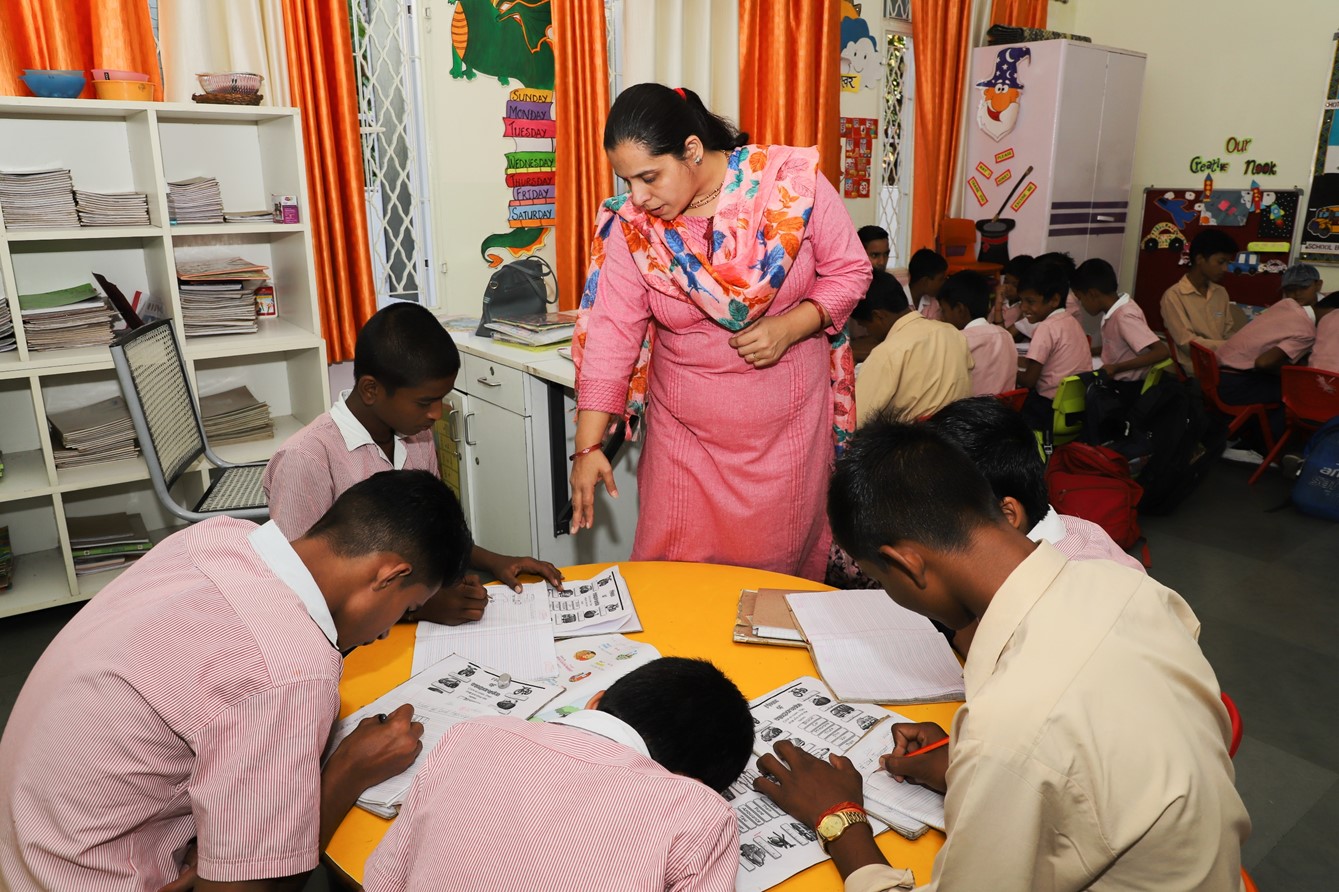 Teacher Neha Malhotra instructs students at the Prerna Boys School in Gomti Nagar, Lucknow, India, October 31, 2023. (Photo: Suraj Rawat, courtesy of Study Hall Education Foundation)
What Funders Can Do
Funders engaging boys and men in gender equity efforts often work along one of two pathways. One is to invest in improving outcomes for boys and men themselves. The other is to explicitly incorporate men and boys into the design and delivery of solutions that aim to improve outcomes for women and girls. These approaches often overlap, but they reflect distinct ways of thinking about what change requires, and the different methods to achieve it. In both cases, the work must be approached with care.
As this work gains urgency and investment, it’s equally important that funding practices are designed so they do not inadvertently reinforce gendered power structures or harmful norms. Practically, this means, for example, engaging local women leaders in sourcing and vetting, ensuring grant requirements include comprehensive safeguarding measures, and embedding impacts on women’s health and safety into measurement, evaluation, and learning frameworks.
Furthermore, funders don’t need to launch a standalone “boys and men” initiative or start from scratch. Many established organizations and networks are already doing this work. For instance, MenCare on caregiving norms, Sonke Gender Justice and Equimundo on gender-transformative practice, MenEngage Alliance as a global learning and movement network, Movember on men’s health, and locally rooted organizations such as Equal Community Foundation in India, which works with adolescent boys and young men to challenge harmful gender norms and prevent violence.
Funders can also learn from peers and collaboratives already investing in this broader agenda, including Echidna Giving, Rohini Nilekani Philanthropies, and the David and Lucile Packard Foundation. Where the fit is right, they can participate through collaborative funding vehicles such as Co-Impact’s Gender Fund or Equimundo’s Caring Masculinity Fund. There are many others; the key is to start with infrastructure that has already earned trust, built evidence, and gained deep local grounding.
Joining existing efforts also gives funders an opportunity to learn while doing. And don’t forget that multiyear commitments and unrestricted funding help to sustain impact. That kind of flexible, longer-term support is especially important for norm-change and healing-centered work with boys and men, where progress depends on accountability, community trust, and consistent practice over time.
***
To be clear, we are not arguing for shifting resources away from supporting women, girls, or gender-diverse people. At a moment when backlash and other headwinds are reversing gains for women and girls in many places and worsening outcomes for men and boys, the larger problem is that total funding falls short of what a broader gender equity agenda requires.
Caring about men and boys isn’t a distraction from gender equity. Gender equity is about building conditions where women, girls, boys, men, and gender-diverse people can be safe, connected, and able to thrive. There is no single solution that fits every context. But the direction is clear: investing in women’s rights and supporting boys and men—especially those facing compounded barriers by race and class—makes progress more durable for everyone.
Edited by Robyn Porteous.