Local giving has long been a philanthropic tradition in the United States. According to the National Center for Family Philanthropy, two in three family foundations focus some giving on a specific geography. In The Bridgespan Group’s experience advising over 50 families in the last 10 years, nearly half of them engage in significant place-based giving. Whether it’s their familial birthplaces, the places where they built their business, or where they raised their families, place is prominent among donors’ priorities.
We also hear from donors a desire to do even more and to become more effective right now. Geopolitical fractures and ruptures in civil society nationally have led some funders to turn toward building community in their own backyards.
“There’s research that shows people feel connected to community when they know their neighbors, when they’re working together and building relationships,” says Molly Talbot-Metz, president and CEO of the Mary Black Foundation, which focuses on improving the health and well-being of the people and communities of Spartanburg County, South Carolina. “When people are feeling so divided and frustrated, there is a real role for place-based funders in helping people re-engage.”
Donors often seek advice from Bridgespan on shifting from reactive giving scattered across their communities to giving that leads to lasting local impact. While there is no one “right way” to give, our work has taught us that if you want to drive results on pressing issues facing families and communities, it’s critical to understand the social and economic disparities—and assets—in a place. These are the basics of effective giving. As you’ll see in the examples below, we’ve also learned that two things are critical for sustained impact: nurturing enduring, trusting local relationships and adopting a generational mindset.
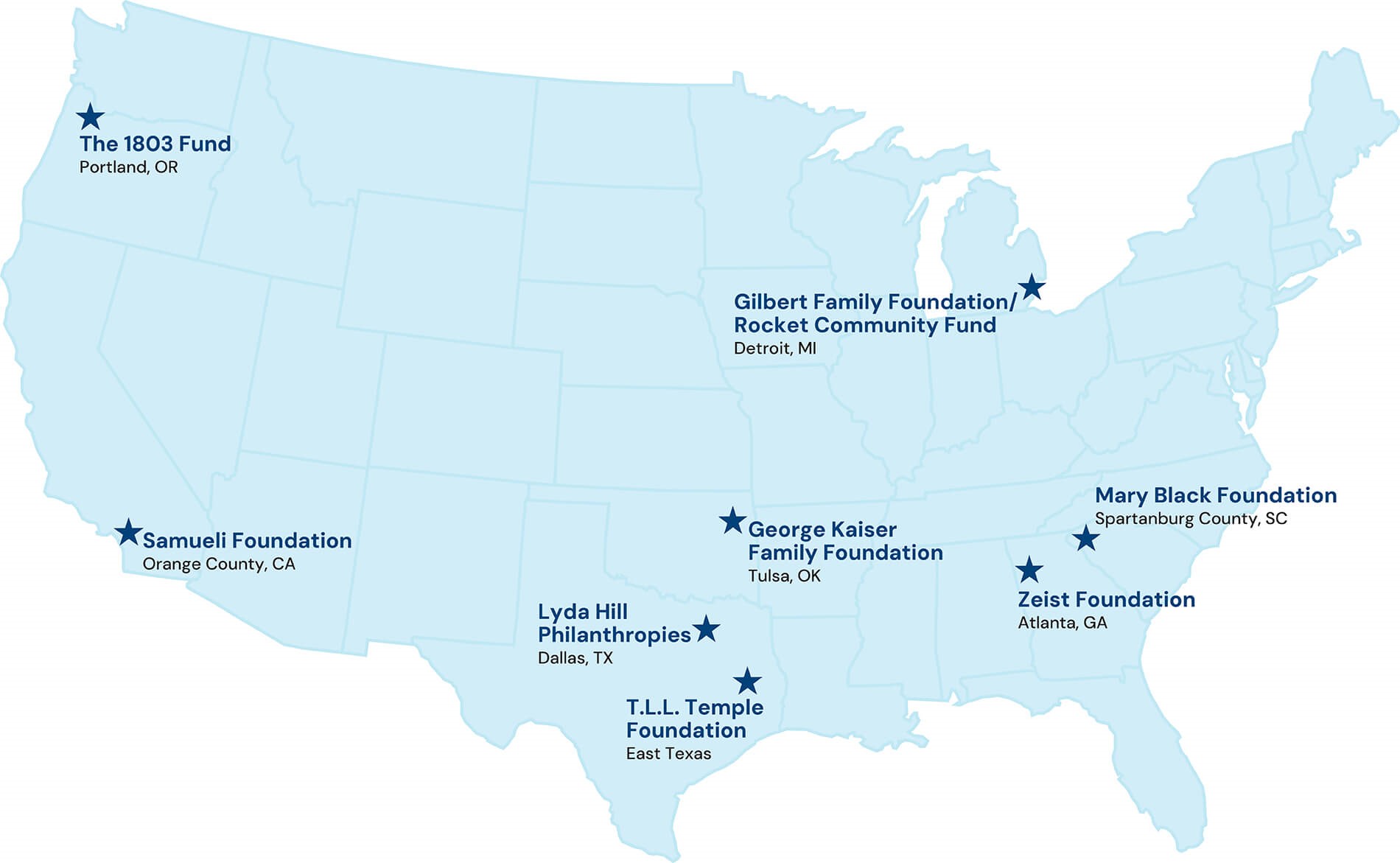 Where Our Funder Examples Are Based
Individual donors and family foundations are nimble, able to respond quickly to emerging needs and opportunities, and to shift course as they engage with communities. That’s particularly valuable in relationship-driven work. They often have a greater appetite for risk and can make long-term, multi-generational commitments to a place, independent of a particular government funding cycle or administration. They also have a uniquely keen sense of local responsibility, grounded in local knowledge and networks, which includes relationships with local and state government agencies. Those relationships are an asset that can ease collaboration.
In our work, we’ve observed common patterns in place-based giving. While it takes all types of public and private funders to effect change in a place, we explore four approaches below and offer examples of funders who have leaned into these unique strengths to drive real impact in their own communities.1 Funders may adopt one or more of these approaches—and others—at the same time.
Start with what you know—then go deeper with what works
Many donors choose to deepen their investment in an issue area, organization, or population they already know well. Starting with what you know first often helps shape long-term strategies. A donor can identify adjacent areas of impact while learning alongside a community. Often, what’s most effective is doing more of what’s already working, building on existing local relationships, and pursuing work that you’re emotionally connected to.
Gilbert Family Foundation/Rocket Community Fund in Detroit
For Dan and Jennifer Gilbert, place-based philanthropy grew out of their philosophy of community investment: the belief that a company’s success is inextricably linked to the community’s success. When Dan Gilbert, co-founder and chair of Rocket Mortgage (originally Quicken Loans), moved much of the company’s workforce—some 1,700 people—to downtown Detroit in 2010, it was a long-term bet on the city’s future. As Rocket deepened its local presence, the Gilbert Family Foundation’s philanthropy followed, alongside the Rocket Community Fund.
With its focus on what it knew best—housing—the foundations’ philanthropic investment aimed to strengthen the civic and economic foundations on which families and businesses alike depend. The Rocket family of companies has a deep understanding of the Detroit housing market. It was natural to apply that unique local knowledge to their philanthropic efforts.
In 2007, the foreclosure crisis rocked Detroit. Property tax foreclosures prolonged and deepened the crisis. Between 2011 and 2015, one in four properties was foreclosed on, which worsened the blight and depopulation Dan Gilbert knew well as co-chair of the city’s Blight Removal Task Force. Thousands of residents were at risk of losing their homes due to back taxes, penalties, and limited access to relief programs.
In response, the Gilbert Family Foundation focused early on increasing enrollment in city programs—such as HOPE—that help low-income residents pay their current year’s property taxes. Over time, the work expanded into the foundation’s Detroit Tax Relief Fund, which has helped more than 13,000 households clear delinquent taxes not covered by the existing city program. And, in 2021, the Gilbert Family Foundation and the Rocket Community Fund announced a $500 million investment to completely eliminate the property tax debt of low-income Detroiters.
“If you’re struggling to pay your property tax this year, you very likely were struggling to pay it last year, and the year before that,” says Darnell Adams, vice president of Detroit Community Initiatives, at the Gilbert Family Foundation. “If you always qualified for assistance and didn't receive it, we will pay those delinquent taxes and give you a fresh slate.”
Many homes also needed critical repairs to remain safe and livable. To address this, the Gilbert Family Foundation helped build a coordinated home repair network, partnering with city agencies and nonprofits, including Enterprise Community Partners. Since then, over 6,000 critical home repairs have been completed.
Across this work, the Gilbert Family Foundation and the Rocket Community Fund have used more than grant dollars in Detroit. In addition to their $50 million annual investment in the city, they bring data, convening power, political relationships, and skilled volunteers. By committing to the long game and correcting course alongside the community, the Gilberts’ approach shows how starting with what you know—in this case, an array of homeownership services—can make a meaningful dent in a city’s housing crisis.
Zeist Foundation in Atlanta’s Edgewood Neighborhood
Many donors have deep connections to a place, which can help shape long-term strategies with deep, local impact. Consider the Zeist Foundation, which has worked in Atlanta’s one-square-mile Edgewood neighborhood for over three decades. Back in 1994, the Zeist Foundation’s founders, George and Jean Brumley, recruited Atlanta native and doctor, Veda Johnson, to launch a pediatric health clinic inside Whitefoord Elementary School. That school-based clinic investment in 1995 evolved into multifaceted place-based work in Edgewood, supporting families via education, health, and human services through the Whitefoord Community Program, a nonprofit the foundation created.
During the first decade, the program operated in Whitefoord Elementary and opened another clinic at Coan Middle School. Engaging with community members, Zeist Foundation leaders identified additional ways to support families in Edgewood. As a doctor, George Brumley understood the significance of the social determinants of health. But it wasn’t until the threat of a big box development that he realized the foundation needed to address affordable housing, and the foundation created another nonprofit intermediary, the Mayson Avenue Cooperative. Beginning in 2007, the foundation made program-related investments that supported responsible relocation and the construction of 140 affordable housing units through the Retreat at Edgewood Townhomes project.
Zeist Foundation leaders built trust by showing up at community and school board meetings, listening closely, and hiring community leaders to launch new initiatives. Years of committed community work helped to build deep relationships. “You can bring money to many situations,” says Atiba Mbiwan, Zeist’s executive director. “But getting folks to work together, collaborate, to think about the greater good, that doesn’t happen without social capital that has built trust.”
Invest in infrastructure—sometimes quite literally
Most communities benefit from philanthropic investment beyond direct service programs. That benefit is often even greater for communities that have faced historic underinvestment, overstretched or absent government services, under-resourced physical infrastructure, and a lack of cohesive nonprofit infrastructure. In such cases, “behind-the-scenes” investments that give nonprofits access to better data, help deliver services more efficiently, and foster more effective collaboration can be invaluable.
The Samueli Foundation in Orange County, California
Many funders find that investing in the collective strength of their local nonprofit ecosystems can be just as critical as supporting strong individual organizations. That insight shaped the Samueli Foundation’s approach in Orange County.
For more than two decades, the foundation and its principals—Susan and Henry Samueli—have directed most of their philanthropic and civic investments locally, to foster a vibrant Orange County. As the foundation approached its 25th anniversary, the Samuelis made a public commitment to accelerate their local giving and deepen their commitment through larger, multiyear investments. To do so responsibly, the foundation recognized the need to step back and assess its existing approaches.
In late 2024, Samueli commissioned research to better understand the assets, capacity, and unmet needs of the region’s nonprofit ecosystem. The research was conducted with the Orange County Community Foundation to both broaden the reach of the findings and ensure they would be useful to other local partners.
The findings revealed a consistent pattern. Decades of restrictive, program-specific funding—from both public and private sources—had left the sector sub-scale, with underinvestment in leadership and infrastructure, and an inability to keep pace with growing complexity and demand.
The research included a survey of more than 600 nonprofit leaders, nonprofit-centered focus groups, and a community town hall. Across these forums, leaders described a persistent disconnect between what organizations needed to be effective and what funders were typically willing to support. Outdated systems, limited collaboration resources, financial fragility, and constrained operating flexibility emerged as consistent barriers to impact.
In response, the foundation immediately launched two open-call funds. In September 2025, the Breakaway Fund awarded $11 million in unrestricted grants to 138 local nonprofits to support “hard-to-fund” needs, including access to specialized external expertise, investments in staff development, and the purchase of essential physical and technology infrastructure. Notably, 77 percent of grantees had never received funding from the foundation.
Later that month, Samueli launched the Build OC Fund, awarding $6 million to eight organizations for critical capital expenses, including deferred maintenance, infrastructure upgrades, and physical space expansion. While these needs often struggle to attract philanthropic support, the Samueli team viewed them as foundational to a healthy and resilient nonprofit sector.
With a lean team and a “no regrets,” action-oriented mindset that prioritizes speed over perfection, the foundation is committed to future funding cycles in the same spirit. Samueli’s experience illustrates how listening at scale—and acting on what nonprofits themselves identify as priorities—can reshape a funder’s approach to ecosystem building. These investments lay essential groundwork for a stronger local nonprofit sector and create conditions for long-term, scalable impact. It also shows that a lean team can innovate quickly.
The T.L.L. Temple Foundation in East Texas
In East Texas, persistent underinvestment in rural physical infrastructure has prevented many communities from maintaining and upgrading essential services, such as local water systems and broadband coverage, leading to poor health outcomes and limited economic mobility. The T.L.L. Temple Foundation has faced these challenges with the community for decades.
“East Texas has too often been a place for some to extract from, versus invest in,” says Charlie Glover, president and CEO of T.L.L. Temple Foundation. “This led to an undercapitalization of infrastructure, which yields a lower capacity of [public] services than many of our neighbors in the state.” T.L.L. Temple Foundation decided to take a unique approach. It leaned into foundational infrastructure investments that laid the groundwork for deeper community-led development in East Texas.
T.L.L. Temple Foundation funds community-driven solutions and physical infrastructure, such as water systems and broadband internet, and serves as a connector to government funding. This connection to government funding takes advantage of distinct assets in Texas, where the state government operates with a budget surplus and has the flexibility to address rural infrastructure challenges. “We have the social capital to sit down with multiple parties and sectors, and the risk capital to build points of success and learnings,” says Glover. “We can then help communities access public funding for infrastructure.”
The T.L.L. Temple Foundation’s work in centering local voices and fostering long-term partnerships has become a model for how philanthropy can strengthen rural infrastructure. The foundation has even helped to launch two Community Development Finance Institutions in East Texas: Communities Unlimited and PeopleFund. “It’s incumbent upon us to attract additional capital and interest to the things that we’re trying to accomplish as a community here,” says Glover.
Stronger together—teamwork makes the dream work
As donors sharpen their focus on specific places, many find that achieving the results they desire requires working with public sector, corporate, nonprofit, and funder partners. In addition to providing critical funding, donors can use their relationships and position to help bring disparate stakeholders together and sustain partnerships through the often messy, adaptive work required for lasting change in a specific geography.
Local and national funders can form powerful, complementary relationships. Local foundations can lay the groundwork to attract national capital and can root strategies deeply in what works in that community. National funders can bring together local funders and offer lessons from the national context. When deployed in partnership with local leaders, national capital can accelerate impact—adding resources and momentum to existing local assets and catalyzing data-driven collaboration and community-wide plans. Blue Meridian Partners, a national philanthropic partnership focused on social and economic mobility, has played an important role by partnering with local funders to develop and implement this approach. It has invested in place-based partnerships in communities across the country to catalyze local philanthropy alongside nationally raised dollars. In the examples below, Blue Meridian made investments, spurred local philanthropic investment, and played a critical strategic role advising on strategic plans, goal-setting, measurement, collaborative action, and fostering connections with other communities to enable shared learning.
George Kaiser Family Foundation in Tulsa, Oklahoma
By collaborating with national and local partners on shared goals, place-based funders can more actively support and steward relationships, driving deeper and more enduring impact. Physical presence in and commitment to a particular locale equips funders with deep knowledge of community strengths, challenges, and opportunities. That proximity and focus facilitate the collaboration needed to make progress on complex challenges.
This approach can include investing in teams to mobilize, connect, and support a network of grantees to inform and strengthen strategies. With Blue Meridian’s partnership, the George Kaiser Family Foundation (GKFF)’s Birth through Eight Strategy for Tulsa (BEST), has done just that through its approach to early childhood care and education. “Being firmly embedded in a place is essential to tackling large-scale problems with multiple contributing factors,” says Sophia Pappas, managing director for BEST at George Kaiser Family Foundation. “Local relationships allow us to stay on the pulse of what impacts Tulsans. While we often draw from national models, we tailor our implementation to leverage strengths within the Tulsa community.”
GKFF’s work in Tulsa aims to disrupt intergenerational poverty by acting early. The GKFF-BEST team manages a network of nonprofit and public agency partnerships to improve outcomes in the first eight years of life. Partners contribute individually and collectively toward four goals: increase the percentage of children born healthy, on a positive developmental trajectory by age three, ready for kindergarten, and successful by third grade. ConnectFirst, BEST’s navigation function, provides a seamless continuum of care starting prenatally through a closed-loop referral tool and education about early childhood development. BEST invested in program expansion and backbone infrastructure, including funding for data systems, governance, and evaluation.
The results are promising. Last fiscal year, 43 percent of ConnectFirst referrals resulted in a service, compared with 38 percent in the rest of the state and 30 percent nationally. BEST has scaled evidence-based programs, including HealthySteps, Family Connects, and the Tools of the Mind pre-K curriculum. Across Tulsa County, 42 percent of Medicaid-enrolled children receive at least one screening in a pediatric setting. Through Family Connects, 27 percent of Medicaid-eligible women in the county receive up to three post-partum visits from a registered nurse. Children who attended Tulsa Educare early childhood programs demonstrated greater growth in vocabulary, oral comprehension, and math skills than a control group, from pre-school through third grade.
GKFF applies this collaborative, data-driven approach across its portfolios to create opportunities for Tulsans, including through criminal justice reform, fostering neighborhood change, enriching arts and culture, and catalyzing economic development. GKFF takes a comprehensive approach. It encourages collaboration across sectors and issue areas, which enables progress on deeply interrelated issues.
Mary Black Foundation, in Spartanburg County, South Carolina
In Spartanburg County, South Carolina, the Mary Black Foundation shows how sustained commitment to cross-sector partnership rooted in community assets and data can lead to tangible impact.
Spartanburg County faces gaps in economic mobility, including deep racial disparities, with Black residents experiencing worse outcomes than white residents across health, education, and economic indicators. The Mary Black Foundation, focused on the health and well-being of youth and families, has a long-standing commitment to changing these outcomes.
The Mary Black Foundation focuses on funding and working deeply in partnership with the community. “It’s not unusual for us to have a 20-year relationship with a nonprofit in our community,” says Molly Talbot-Metz, president and CEO of the Mary Black Foundation. The foundation brings assets beyond capital to foster collaboration toward shared goals. It connects stakeholders, acts as a thought partner on research, and builds nonprofit capacity.
The Mary Black Foundation has worked with stakeholders over several decades to foster collaborative, evidence-informed strategies in early childhood. For example, it worked with a small group of funders, public system partners, and nonprofit partners to implement a local pilot to access quality and support for early childhood providers. This work led to stronger early childhood programs and helped secure public funding.
In 2020, Blue Meridian Partners invested in the Spartanburg Academic Movement (SAM) to develop a collaborative plan for economic mobility and helped crowd in other funders. The Mary Black Foundation played a significant role in supporting the partnership in Spartanburg, investing alongside Blue Meridian Partners, the Duke Endowment, and other regional funders. National and local funders played complementary roles, combining national perspective with deep local knowledge and relationships.
In partnership with SAM and the Spartanburg County Foundation, the Mary Black Foundation helped convene public sector leaders, nonprofit organizations, funders, and other stakeholders. Given its trusted relationships, the foundation played a particularly important leadership role in helping partners develop collaborative early childhood strategies, building on programs and leadership already present in the community.
SAM and its partners developed and implemented strategies that expanded evidence-based early childhood programs and seeded initiatives to increase post-secondary completion. Because city, county, and district leadership were deeply engaged from the beginning, the work led to practice and policy changes within local systems. Spartanburg County is beginning to see early indications that the work is making a difference. Third-grade reading has begun to tick upward and early childhood investments have helped increase kindergarten readiness and decrease emergency room visits.
The Mary Black Foundation has played a similar role in complementary issue areas in Spartanburg County, quietly supporting collaborative initiatives in infant, adolescent, and maternal health and well-being alongside other funders. This commitment to working in partnership—and navigating that complexity—has helped spark a uniquely collaborative culture and shared action in Spartanburg. “It’s a different level of engagement when we are in community with our partners,” says Talbot-Metz. “We are each other’s neighbors, and we all care about improving our community. These are authentic relationships, and that makes us truly accountable to each other.”
Consider a range of investment types—capital takes many forms
Many place-based funders look beyond traditional grantmaking and consider how best to use the full range of impact capital available to them. They wield political influence, convening power, and social capital. Some decide to lean more into investing in policy work and advocacy through grants to 501(c)(4) organizations, while others use impact-first investing or commercial investments. Through deep, relational work with communities, these funders recognize how their full portfolio of assets can converge to address systemic challenges and drive results for families and communities.
Lyda Hill Philanthropies in Dallas, Texas
From the beginning, Lyda Hill Philanthropies has centered on nature, science, and strengthening nonprofit organizations—priorities with national and global reach. The organization has recognized over time that those same priorities can have an outsized impact locally.
“Investing in Dallas and North Texas strengthens the broader impact we’re trying to achieve,” says Margaret Black, managing director at Lyda Hill Philanthropies. “It builds talent, supports jobs, and reinforces the civic infrastructure that innovation depends on.”
Through engagement with local partners, the team saw consistent pressure points across the nonprofit sector—especially rising infrastructure and operating costs. “We kept hearing the same challenge: core expenses were crowding out mission work,” says Black. “If we could relieve some of that pressure, organizations could focus more fully on delivering impact.”
That thinking led to a broader strategic question: How could Lyda Hill Philanthropies strengthen the local nonprofit ecosystem, not just individual organizations?
On a 26-acre campus—a commercial real estate asset called Pegasus Park in which Lyda Hill is a co-investor—35 nonprofit and social impact organizations have moved into a space on a few floors of the main building. Known as the Water Cooler, these tenants receive subsidized rent, infrastructure support, and shared services.
“Organizations working to solve the world’s hardest problems want the best talent,” says Black. “You could put them in a strip mall with old computers, but if you gave them the Google campus, could you attract greater talent and keep them?”
In its first five years, Water Cooler has generated more than $26 million in value for nonprofit tenants, and 87 percent of its tenants report stronger talent attraction and retention, says Black. Some of the most meaningful outcomes, however, are less quantifiable. Proximity has catalyzed new partnerships, including a collaboration between the largest charter school network in Texas and an AmeriCorps training organization to build a pipeline of new teachers.
“This would not have happened if they weren’t walking the halls together,” says Black. “When people share space, they share ideas.”
The 1803 Fund in Portland, Oregon’s Albina Neighborhood
Innovations in capital allocation can come from a funder’s deep knowledge of a place and its existing disparities. The 1803 Fund in Portland, Oregon’s Albina neighborhood offers a striking example of leveraging philanthropic capital to catalyze broader community investment.
Albina, the historic center of Black Portland, has endured decades of disinvestment, displacement, and a hollowing out of critical resources for Black communities. Yet the neighborhood is rich in community and cultural assets, including dedicated leaders who deeply understand and serve the community. Phil Knight, co-founder of Nike, and his wife Penny are notable supporters of leaders in Albina and have developed strong relationships over decades with several youth-serving community leaders.
In 2020, as communities across the country grappled with a racial reckoning, Albina community leaders approached the Knights with a comprehensive and distinctive vision for a transformative investment in the community’s long-term vitality. That cohesive plan eventually became the 1803 Fund. The plan called for the creation of infrastructure—a full suite of financial tools and assets—that would enable investment in and for Black Portland to advance generational wealth and well-being. The fund would include investments ranging from housing to arts and culture, all to resource the self-determination already present in the community.
In 2023, the Knights made an upfront $400 million investment in the 1803 Fund, marking a transition in the Knights’ giving approach—from investing in individual leaders and organizations to making an enduring community investment to drive transformative impact in the lives of Albina residents.
Rukaiyah Adams, an Albina native and investor, served as the principal author of the initial 1803 draft strategy, which she grounded in what she calls “respect-based philanthropy” and in the intention to strengthen existing community assets through deliberate, strategic impact-first capital investments. “Our grantmaking and investing are one,” says Adams, now the CEO of the 1803 Fund. “Our grants are meant to make our investable assets succeed.”
Adams' vision and strategy are clear and expansive. She has drawn down substantial public investment and leveraged traditional private capital. Two years in, the fund has made initial investments of large five-year grants to 11 organizations focused on redevelopment and community building. In November 2025, the fund announced a $70 million investment that includes the acquisition of more than seven acres for mixed-use development to create shared spaces centered on learning, creativity, and sustainable business for Black Portlanders.
1803 Fund envisions the area as the intersection of commerce and culture. “For communities of color, placemaking has to be designed for and center the culture of the people,” says Adams. “Designing around joy is what will transform a place. In Black culture, that is how we carry on—joy and delight are so important.”
Lasting Change Requires Commitment
Place-based giving can begin with an issue you know, a neighborhood you love, or an issue that calls you in. The approaches above offer four entry points that share a common thread: lasting change requires commitment. Effective funders learn the history of a place to better understand both the barriers communities face and their intrinsic assets. They also commit to working alongside local leaders for the long haul. Along with their money, place-based funders bring time, relationships, and a willingness to listen and adapt.
Those who do this well have a strong chance of driving meaningful results on key issues, from health and education to housing and basic infrastructure. These are the building blocks of thriving communities.
When place-based funders invest in their own backyards with humility and staying power, they help build trust, shared purpose, and local problem-solving. In a fractured national moment, place-based philanthropy remains one of the best ways to renew civic vitality—one community at a time.
Footnote
1. We have had the privilege of advising many philanthropies in their work. Some of the organizations and individuals named in this article are current or former Bridgespan clients.
We would also like to thank Bridgespan colleagues who also contributed thought leadership to this article, including Reilly Kiernan, Debby Bielak, Betsy Doyle, and Jeff Bradach.