
One of the most important questions for every nonprofit leader is, “Where will the money come from?” After all, organizations can only achieve the impact they seek if they can secure the funding they need. This is true in the best of times and is even more salient today, as many organizations face funding disruptions.
In 2024, our Bridgespan Group team explored this question for large US nonprofits (those with annual revenue above $50 million). We found that over 90 percent of these “really big” nonprofits raised the bulk of their money from a single category of funding, such as government or program revenue. And for the majority, this dominant revenue category was very dominant—it made up at least 90 percent of their total funding.
Yet large nonprofits represent only a small fraction of all nonprofits. We wanted to learn more about small and midsize US nonprofit funding sources—while acknowledging that the distribution of resources in the field is not always equitable, since large organizations hold the lion’s share of the sector’s overall resources.
Using publicly available data from financial statements, tax filings, and other online resources, we analyzed a random sample of 175 nonprofits across three sectors chosen for their contrasting funding patterns: civil rights, environment, and youth services. We also interviewed 15 leaders of small and midsize nonprofits to learn more than the numbers alone could tell us. (See Research Methodology.)
What we found is that the funding models of small and midsize organizations mimic those of large nonprofits—with subtle differences that might influence how they approach their funding strategies.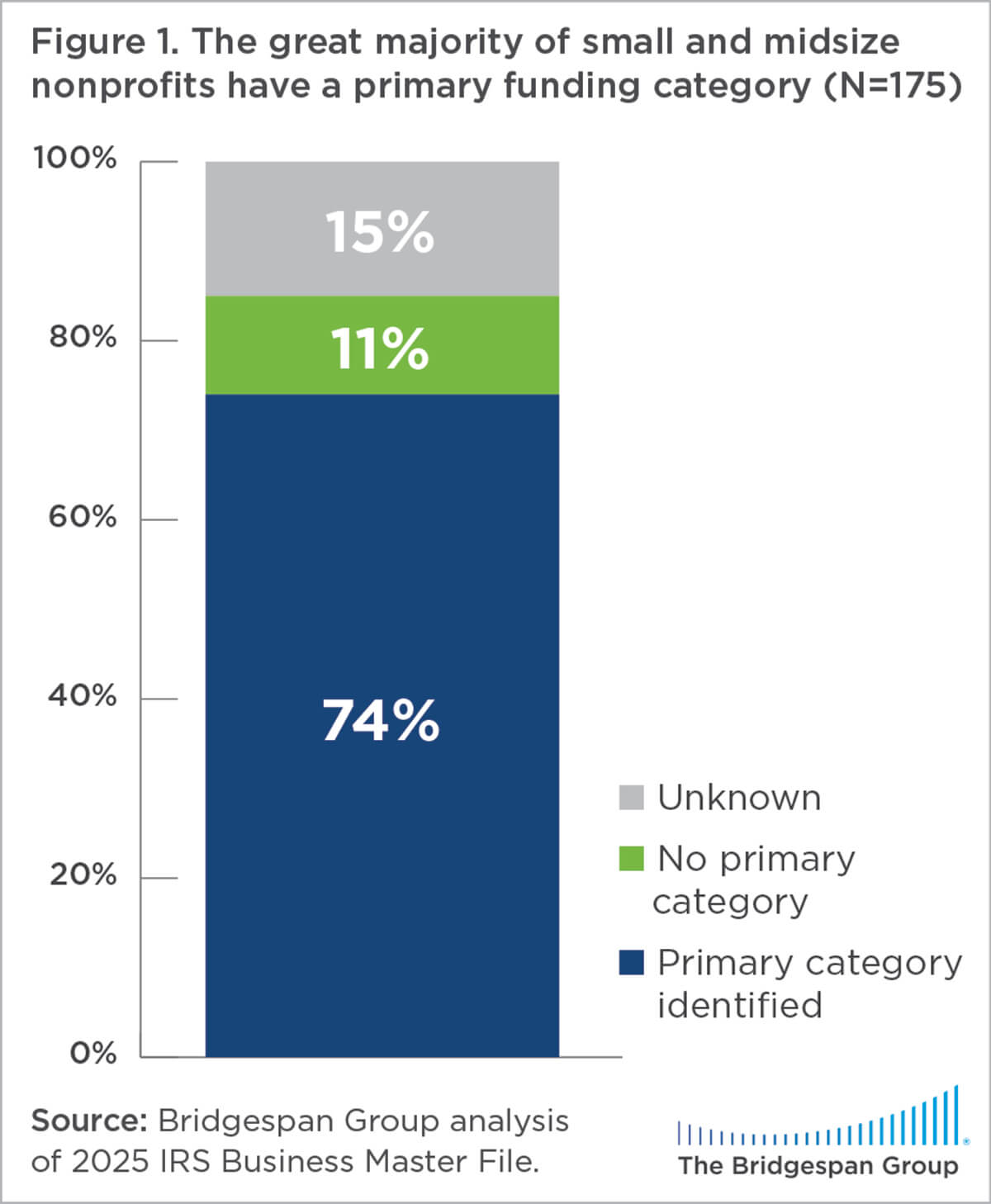
Approximately three-quarters of nonprofits in our sample raised most of their revenue from a single funding category
We grouped sources of revenue for the organizations in our sample into five funding categories: government, program services (earned revenue), foundations, individual donations, and corporate grants. For 74 percent of the nonprofits in our sample, one category accounted for at least half of their revenue (see Figure 1), and often much more. Eleven percent had no single dominant funding category, instead relying on a mix. For 15 percent, there wasn’t enough publicly available data for us to differentiate funding categories.
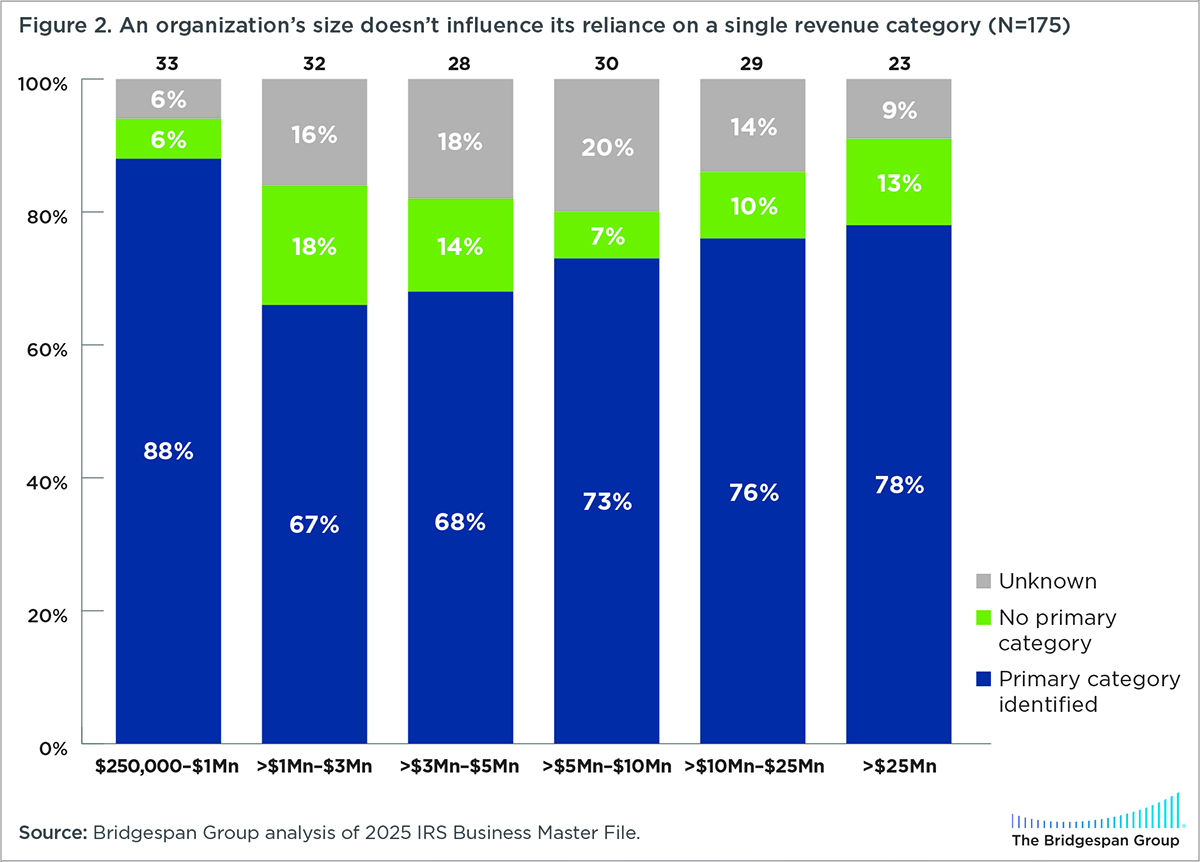
As shown in Figure 2, we found no correlation between the size of an organization and its reliance on a single revenue category. Most nonprofits, regardless of size, depend on one main revenue category.
Many executive directors have experienced a well-intentioned board member or advisor recommending that they diversify their funding sources as broadly as possible across categories. Yet our research shows that most small and midsize nonprofits primarily rely on a single funding category. While data alone can’t tell us if this is the best strategy—we do know it is the most common one. And our interviews and Bridgespan’s work with a range of nonprofits seem to confirm what we previously learned about large nonprofit funding models: focus on revenue concentration, not diversification.
We should be clear here: by “concentration” we mean focus on a single revenue category, such as foundations or government. Within that category, organizations often pursue multiple sources of revenue to create effective and resilient funding strategies. For example, organizations that rely mainly on foundations will often work hard to engage a wide range of philanthropic donors rather than relying on just a handful of stalwarts. And a government-funded organization might pursue a mix of local, state, and federal dollars, or multiple agencies at each level. Nonprofits we spoke with that rely on government funding are committing to this approach now more than ever, as many weather instability in federal funding.
A secondary funding category can be vital
The large US nonprofits we previously studied were very reliant on their primary funding category, which accounted, on average, for 90 percent of their total revenue.
Small and midsize nonprofits are somewhat less reliant on their primary category. For the organizations in our sample for which we found enough information to calculate a percentage, their primary funding category accounted, on average, for about three-quarters of their total funding.
Small and midsize nonprofits—even more than larger ones—may therefore want to think about developing a secondary revenue category to generate a smaller but still significant portion of their revenue. For those organizations for which we could identify a clear secondary revenue category, we estimate that it accounts for about 15 percent of their revenue. This suggests that small and midsize nonprofits can benefit from building dedicated capabilities and infrastructure to effectively tap both primary and secondary funding categories. Also, developing a reliable secondary revenue stream can help organizations achieve more stability in times of rapid growth, support programs for which the primary funding source is not a good fit, or lay the groundwork for expansion.
Most nonprofits have a “natural match” between their organization and their primary category of funder
We use the term “natural match” to describe the pattern of connections between a funder’s interests and motivations and an organization’s work, including its mission, activities, and populations of focus. Many government agencies, for example, fund education and human service nonprofits because these causes naturally link to their roles in serving constituents. And many philanthropists fund early-stage medical research because they or their families have had traumatic experiences with diseases, and they are eager to see medical advances.
To ensure that the concept of natural match applies to small and midsize organizations in the same way it does to large ones, we conducted this analysis across three specific sectors—civil rights, environment, and youth services—rather than across the whole range of US nonprofits. What we found confirms what we see in our ongoing work with a wide range of nonprofits: organizations’ funding models are strongly influenced by the sectors in which they work.
Different categories of funders often fund different kinds of work. Our data suggests that small and midsize youth services organizations rely primarily on government. Federal, state, and local governments have long supported school, after-school, and other kinds of youth development programs. Civil rights organizations rely primarily on foundations, which often support advocacy work in a way that government or corporate funders rarely do. For the environment sector, there was no single obvious natural match—perhaps reflecting that environmental nonprofits conduct a range of activities (such as advocacy, land stewardship, or direct service), each of which may be a natural match for different categories of funders.
As we discussed in “Finding Your Nonprofit’s Funding Strategy,” understanding what different categories of funders tend to fund and how their interests match with a nonprofit’s work can help a nonprofit better understand what differentiates the organization in the eyes of funders.
* * *
Many nonprofit leaders—and boards—often worry about “leaving money on the table” by not pursuing more categories of funding. But the central finding of our research—that the great majority of US nonprofits, regardless of size, rely on a single funding category for most of their revenue—underlines the importance of focus.
This isn’t new advice, but we think it’s advice worth repeating: by focusing and building the capabilities to tap into one or two funding categories effectively, an organization stands a better chance at finding and pursuing a strategy that attracts the dollars it needs to achieve its aspirations for impact in the world.
Research Methodology
To assemble our dataset of 175 US nonprofits, we first pulled all registered nonprofit organizations in the United States with NTEE codes (National Taxonomy of Exempt Entities) related to civil rights, environment, and youth services from the 2025 IRS Business Master File, 28,725 in total. We then randomly sampled a subset of these organizations across six different buckets of organizational revenue. We matched NTEE codes with IRS Form 990 filings to determine each organization’s overall revenue and to create an initial breakdown of revenue sources (i.e., contributions, government, and program service fees). To learn more about revenues described as “contributions” in the Form 990, we looked at the most recent audited financial statements, annual reports, and other publicly available financial data. Using this information, we categorized all revenue into one of the following: corporate, government, individual donations, foundations, program services, or other to determine if more than 50 percent of an organization’s revenue came from a single revenue category. Invensis, a data processing firm, supported our team in sourcing and checking some of the data. We also conducted interviews with 15 leaders of small and midsize nonprofits to complement the quantitative analysis with lived experience and perspective.