
As funders live into the first four principles for building strong, resilient nonprofits, paying careful attention to DEI considerations can help funders identify and address inequity — with associated gains accruing to funders, nonprofits, and communities alike.
India has a long history of systemic inequities based on factors such as caste, gender, tribal origin, and religion. Nonprofits benefit from having leaders and staff with lived experience of the individuals and communities they serve. It puts them in a strong position to take into account the distinctive strengths and needs of diverse, historically marginalised communities, helping them design more effective programmes that consider the root causes of social problems.
Yet our research has shown that problems of underfunding, lack of reserves, and inability to create operating surplus are more frequently encountered by nonprofit organisations with Dalit, Bahujan, or Adivasi (DBA) leaders, as well as those not located in major cities. For instance, 70 percent of nonprofits led by members of DBA communities did not report any operating surplus in the three years prior to our 2020 survey, compared to 45 percent for non-DBA-led nonprofits. Two-thirds of the non-metro and rural nonprofits reported no surpluses in the same period, compared to 39 percent of metro-based nonprofits.[18] Similarly, a higher percentage of DBA-led nonprofits demonstrated financial vulnerability against the comparison set.
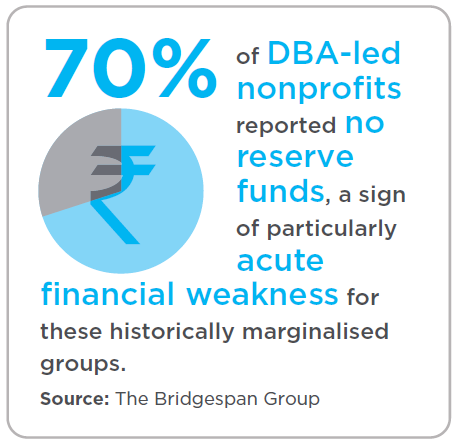 An intentional focus on DEI can help to address the disproportionate financial gap these critical agents of social change face and thus accelerate progress on India’s steepest challenges. It’s important for funders to understand the unique context of nonprofit partners who may have faced systemic marginalisation and to walk the extra mile to support their organisational development and financial resilience. A number of funders spoke about the importance of DEI and indicated that they are early in their journeys towards integrating DEI principles in their grantmaking.
Bring an explicit DEI focus to grantmaking processes
Some funders have changed how they select grantees by bringing equity considerations into the process. The Ford Foundation, Rohini Nilekani Philanthropies, and the GROW Fund anchored by EdelGive Foundation are amongst the funders that have integrated DEI principles into sourcing and due diligence processes. This approach involves, for example, soliciting grant applications in multiple languages; creating a support infrastructure, such as a helpline in multiple languages, to assist applicants; and ensuring geographic representation.
IndusInd Bank CSR focuses on gender and inclusion throughout its grantmaking process. For example, it collects DEI-related data as part of grant management in order to support nonprofit partners in identifying and serving community needs with existing and potential programmes.
Funders can also track DEI-related indicators amongst their grantees (e.g. nonprofit leadership and team composition, the composition of communities served). Setting targets for a more representative portfolio can help maintain focus on DEI during the sourcing and due diligence process. For example, the GROW Fund pays particular attention to gender diversity among leadership teams and boards when selecting organisations for the GROW cohort.
Adopt a DEI framework to guide internal operations
The Bill & Melinda Gates Foundation has made a public statement about incorporating DEI as a core tenet of its grantmaking. This commitment creates accountability within the organisation to integrate DEI into its leadership, talent, culture, and partnerships with public progress reports.
Similarly, in addition to keeping the focus on supporting nonprofits working with and led by historically marginalised communities, Mariwala Health Initiative has embedded DEI principles in its hiring and human resources policies to build more diverse, inclusive, and resilient teams and programmes. It places particular emphasis on ensuring that its team and advisory board have representation from the communities it serves.
Funders have a significant distance to travel to incorporate DEI principles into their internal and external operations. Sharing more with peers about what they have learned can help accelerate learning about what works and what doesn’t.
