
Core costs[6] — often referred to as indirect costs — are a nonprofit’s shared administrative or support-function expenses. These include salaries of non-programme employees, rent and utilities for a central office, human resources, finance and accounting, fundraising, communications, technology, and measurement and evaluation. Such functions are essential for nonprofits to conduct day-to-day operations and deliver on their impact mandates. Adequate coverage of these costs allows nonprofits to make critical investments in operational effectiveness, governance, regulatory compliance, and financial management — all goals funders share.
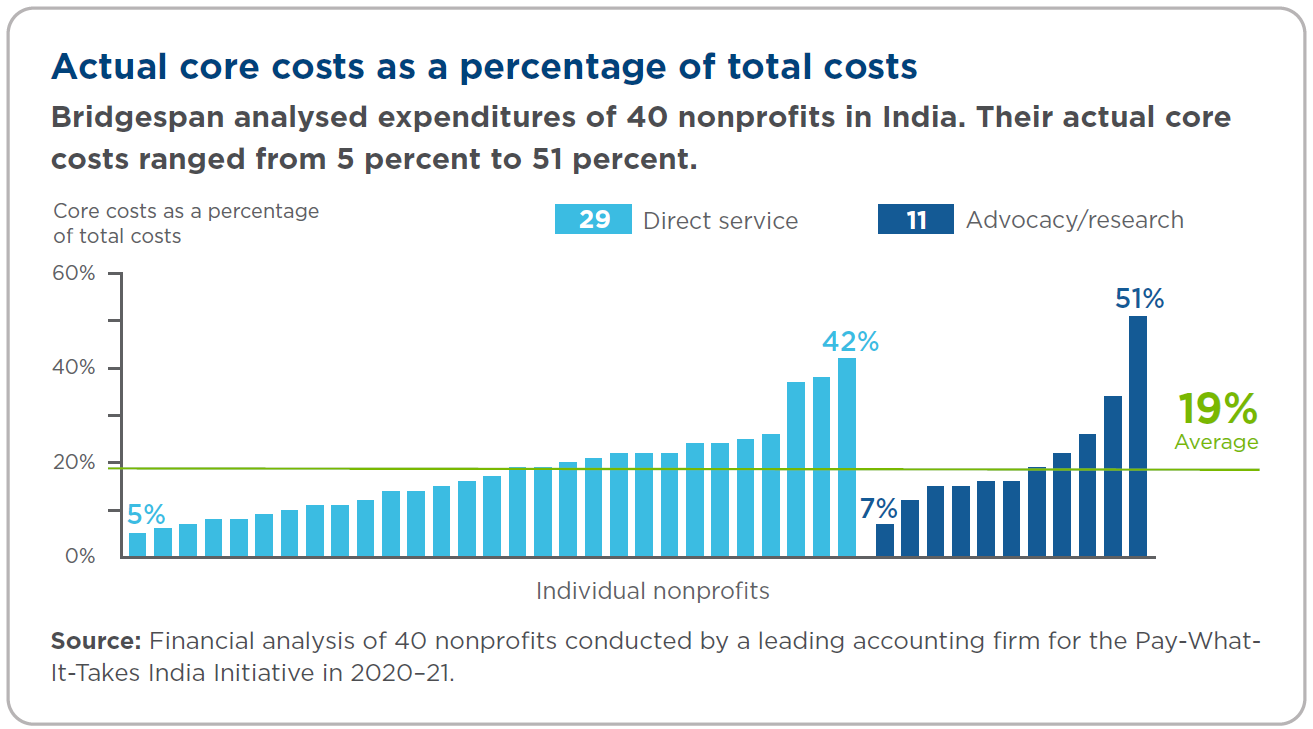
Financial analysis by the PWIT India initiative in 2021 revealed that core-cost rates vary amongst nonprofits. The analysis, which was carried out for 40 leading and relatively well-funded nonprofits, revealed that actual core costs ranged from 5 percent to 51 percent of total costs and averaged 19 percent.[7] The average core-cost coverage provided by key donors to these nonprofits was just 9 percent.
Government regulations affect both perception and reality when it comes to funding core costs. Amongst CSR organisations, there persists a misconception that regulations cap the amount nonprofits may receive for core costs at 5 percent. In fact, this cap only applies to the amount a business may spend on its internal CSR programme administration.[8] Regulations do not cap what a CSR programme may allocate to pay for a nonprofit’s core costs. However, our research has found that many CSR programmes typically provide little or no support for core costs and attribute this to regulatory compliance.
Regulations also impact foreign donors. The Foreign Contribution Regulation Act (FCRA) amendments passed in September 2020 cut by more than half (from 50 percent to 20 percent) the percentage of total funds that foreign donors can give to cover a nonprofit’s core costs.[9] To be sure, that’s still more than twice the average currently provided by key donors.
“To run good programmes you need good talent, who need to be well compensated. We cannot expect work to happen if we are not providing at least that basic cost to them [nonprofit partners].”
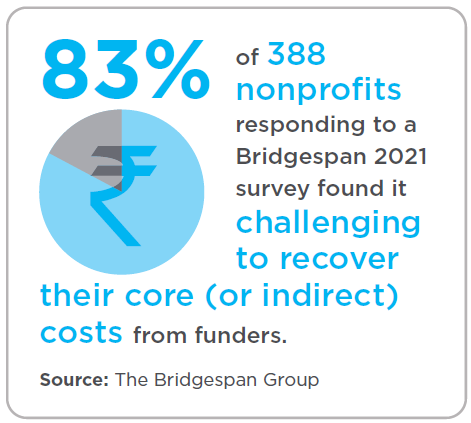 However, regardless of the funding source, 83 percent of nonprofits responding to our 2021 survey reported that they struggle to get adequate core-cost coverage. At the same time, roughly 68 percent of funders reported that they have flexible core-cost policies. This disconnect strongly suggests the need for better communication and more funder flexibility towards covering their fair (or proportionate) share of nonprofit partners’ actual core costs. Otherwise, the chronic underfunding that nonprofits experience will continue to undermine the lasting social impact funders and nonprofits strive for.
Provide need-based coverage
Funders adopting this approach do not have a predetermined percentage or cap for core costs. They seek to understand a nonprofit partner’s budget and cost structure, recognising that core costs vary depending on the type of organisation and the nature of its programmes. Funders adopting this approach include Forbes Marshall CSR, IndusInd Bank CSR, Axis Bank Foundation, and LGT Venture Philanthropy.
Set a core-cost range with flexibility provided on a case-by-case basis
Funders that support similar kinds of organisations over many years may develop a preferred or predetermined core-cost range based on their experience and in consultation with nonprofit partners. ASK Foundation pursues this approach while also recognising the need for flexibility and making exceptions for nonprofits that offer a persuasive case for above-range coverage.
Focus on the total cost to deliver a programme
Some funders focus on the total cost of delivering a programme, including core costs. They provide nonprofits with the flexibility to use funds across budget line items, as needed.
Mahindra Group CSR works with nonprofits to develop an understanding of total costs to achieve a desired outcome and track a cost-per-programme-participant metric. This helps Mahindra Group understand the total cost — including and going beyond direct programme costs — to achieve impact on a unit level. Mariwala Health Initiative and Thermax Foundation adopt a similar approach.
Provide unrestricted/flexible funding
Unrestricted funding is another way funders support nonprofit partners in covering their core costs. Given the flexible nature of such funding, nonprofits are free to deploy it on their core costs and wherever they see the highest needs. Mariwala Health Initiative, Rainmatter Foundation, and Rohini Nilekani Philanthropies pursue this approach, which is rooted in mutual trust and a collective vision of change. (See sidebar below.)
Unrestricted/flexible grantmaking benefits funders and nonprofits
Of all the approaches to paying for core costs, unrestricted/flexible grants stand out as the optimal solution, giving nonprofits maximum flexibility to decide how to cover expenditures associated with shared administrative and support functions. But the benefits extend beyond core costs. Nonprofits can spend their unrestricted/flexible funds in ways that allow them to do their best work, including on programmes or organisational development.
For funders and nonprofits, unrestricted/flexible funds reduce time-consuming paperwork. Nonprofits are freed from mapping restricted funds to eligible cost categories. And funders spend less time on the logistics of grantmaking and reporting and more time on impact-focused efforts.
When combined with multiyear commitments, unrestricted/flexible funding positions nonprofits to plan for the future, strengthen organisational capabilities, and achieve stronger outcomes. Nonprofits characterise unrestricted/flexible, multiyear grants as “a game changer” and “transformative.”
Mariwala Health Initiative, Rainmatter Foundation, and Rohini Nilekani Philanthropies are amongst the Indian funders who practice unrestricted/flexible multiyear grantmaking. They trust their nonprofit partners to allocate funds across programme and operational needs. These grants allow recipients to experiment and innovate to identify better solutions. Deepa Pawar, the managing trustee and founder director of Anubhuti Charitable Trust, put it this way:

(“The trust imposed in us by the funder has given us confidence to experiment and learn. We are secure in the knowledge that they are with us in this journey. For our organisation, which works on mental health issues in small rural communities, this is very important.”)
